No, Elizabeth Warren Still Isn’t Running

by Dish Staff

Fed Chair Nominee Janet Yellen Testifies At Senate Confirmation Hearing

James Antle III quips that “Elizabeth Warren may be the last liberal in America who doesn’t want Elizabeth Warren to run for president”:

Warren was interviewed by National Public Radio Monday and was asked the standard question several times. “I’m not running for president,” she said. What is she telling liberal independent groups? “I told them, ‘I’m not running for president.’” Never ever? “I am not running for president,” she replied. “You want me to put an exclamation point at the end?”

Sounds pretty definitive, right? Except the Washington Post responded to the interview with a piece titled, “Why Elizabeth Warren is smart to not totally rule out running for president.” The political press clearly wants Warren to run.

Sargent doesn’t believe Warren “has any intention to run.” So why are progressive groups still talking her up?

Anything that boosts Warren’s visibility might also boost the potential power and influence that Warren may be able to exert within Congress — and over the Democratic Party in general — as their chosen vehicle for progressive policy ideas. That might boost the groups’ own influence over the debate.

Tomasky calls Warren the most powerful Democrat in the country:

But she does have this problem:

The media will always peg her as “left,” a word that in modern American media usage is clearly a pejorative. And if she just gets stuck there, her influence, however great among the Democratic base, will never grow outside of it. More centrist Democrats will make a few gestures in the Warren direction, but nothing more.

So Warren’s great challenge is to counter that dismissal by showing that her ideas do indeed have appeal outside the hard-shell Democratic Party base. They do, potentially—a number of polls have shown that Americans, including many in the center and even some on the right, have negative views of Wall Street and would back tighter regulation. She can speak to goo-goo eyed crowds in Boston and New York and San Francisco and Los Angeles, and while she’ll wow the already converted and rake in the money, she won’t be changing anything. But if she can take her message to Des Moines and Louisville and Columbus and Jacksonville and demonstrate that audiences are receptive there, then she’ll break out of the box the media wants to assign her. And if she can do that, she’ll become a figure of un-ignorable influence, and she’ll start making the likes of Clinton really pay attention.

Beinart rejects a comparison bandied about:

The better analogy is not between Elizabeth Warren and Ted Cruz. It’s been Warren and Rand Paul. Warren’s crusade against Wall Street may appeal to young blue collar Republicans in the same way Paul’s crusade against the national-security state appeals to young liberal Democrats. Both Warren and Paul are exploiting a divide in the other party. Democratic elites are more hawkish on foreign policy than their party’s rank and file; Republicans elites are more pro-Wall Street than theirs.

But Ed Kilgore is unsure how popular her politics would be:

To most Democrats most of the time, Warren is raising important and legitimate concerns about Wall Street that must be addressed, not just dismissed as “class warfare.” To some Democrats some of the time, she represents a decisive break with the Clinton and Obama traditions that is morally necessary.

But let’s don’t pretend there’s a slam-dunk “electability” case for this kind of politics. Yes, the “median voter theorem” of politics that dictates a perpetual “move to the center” by general election candidates has lost a lot of its power just in the last few years. But the countervailing “hidden majority” argument for more ideological politicians of the left and the right is hardly self-evident, and has in the past often been fool’s gold.

Sarah Mimms hears from Republicans who “see Warren as a way to paint the Democratic Party as increasingly beholden to its liberal wing and removed from moderates”:

Warren is hardly the only Dodd-Frank champion among congressional Democrats. And she’s far from alone in opposing the changes pushed by Republicans this week. …

But other members of the Democratic Conference in the Senate aren’t seen as rising stars the way Warren is. Few are considered potential presidential candidates. And none serves as well in the role of liberal specter over the next two years as Warren will, particularly now that she is a member of leadership. “The more exposure she gets, the better for us,” [RNC spokesman Sean] Spicer said. Warren could easily become a poster-woman for the Democratic Party over the next two years, he argued, serving the same purpose as Pelosi and Reid have in Republican advertising and strategy.

Dreher, for one, hopes Warren “will run for president in 2016 to force a national conversation on the Washington-Wall Street power nexus”:

A populist who talks like Elizabeth Warren and really means it is a Democrat a conservative like me would consider voting for, despite her social liberalism. As Phyllis Schlafly said back in 1964, in defending Goldwater against the Establishment Republican Nelson Rockefeller, a contest between Warren and Clinton, and a contest between Warren and just about any Republican would give the country a choice, not an echo. She almost certainly couldn’t beat Hillary for the 2016 nomination, but a Warren candidacy would get her name and her issues out there.

Andrew Prokop doubts it will happen:

[I]f Hillary doesn’t run, or her standing in the polls begins to plummet — it seems conceivable that Warren could heed the calls of various activists and jump into the race. But if Warren thought a presidential bid looked like a promising and appealing prospect under current conditions, she’d be floating the possibility of a run now, like Jeb Bush is. For the moment, it’s best to take her at her word that she’s focused on the Senate.

Larison thinks “it would probably be a better use of Warren’s time to concentrate on her role in the Senate”:

Warren hasn’t even finished her first term in office, and she is just now starting to have some real influence. That role may not be entirely incompatible with running a presidential campaign over the next year or so, but challenging Clinton will inevitably take her away from the job she was elected to do. It is there that she might stand a chance of achieving something. Running around Iowa and New Hampshire might provide the occasion for some interesting primary debates, but it isn’t going to have much of an effect.

(Photo by Alex Wong/Getty Images)

Why Didn’t Amy Pascal Just Pick Up The Phone? Ctd

by Michelle Dean

A reader compares the Sony hacking to this year’s sexting hacks:

I was a Sony Pictures employee up until two months ago. I worked as a television producer on the Sony lot for the previous two years. On a daily basis, I passed by Amy Pascal and Michael Lynton and the others whose private emails have now been leaked (contrary to Michelle Dean’s disdain that they’re just “big fancy business people,” they’re actually very cool, approachable people), and I have been warned that my private information has very likely been leaked as well – as have any present and former Sony Pictures employees going as far back as 1995. (!)

Let’s first remember what this hack is about: Private documents and emails were illegally stolen and leaked to the public, with more leaks threatened, in order to blackmail Sony out of releasing a film – they have specifically demanded that Sony not release “The Interview.” Put another way, foreign hackers are blackmailing Americans out of exercising their First Amendment rights. And now the media outlets that continue to print the salacious details revealed in these stolen documents are complicit in that blackmail scheme, having given the leaked information the damaging attention that the hackers wanted. The media crossed the line when the reporting shifted from the story of the hack itself and the criminal investigation, to printing every salacious email they could find.

This is not a Snowden leak where it can be argued that this is information about our government that is vital to American citizens. As Sorkin pointed out, these hacks reveal no laws broken by Sony. So this is nothing more than sleazy tabloid journalism using documents stolen by criminals. It is the complete lack of ethics of The Fappening all over again. It doesn’t matter how we got the information, there’s page-views to get! Is this the norm now?

And the worst part is, in the few stories that I’ve read on this, I have seen nothing that would shock anyone in the entertainment industry: Film executives and producers talk bluntly about scripts and actors and personalities because that is the business that they are in. They have to be both passionate and direct, or they aren’t doing their jobs.

Let’s flip the script, so to speak: All of your personal information, emails, your employees’ medical records, payrolls, etc. are leaked by foreign hackers, who threaten to release more if you publish a controversial story. The FBI is investigating. How would you feel about all of your fellow bloggers printing every salacious, taken-out-of-context detail of every email you’ve sent for the past 20 years, making it front page news every day for three straight weeks, and counting? Would you really blame YOURSELF?

To answer the reader’s last question first: I would, at least a tiny bit. But then I’m the self-lacerating sort. And I also tend to see things in questions of degrees.

Of course I would be unhappy to see journalists publish people’s unredacted medical records and social security numbers, which I would agree are analogous to the sext leaks of early September. And I completely sympathize with the panic employees caught up in this mess might feel about that. As far as I know, no one has yet printed things like that but it’s not much comfort.

My point was more limited than this reader imagines. I was simply pointing out that business executives do not have a clear-cut expectation of complete privacy in emails that related to business negotiations and transactions. That goes for the “cool, approachable” executives, too. Business people are regularly called onto the carpet by their lawyers and shareholders to account for their actions in managing the company. It’s just part of the deal along with the rich severance payout.

Is that an abridgement of their First Amendment rights? I’m not so sure. I think it’s just about being a responsible executive.

These emails may not show “illegal” activity per se, in that nothing in them hints at criminality. But they do have the potential to incur big costs for the company in later disputes and litigation. And shareholders do, by the way, have some interest in knowing how the company’s management behaves. The public interest here may not be as clear-cut as in the Snowden matter but these aren’t simply “private” matters. And as an experienced big fancy business person (I think she can survive a tongue-in-cheek remark), I’m sure Pascal knows that intimately.

Update from a reader:

Michelle Dean was right to feel sorry for the in-house counsel at Sony who has tried to prevent everyone there from sending sensitive e-mails – clearly, the message hasn’t gotten through there based on that note from a former Sony employee. News flash to everyone in the US: your company, not you, owns your e-mails! When you hit “delete” on an e-mail, it means “saved forever on a server and/or hard drive somewhere”. Anyone in this day and age who thinks they have any expectation of privacy in any e-mail exchange is sorely mistaken.

When you communicate by e-mail, it feels like a conversation, but it’s like etching something into stone. I tell everyone at my company that for any e-mail you write, imagine seeing it blown up on a giant screen in courtroom somewhere, and you having to explain what you meant by it. I’ve sat through that exact scenario hundreds of times, and have seen offhand e-mails written in the middle of the night create hundreds of millions of dollars in liability for a company, and countless deposition and trial time being spent talking about one or two sentence e-mails. I’ve also seen sexually explicit e-mails (and photos/videos) that would make anyone blush, and these have been viewed and discussed in open court.

I also don’t understand the reference to “First Amendment Rights” by the former Sony employee. Where is the US government involved in stopping anyone at Sony from saying anything? The authorities should go after whoever hacked into the system, and convict them of a crime if they can be caught, but the people who wrote these e-mails assumed the risk when they decided to write an e-mail instead of picking up the phone (or walking down the hall). With everything that’s happened the last few years, including Snapchat hacks etc., it’s amazing to me that people are still surprised when their e-mails get exposed for the world to see.

Forward thinking companies are automatically deleting all e-mails after a short period of time (i.e., 90 days), both to save storage money and to avoid situations like this. Microsoft was at the forefront of this, and has been extremely pleased with the results. Sony (and all of the other studios) may want to consider a similar policy, which would have avoided most of the most embarrassing leaks.

Bigger, But Better?

by Chris Bodenner

Looking back at 2014, Felix Salmon runs through all the high revenue and venture capital numbers of new media companies like Buzzfeed, Vice, and Vox:

The small but self-sustaining bloggy site is a thing of the past: if you’re not getting 20-30 million unique visitors every month, and don’t aspire to such heights, then you’re basically an economic irrelevance. Advertisers won’t touch you, you won’t make any money, and your remaining visitors will inexorably leach away as they move from their desktops to their phones.

But if you’re like the Dish and rely on subscribers rather than advertisers, you don’t need to be so dependent on huge traffic numbers. And even if you can get those numbers and their corresponding ad dollars, advertisers are fickle, as Gawker recently saw when it lost “seven figures” in ad revenue from their controversial coverage of Gamergate. (Can you imagine the ad backlash over Dish controversies like Scrotumgate or all the graphic photos of dead children in war zones?) Speaking of Gawker, Michael Wolff absorbs a recent staff memo from founder Nick Denton, who outlined a big management shakeup and a refocus on generating scoops over Facebook-friendly fodder. Here’s Wolff:

Gawker, or the Gawker identity, Denton seemed to acknowledge in his memo, is a casualty in the race for traffic: Gawker succeeded because it was a carefully molded product (a small band of young people overseen by Denton — with Denton constantly hiring and firing his editors). But then it morphed into a business with a much larger number of ever-younger people having to produce more and more, and working with less and less editorial vision or leadership. Gawker began to focus on an open area of parallel writing (i.e. free writing) designed to enhance its traffic base — but, too, with the natural effect of diluting quality and confusing purpose. … [A]t somewhat cross purposes to his desire to better compete with BuzzFeed (or admitting that this is impossible), Denton urged his company back to its blogging roots.

In Denton’s words:

[Blogging is] the only truly new media in the age of the web.

It is ours. Blogging is the essential act of journalism in an interactive and conversational age. Our bloggers surface buried information, whether it’s in an orphaned paragraph in a newspaper article, or in the government archives. And we can give the story further energy by tapping readers for information, for the next instalment of the story, and the next round of debate. The natural form of online media is the exchange, not the blast. [New executive editor Tommy Cragg’s] ethos gives us the best chance of recapturing the honesty of blogs, before their spirit was sapped by the tastes of the Facebook masses.

Denton is even jumping back into the blog saddle himself, something he hasn’t done regularly since 2008. Responding to Wolff and Salmon, Mathew Ingram pushes back on the perception that bigger is better when it comes to new media:

[They both] seem to see media success as being composed of just one thing: namely, huge amounts of traffic gained by reaching a massive audience of millennials and then selling them to advertisers for tens of millions of dollars. That’s what Salmon seems to mean by talking about how the “table stakes” for starting a digital media company have never been higher, and small sites are a thing of the past.

But this is demonstrably not true. The cost of starting a digital-media entity, even a potentially successful one, has never been lower. Ask Jessica Lessin, who left the Wall Street Journal to start The Information, or Lara Setrakian of News Deeply, or Andrew Sullivan of The Daily Dish, who is now making close to $1 million a year from his readers — or blogger Ben Thompson, who went from being a relative unknown to running his own self-financed blog company. As Thompson put it in a recent post on his site Stratechery:

“The thing about Internet scale is it doesn’t just have to mean you strive to serve the most possible people at the lowest possible price; individuals and focused publications or companies can go the other way and charge relatively high prices but with far better products or services than were possible previously.”

… It may not make you a billionaire, but that doesn’t mean it isn’t possible. The New Republic’s problem isn’t that it somehow needs to transform itself into a massive mega-media entity like BuzzFeed, it just needs to do a better job of identifying a market need or an audience that is passionate about its content, and then giving them a way of helping to support that mission.

That’s precisely the insight that venture capitalist Roger McNamee shared when discussing the Dish to Charlie Rose shortly after we went independent two years ago, and it’s an insight even more relevant today as sponsored content and click-bait are consuming the new media landscape.

What The Hell Just Happened In Pakistan?

by Dish Staff

Pakistan

Nine Taliban gunmen disguised as soldiers attacked an army-run school in Peshawar this morning, killing at least 145 people, mostly children, and holding hundreds more hostage before dying in an eight-hour gun battle with security forces:

The militants’ assault on the school started at about 10 a.m., when the gunmen entered the Army Public School and Degree College in Peshawar, the capital of Khyber Pakhtunkhwa Province. Local news reports said the gunmen were disguised as paramilitary Frontier Corps soldiers and gained entry by scaling a wall at the rear of the main building. The attackers then opened fire on students with guns and grenades and, in a chilling echo of the Beslan school siege in Russia in 2004, took dozens of people hostage in the school’s main auditorium, according to news reports. … By late afternoon, the army said it had cleared three sections of the school compound and that troops were pushing through the remaining sections. After the last of the militants was killed, officials said, soldiers were sweeping the compound for explosives.

In taking credit for the attack, the Pakistani Taliban (TTP) said it was in retaliation for a recent military offensive against the group in the lawless region of North Waziristan. Sami Yousafzai rang up a TTP commander to ask why exactly his comrades believed that the mass murder of children was an appropriate act of revenge:

[Jihad] Yar Wazir justified the killings as fitting retribution. “The parents of the army school are army soldiers and they are behind the massive killing of our kids and indiscriminate bombing in North and South Waziristan,” which are the TTP strongholds. “To hurt them at their safe haven and homes—such an attack is perfect revenge.” But the children are innocents, I said. What about them, I asked?

“What about our kids and children,” he said. “These are the kids of the U.S.-backed Pakistani army and they should stop their parents from bombing our families and children.” Yar Wazir went on: “Those kids are innocent because they are wearing a suit and tie and western shirts? But our kids wearing Islamic shalwar kamiz do not come before the eyes of the media and the west.”

To Juan Cole, the attack is indicative of the TTP’s desperation:

North Waziristan had always been protected by military intelligence and so had become a haven for al-Qaeda offshoots. But in the past 6 months Pakistani army troops have killed nearly 2000 fighters and deeply disrupted what is left of the Pakistani Taliban. The group that took over the school complains of the perfidy of the government’s bombing. So this school attack was the Pakistani Taliban taking revenge for the government’s disruption of their terrorist activities. This is not a sign of strength but of weakness, and they lashed out at a soft target. They are facing a major defeat. That is its significance.

And Samira Shackle expects that “the sheer brutality of the event will answer some of the internal political debates about how best to tackle the terrorist threat”:

As recently as spring, the Pakistani government was pursuing talks with the Taliban, even as violent attacks across the country surged. Many in the mainstream political right wing still agitate for appeasement and negotiations rather than a military operation. And amongst the wider population, there is a fault-line of people who explicitly or tacitly support the actions of the TTP and associated groups, even as they suffer the effects of this campaign of terror. Some commentators have suggested that the sheer brutality of this assault will undermine the arguments of those who would like to see negotiations with the TTP, and will perhaps reduce that element of support amongst the wider populace. The group is seeking the destruction of the Pakistani state as its minimum, and speaks only the language of violence. That is no starting point for a meaningful settlement.

(Photo: A view of the coffins at Lady Reading Hospital where the casualties of a Taliban attack on a school were carried in the northwestern city of Peshawar, Pakistan, on December 16, 2014. By Metin Aktas/Anadolu Agency/Getty Images)

Abolish Police Unions

by Will Wilkinson

There’s a solid leader in this week’s issue of The Economist on the need for reform in American law enforcement. The Economist endorses rolling back police militarization, more fastidious record-keeping about police killings, and the deployment of body cameras. There’s also this, under the heading of accountability:

[I]t must be easier to sack bad cops. Many of America’s 12,500 local police departments are tiny and internal disciplinary panels may consist of three fellow officers, one of whom is named by the officer under investigation. If an officer is accused of a crime, the decision as to whether to indict him may rest with a local prosecutor who works closely with the local police, attends barbecues with them and depends on the support of the police union if he or she wants to be re-elected. Or it may rest with a local “grand jury” of civilians, who hear only what the prosecutor wants them to hear. To improve accountability, complaints should be heard by independent arbiters, brought in from outside.

I agree with every bit of this, but none of it’s going to happen as long as police unions are allowed to exist. Just as teachers’ unions block almost every conceivable democratic reform to the public school system, police unions continually stymie attempts to resist the corrupt, praetorian tendencies of American law enforcement. Nationwide, police unions fight tooth-and-nail to keep even the most abusive cops on the streets. So good luck “sacking bad cops” with police unions in the way.

Other reforms face similar resistance. In Miami, the police union has opposed, and continues to oppose, a popular initiative to equip the police with body cameras. Or how about the ex-cop private investigators, working for a law firm representing more than 120 California police-officers’ unions, who tried to frame a Costa Mesa city councilman for drunk driving. Why? Because he tried to mess with police pensions. Steven Greenhut of the San Diego Union-Tribune asks:

This raises an important question: How widespread is this kind of behavior? At a Costa Mesa press conference last year, elected officials from other cities made allegations of police using disturbing tactics to achieve their political goals.

“What kind of world do we live in when the people we give guns and badges to hire private investigators to surveil public officials?” asked Righeimer. Calling it “unseemly,” OC prosecutor Robert Mestman said this case is significant because the victims “are democratically elected city council members.” Mensinger said it seemed Orwellian: “Public officials should not be extorted over public benefits.”

The Costa Mesa story may be about pensions rather than the conduct of routine police work, but it is indicative of the gangsterish anti-democratic pressure police unions routinely exert within the political system. In New York City, the Patrolmen’s Benevolent Association is currently sending a not-so-subtle “nice place you got here” message to Mayor Bill de Blasio in response to his failure to signal complete obsequious deference to the union after a grand jury declined to indict the police officer who was filmed killing the unarmed and submissive Eric Garner with a chokehold. The union has asked its members to fill out a form requesting that the mayor stay away from his or her funeral should he or she be killed in the line of duty. “Due to Mayor de Blasio and Speaker Mark-Viverito’s consistent refusal to show police officers the support and respect they deserve, I believe that their attendance at the funeral of a fallen New York City police officer is an insult to that officer’s memory and sacrifice,” the form reads.

Such drama! Such entitlement! All because the mayor publicly demonstrated some modest, measured sympathy for those protesting the crookedness of a system in which police are able to kill with impunity. Such disrespect for the uniform! The message the union is sending to the man duly elected to, among other things, oversee the city’s police is clear: fall in line or get out of the way.

I have long argued that government employees ought not be allowed to unionize. When public employees collectively bargain, who are they bargaining against? Their public employers, which is to say, the democratic public, which is to say, us. The point of a democratic government is to govern in a way that more or less tracks the public interest. The point of a government employee union is to organize against the public interest, to get in the way when the democratic public’s notions about its interests conflict with the interests of the union’s members. When a public-sector union is strong, government of the union’s domain is effectively ceded to the union itself. When that domain is the armed, business end of the law’s coercive authority, that’s a giant problem. It shouldn’t be allowed.

The political problem with abolishing police unions is obvious enough. Democrats reflexively defend unions, and Republican antipathy to public-sector unions disappears when it comes to cops and firefighters. Heroes, you know, every one. This rare bit of bipartisan concord leaves police unions spectacularly well-defended against reform. Until one party or the other begins to see the damage unions do, and becomes willing to fight it, anything more than superficial change is impossible.

A Republican Pop Quiz

by Dish Staff

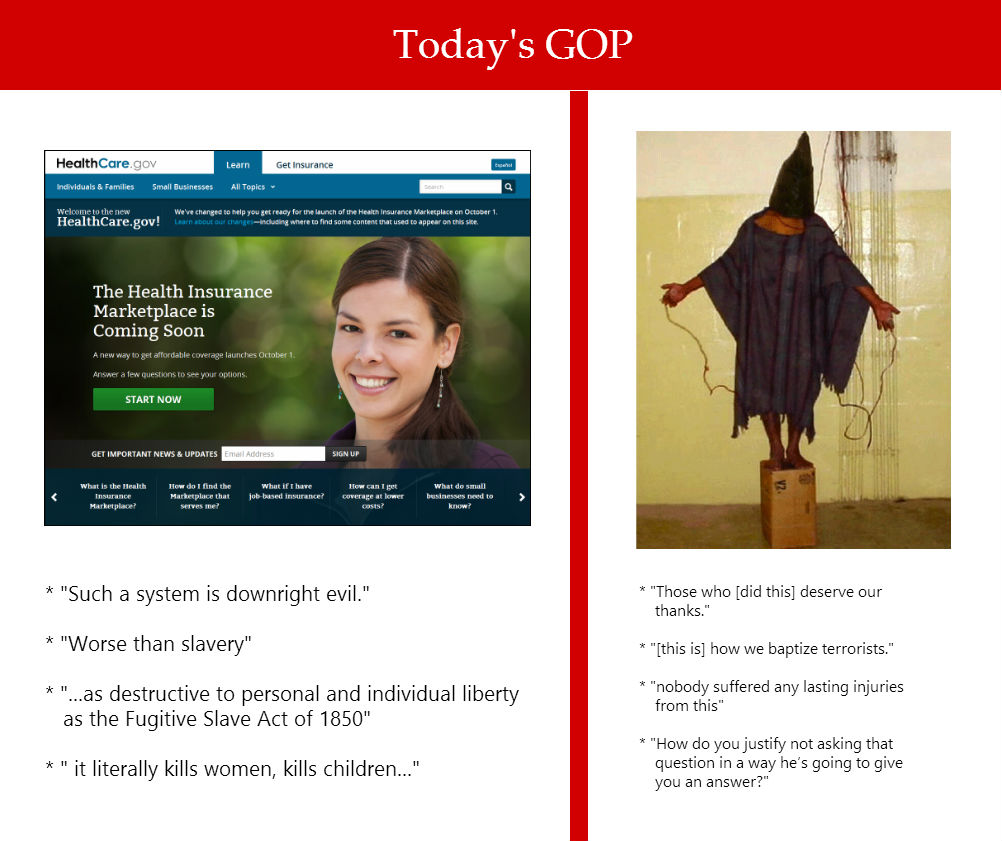
A reader sent this in:

unnamed (25)

Can you answer which Republican figure said each quote? Answers after the jump:

On Obamacare:

1. Sarah Palin, former half-term governor of Alaska, vice-presidential nominee, reality show star

2. Ben Carson, surgeon and 2016 presidential contender. (Though his exact words were: “the worst thing that has happened in this nation since slavery.”)

3. Bill O’Brien, New Hampshire state representative

4. Michele Bachmann, congresswomen

On torture:

1. Marco Rubio, senator

2. Palin

3. Peter King, congressman

4. Steve King, congressman

(Though the following quote from Dick Cheney would have made a better pick: “What are we supposed to do kiss him on both cheeks and say ‘please, please tell us what you know’?”)

Those “Notable Books Lists”? They’re Useless

by Michelle Dean

Those end of the year book lists are lumbering around the internet right now, coming soon to a friend’s Facebook wall near you. NPR’s list of 2014 Great Reads numbers 250; the New York Times Book Review offers the slightly more conservative 100 Notable Books of 2014. The hugeness of these lists betrays something: their uselessness. My eyes always cross at lists that number above, say, 25. It certainly doesn’t narrow down the Christmas shopping list much.

Plus, these lists get to be disquieting documents of the Way We Publish Now. I would love to believe that we live in a publishing environment where we were producing at least a hundred well-edited, well-considered books a year. Unfortunately, as Ursula K. Le Guin recently put it to the shocked horror of most at the National Book Awards ceremony, writers instead work in an industry controlled by “commodity profiteers [who] sell us like deodorant, and tell us what to publish, what to write.” It’s not an amazing environment for the production of literature. Mostly, publishers are throwing all sorts of stuff at the wall to see what sticks. I find it overwhelming and kind of sad to receive as many bad galleys as I do, often bought by a publisher for a great deal of money, but landing on my doorstep with the undignified plop of thawed turkey.

Listing so many books as “notable,” given that context, smacks of desperation.

It’s certainly always been the case that publishers churn out tons of books a year that flame out and die in the remainder piles. But even the largest pinch of salt, 2014 has seemed particularly bad. Precisely three newly published books have managed to take up permanent residence in my head this year: Marlon James’ A Brief History of Seven Killings, Jenny Offill’s Department of Speculation, and Hermione Lee’s biography of Penelope Fitzgerald. And while other people might compose their lists differently, or count in their own findings five, ten, or even fifteen notable books, listing a hundred or more just feels… careless. It feels like the work of marketers, not of people who care about identifying good books.

If you are looking for new book recommendations, you’ll find yourself much better off consulting The Millions’ Year in Reading columns. There recommendations do not have to meet some insane artificial round number. No one is constrained by what happens to be on the publishers’ lists. In fact if anything the books they recommend tend to skew old. Michael Schaub, for example, wants you to read some Galway Kinnell. Jayne Anne Phillips has been re-reading Stephen Crane. Tana French got around to Strangers on a Train.

If someone asked me, for example, I would have told them that Words in Air: The Complete Correspondence Between Elizabeth Bishop and Robert Lowell, is the book that changed my life this year. I had to consult it for some book research and then never stopped quoting it. I’ve become quite annoying on the subject and am desperate for someone else to talk about it with. Isn’t that what you want to hear, anyway, from someone recommending a book to you, rather than two tossed-off lines of plot summary in a sea of 99 other books?

Warning: This Tomato May Contain Blood, Sweat, And Tears

by Dish Staff

Reporter Richard Marosi and photographer Don Bartletti spent a year and a half investigating the awful conditions under which farm workers in Mexico labor to bring fresh produce to the American market. The first installment of their massive four-part exposé in the LA Times outlines the numerous human rights violations they discovered and calls out major US retail and restaurant chains, including Walmart and Subway, for buying produce from the offending farms:

At the mega-farms that supply major American retailers, child labor has been largely eradicated. But on many small and mid-sized farms, children still work the fields, picking chiles, tomatillos and other produce, some of which makes its way to the U.S. through middlemen. About 100,000 children younger than 14 pick crops for pay, according to the Mexican government’s most recent estimate. During The Times’ 18-month investigation, a reporter and a photographer traveled across nine Mexican states, observing conditions at farm labor camps and interviewing hundreds of workers. At half the 30 camps they visited, laborers were in effect prevented from leaving because their wages were being withheld or they owed money to the company store, or both. …

The practice of withholding wages, although barred by Mexican law, persists, especially for workers recruited from indigenous areas, according to government officials and a 2010 report by the federal Secretariat of Social Development. These laborers typically work under three-month contracts and are not paid until the end. The law says they must be paid weekly. The Times visited five big export farms where wages were being withheld. Each employed hundreds of workers. Wal-Mart, the world’s largest retailer, bought produce directly or through middlemen from at least three of those farms, The Times found.

Part 2 focuses on one particularly Dickensian labor camp, where those too sick to work were reportedly denied food and medical care, and where asking for a few extra tortillas for her children could earn a worker a beating. Tom Philpott stresses how heavily Americans rely on Mexican farms for our cheap and abundant fruits and veggies:

The US now imports nearly a third of the fruit and vegetables we consume, and Mexico accounts for 36 percent of that foreign-grown cornucopia, far more than any other country. And we’re only growing more reliant on our southern neighbor—imports of Mexico-grown fresh produce have increased by an average of 11 percent per year between 2001 and 2011, the USDA reports, and now amount to around $8 billion. The Times investigations demonstrates, with an accumulation of detail that can’t be denied or ignored, that our easy bounty bobs on a sea of misery and exploitation.

These revelations, Erik Loomis argues, strengthen the case for an international legal framework to hold American companies accountable for doing business with human rights abusers:

As I argue in Out of Sight, these conditions are precisely why central to our demands for a just world must be international labor standards enforceable in U.S. courts. Anything else will keep workers in these conditions. If Subway wants to use tomatoes grown in Mexico, fine. But those tomatoes have to be produced in conditions that stand up to a basic test of human rights. If wages are stolen, workers threatened, bathing facilities not provided, etc., then workers should have the right to sue for recompense in American courts. Subway, Safeway, McDonald’s, etc., must be held legally responsible for the conditions of work when people labor in growing food for them to sell. This has to be a legal framework. Mass movements are useful only in the short term because we will move on to the next issue.

The Peril Of Yak Poop

by Dish Staff

4782209145_dbce36fa23_b

Eric Holthaus explains:

Yak dung, when used as fuel, is arguably dirtier than coal but is definitely much cheaper. Particulate pollution from burning animal dung greatly increases the risk of lung cancer and other respiratory ailments, the occurrence of which can be slowed by switching to cleaner ways of heating homes. …

A new paper accepted for publication in the journal Atmospheric Environment provides some of the first quantitative data on both black carbon and indoor air pollution during the cool season in Tibet. Via air samples and a survey of households in the Nam Co region of Tibet—the name means “heavenly lake”—researcher Eri Saikawa and her team learned things were even worse than they suspected. Her survey admittedly had a small sample—just 23 households responded—but is nevertheless illuminating.

A majority of residents had access to improved cookstoves, even solar power, but yet every single respondent still used yak dung for heating. Saikawa explains this by noting that average annual income per household is just $890 a year. Yak dung is simply the cheapest fuel available.

Previous Dish on poo-based energy here and here.

(Photo by Lyle Vincent)

The Casual Classism Of “You Had One Job”

by Phoebe Maltz Bovy

As hashtag memes go, #YouHadOneJob (see also) seems like a lighthearted bit of fun. For the uninitiated: The hashtag is meant to collect instances of hilarious on-the-job fails:

https://twitter.com/swhammerhead/status/538064512235343872

Yes, I laughed. Then again, my sense of humor is such that an out-of-context roll of toilet paper on its own could also have that effect.

But the hashtag often gets used for more run-of-the-mill customer-service gripes, of the they-got-my-order-wrong variety. (I don’t wish to start a shaming cycle, so no specific links to those tweets. A glance at the hashtag will provide copious examples.) While these are indeed among the less clever uses of the meme, they’re not exactly out-of-place. After all, the butt of the joke is someone with a low-skilled job. More than that: Part of the joke is the job itself.

It’s supposed to be hilarious that someone’s honest-to-goodness job is lining up tiles properly or spelling a sign correctly; the ineptitude at the simple task is just icing. The “you” of the meme doesn’t refer to a readily identifiable worker (and thank goodness), but the implied worker would probably be – or perhaps was – fired for the mistake. On the rare occasions when it’s used to refer to a failure at a complex task, the joke falls flat, because clearly making a flu vaccine is not just “one job” in the sense the meme requires.

The question is, why this mean-spirited (if sometimes quite funny) meme, and why now? Aren’t we supposed to be living in an era of hypersensitivity? Why hasn’t the privilege of users of this hashtag been called out? (According to a few minutes of Googling, it has not.) Does #YouHaveOneJob tap into employment anxieties of those who are or have been un- or underemployed? Or is it just yet another example of the online quest for affirmation?