Heidi Woodman‘s project Gold Fever examines the Ghanaian gold industry. She describes the country’s relationship with gold as “complex and paradoxical”:
On the one hand, the industry is crucial to the health of the country’s formal economy. But on the other, production of the precious metal has had devastating long-term effects on the environment. This in turn has both direct and indirect adverse socio-economic repercussions, especially since an estimated 70%-80% of the population rely on the land for their livelihoods in one form or another. As such, Ghana’s health and success as a country and as a population is inextricably linked to its environment. So, the relentless pursuit of gold, while profitable in the short-term, is ultimately destroying the things that are most precious to Ghana.
Writing in Nature, Arturo Casadevall and Liise-Anne Pirofski urge microbiologists to retire the pathogen paradigm, arguing that “the focus on microbes is hindering research into treatments”:
The term pathogen started to be used in the late 1880s to mean a microbe that can cause disease. Ever since, scientists have been searching for properties in bacteria, fungi, viruses and parasites that account for their ability to make us ill. Some seminal discoveries have resulted — such as the roles of various bacterial and fungal toxins in disease. Indeed, our oldest and most reliable vaccines, such as those for diphtheria and tetanus, work by prompting the body to produce antibodies that neutralize bacterial toxins.
Yet a microbe cannot cause disease without a host.
What actually kills people with diphtheria, for example, is the strong inflammatory response that the diphtheria toxin triggers, including a thick grey coating on the throat that can obstruct breathing. Likewise, it is the massive activation of white blood cells triggered by certain strains of Staphylococcus and Streptococcus bacteria that can lead to toxic-shock syndrome. Disease is one of several possible outcomes of an interaction between a host and a microbe.
It sounds obvious spelled out in this way. But the issue here is more than just semantics: the use of the term pathogen sustains an unhelpful focus among researchers and clinicians on microbes that could be hindering the discovery of treatments. In the current Ebola epidemic in West Africa, for instance, much attention has been focused on the ill and the dead, even though crucial clues to curbing the outbreak may be found in those who remain healthy despite being exposed to the virus.
Reviewing Walter Isaacson’s The Innovators, James Surowiecki notices an important one – we shouldn’t romanticize the role of lone geniuses:
That may sound odd, since the story of invention is usually told as a story of great inventors. But as Isaacson reveals, the true engine of innovation is collaboration. The pairing of a creative visionary and a more practical engineer (such as John Mauchly and J. Presper Eckert, who created ENIAC, or Steve Jobs and Steve Wozniak at Apple) can be enormously productive. And it isn’t just strong pairs, either; the organizations that have done best at innovating have typically been those that have relied on strong teams made up of diverse thinkers from lots of different disciplines. …
One of the reasons diverse teams have tended to be more successful is that they have done a better job of turning ideas into actual products.
This is an important theme in Isaacson’s book: genuine innovations are not just about brilliant insights. They’re the result of taking those insights and turning them into things that people will actually use and then finding a way to get those products into people’s hands. One of the more interesting sections of The Innovators is Isaacson’s account of John Atanasoff’s quixotic quest to build a general-purpose computer by himself in the early 1940s. Atanasoff anticipated important aspects of what would become ENIAC and constructed a prototype. But because he worked alone, in Iowa, rather than in a lab with other scientists and engineers, his computer never became fully functional, and he became a footnote to history, eclipsed by Mauchly and Eckert. Isaacson takes Atanasoff’s efforts seriously, but he notes that “we shouldn’t in fact romanticize such loners.” Real innovation isn’t just about an invention. As Eckert put it, “You have to have a whole system that works.” And that’s hard to do when you’re all by yourself.
He was too original to classify in his own day or to fit the pigeonholes of academe in ours. The American political theorist Russell Kirk called him the “father of conservatism” and this has become the conventional wisdom. There is something in it. Burke certainly believed in property, hierarchy and tradition and defended them with passion and occasional savagery.
However, typecasting him as a conservative makes his legacy banal and obscures its subtleties. Burke, the believer in hierarchy and tradition, was also Burke, the champion of the voiceless millions of Bengal; Burke, the friend of the liberty-loving American colonists in their dispute with the British crown; and Burke, the hammer of the grasping Protestant landlords of his native Ireland and their cruel penal laws.
For Lord Acton, the 19th-century historian and Gladstone protégé, Burke was one of the three greatest liberals in British history, along with Gladstone and Macaulay. Macaulay, too, considered him the greatest man since Milton. Gladstone thought his writings on Ireland a “magazine of wisdom”. Woodrow Wilson saw him as a paramount interpreter of English liberty. John Morley, Gladstone’s disciple and eventual biographer, wrote an admiring study of Burke while making it clear that he differed with him over the French Revolution.
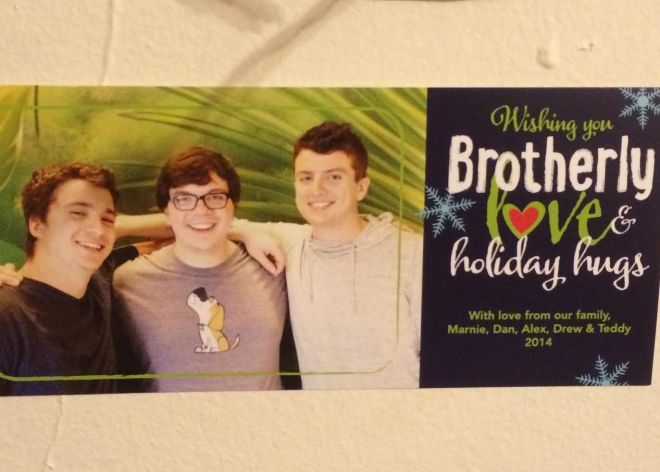
A handful of your photos especially warmed our hearts this Christmas:
Hey Andrew and company! On a recent family vacation to Las Vegas, I brought along my Dish t-shirt. My mother, desperate for post-empty nest family photos, snapped pictures at every conceivable opportunity in the hopes of getting something for our family Christmas card. Lo and behold, the photo that made the cut featured yours truly donning the now-iconic howling beagle. Now dozens upon dozens of my parents’ friends will get some not-so-subtle Dish advertising beamed into their mailboxes this December; I hope I can help drive up the subscription numbers (I bought my dad a gift membership for starters)!
Another subscriber:
My soon-to-be-husband correctly picked up on my not-too-subtle hints, and gave me my very own Dish mug for an early Christmas present! I am a thoroughly delighted Dish head, and enjoyed the inaugural cup o’ joe just this morning.
I’ve given Dish subscriptions as holiday gifts – selectively, to certain friends and family members – for several years now, often explaining that I certainly don’t agree with every opinion or perspective contained at the Dish, but that I always find it lively, engaging, and thought-provoking.
So I raise a cup of kindness and gratitude to you, Andrew and Team Dish. Here’s wishing you all health, happiness, and stamina for the year ahead.
P.S. Yes, that’s a fabulous, glittery rainbow flag ornament in the background on the tree!
And another:
I’m sure you’ll be inundated with these on the 25th, but as a Hispanic celebrating Noche Buena, I have a one-day headstart to boast about my amazing wife’s gift-giving abilities. She knew just how to make this Dish-head happy this year, with a double whammy:
I love her. And I love you guys. Merry Christmas, and here’s to a very happy, Dish-filled New Year.
And speaking of 2015:
Has The Dish ever thought of doing some kind of gathering of Dishheads? It would be awesome to be able to chat with the whole team as well as with each other. Not sure exactly what the format would be, but it might a great way to further the Dish community, as well as provide some in-person recognition for you guys. Mainly, I suggest it for selfish reasons: I don’t know any other Dishheads, but would like to!
Events are very much on our agenda for the new year, so stay tuned. And thanks again for your support in 2014. We’ll have a year-end update soon.
Helen Thompson characterizes the holiday plant as “basically a vampire,” calling it “a parasite that spends its days sucking the ‘lifeforce’ from trees round the globe”:
Mistletoe’s parasitism starts with poop and exploding berries. Mistletoe bushes clump on branches like something out of a Dr. Seuss book. Their parasitism is airborne. Birds eat their berries, which are coated in gluey material called viscin. The birds poop all over the forest, and thanks to the viscin, the mistletoe seeds in said poop stick to branches. Once firmly attached to the branch, mistletoe sprouts and drills down into the branch until it reaches the tree’s veins. It sticks a haustorium (basically a straw) in and sips the tree’s mineral and water cocktail.
Another group of mistletoes, dwarf mistletoes, does things a bit differently. In a dramatic twist on mistletoe reproduction, their seeds explode, literally. The blast zone can reach up to 15 feet. Seeds stick to saplings and wedge themselves into the tree’s innards, infecting the entire tree, and sprouting sometimes years later. These guys are full parasites, taking sugar, water, and minerals from the tree. “Dwarf mistletoe is freaky, freaky, freaky stuff,” says David Watson, an ecologist at Charles Sturt University in Australia. “Its [shoots] look like miniature asparagus.”
Eventually, the mistletoe bush grows, blooms, and forms berries, and the cycle begins anew.
For a more festive take on the plant, check out the below Broad City webisode, which follows Abbi’s pursuit of her first below-the-mistletoe kiss:
Joseph Bottum, the critic and author, explains why he has taken to writing Christmas songs – they are “one of the last few enchantments left in our public world”:
Think of it this way: If meaning comes only from us — if meaning arrives only via the human outlook on the world — then there is nothing meaningful in itself. Oh, sure, we have great emotions and great hungers. That’s part of what we want art to express. But what outside ourselves is inherently worthy of having our great feelings attached to it? In a thin world, nothing is enchanted. Nothing is naturally weighty, meaningful, infused with power. Nothing is rich, thick, and alive with the kind of true beauty that art needs to survive beyond a few generations.
Throw in a few zombies, however, and you’ve got a world, for screenwriters and viewers, that thrums with all the deep meaning of the apocalypse and the end of days. Toss in some vampires, ghosts, and demons, and you have a world in which evil and good have palpable presence.
In other words, a hunger for a metaphysically rich, supernaturally thick, emotionally wrought world is written across our age. And Christmas still provides it to artist and audience.
(Video for the Bottom-penned “Some Come to See the Lord”)
In his sci-fi series Black Mirror, the great Brit Charlie Brooker uses his mordant wit to send up technologically-dependent modern life. The series’ newest episode, White Christmas, is a holiday special critics are hailing as “about as festive as being bludgeoned to death by a stocking full of coal, but … also an unerringly brilliant piece of lo-fi sci-fi.” Louisa Mellor sums up the episode’s central conceit:
Taking Google Glass to its logical conclusion, the world of White Christmas is populated by augmented humans whose Z-Eye implants let them control and share what they see. It’s in this kind of technological advance – one that doesn’t seem far off in the realm of possibility but that has the potential to shatter human relationships – that Black Mirror specialises.
The episode features John Hamm as Matt, who makes a living off such advanced tech. Sam Wollaston thinks Brooker’s “dystopia isn’t outrageous, it’s plausible, and all the more terrifying for it. Less sci-fi, more like now after a couple of software updates”:
Matt’s day job … – working for Smartintelligence, a company that, accompanied by Rossini’s Thieving Magpie overture, extracts “code” from people under anaesthetic, stores it in a widget called a cookie before implanting it into a simulated body, which is what happens to Greta (Oona Chaplin) – well, that’s basically human cloning. There’s probably a company in South Korea that’s about five minutes away from doing that. There’s a company in South Korea that thinks it can clone a woolly mammoth from a piece of 40,000-year-old frozen mammoth meat; putting people’s code inside plastic eggs like this, before turning them into slaves, has got to be easier.
Yes slaves. Because this isn’t just about the technology, it’s about the issues – very real world ethical issues – surrounding the technology. It’s about slavery and morality and torture and separation and access to children as well as the technology, and what the technology does to us. It’s about people, which is its real beauty. Along with all the razor-sharp wit, the nods and the winks, it manages to be a very human story.
Willa Paskin also finds the episode eerily relevant:
In “White Christmas,” wearable tech has advanced beyond the rudimentary stages of Google glass and become Z-eyes, irremovable implants that let you take pictures and record things and, if you must, “block” other people. As used in “White Christmas,” blocking makes the person who is blocked and the person who has done the blocking look like grey, fuzzy outlines to one another. They can’t hear each other or communicate, and the blocked party has no recourse.
The terminology suggests a lineage with blocking someone on Facebook or Twitter. But here in 2014 we tend to understand blocking as essentially protective: It insulates people from unwanted attention and (often misogynistic) threats—though of course it also keep ex-friends and other irritants out of your feed. While Black Mirror understands the protective quality of blocking—the episode expressly deals with some messy, vile misogyny—it is more concerned with the ways blocking can be abused. In “White Christmas,” blocking is largely something women do to men in lieu of communicating with them. It’s the technological equivalent of sticking one’s fingers in one’s ears, an all-powerful silent treatment that can, sometimes, take on draconian legal backing.
If that sounds a bit wrong-headed, “White Christmas,” like the most disturbing episode of Black Mirror that exists, the similarly titled “White Bear,” asks questions about what we are willing to do to the least worthy amongst us: the convicted, the guilty, the criminal. When technology makes it easy to ignore, ostracize, manipulate, and torture the worst of us, might not the rest of us comply?
Merry Christmas.
The Christmas special is currently only available outside the UK on Direct-TV, but other would-be viewers can stream the previous two seasons on Netflix. The show, as Emily Yoshida explained last year in a spoiler-free guide, is best watched without much foreknowledge.





 The Dish