It’s Not Just Rush

Radley Balko listens to some left-wing talk radio, specifically Ed Schultz:

Schultz actually said that Fox News anchors were secretly hoping for shots to be fired, for government officials to be killed, and for an ensuing violent overthrow of the government. He strongly implied that tea party organizers want Obama to be assassinated. He equated Texas Gov. Rick Perry’s statement in support of the 10th Amendment this week as akin to support for a bloody revolution.

Follow up here.
Then And Now

"It's terrible and it's made life difficult for awhile…But if it becomes clear that this is the exception and [the troops involved] are held accountable, it could end up being an impressive demonstration to countries where torture is routine,"- Bill Kristol, as quoted by Robin Wright of the Washington Post, May 7, 2004 in response to Abu Ghraib.

"[Can we] afford Obama's "dark and painful chapter" attitude, exemplified by his foregoing certain interrogation techniques in the present and future, and his exposing and deploring what was done in the past?," – Bill Kristol, April 17, 2009.

"Of course, it's not the same as Saddam's torture — which was a matter of top-down policy, not the result of assholes who deserve jail or execution, and will probably get one or both,"- Glenn Reynolds, April 30, 2004.

"HMM: Attorney: Justice Memos Prove U.S. Did Not Torture," – Glenn Reynolds, April 17, 2009.

The Canard That The Memos Spilled Any Secrets

It’s very hard to believe that anyone is making this statement with a straight face. Rahm sums it up:

“One of the reasons the president was willing to let this information out [was that] the information was out,” he said. “So if they’re saying you basically have exposed something, it’s been written. Go get the New York Review of Books. It is there. So the notion that somehow we’re exposing something — it’s already been out. In fact, President Bush…allowed a lot of this information out. So the notion that somehow this all of a sudden is a game changer doesn’t take cognizance of the fact it’s in the system and in the public domain. Therefore, it’s not new… Number two: it’s one of the key tools al Qaeda has used for recruitment. There has been a net cost to America by changing the way America is seen in the world, which means banning this technique and practice, we have actually stopped them and prevented them from using it as a rallying cry.”

Sex Addiction Is A Myth?

Vaughan applauds a recent article:

There is virtually no published research on 'sex addiction' and it isn't an officially recognised diagnosis, but it has become fashionable to describe compulsive or non-mainstream sexual tendencies in these terms. Partly, as the article notes, because addiction has become the 21st century's label of choice for people who want to medicalise less acceptable sexual behaviours…

Why Does Healthcare Cost So Much? Ctd

A reader writes:

Both of my parents are physicians in Massachusetts, and, while they may be biased in their opinions about the merits of malpractice, they emphasize that it has caused them more and more to practice defensive medicine.

Simply put, defensive medicine is the use of medical practices designed to prevent malpractice.  A 25 year-old kid may come to a physician complaining of chest pain.

The likelihood that they have a life-threatening condition is as close to zero as can be doctors will order an MRI just so that they cannot be sued later on for not following procedure.  What that means is that insurance pays $1,000 for an unnecessary procedure, which could’ve been spent on something worthwhile.  Physicians study and work for 8 years post-college in order to ply their trade, and in a lot of situations, are equipped to make decisions without the need for costly tests.  Defensive medicine leads to hundreds of billions of dollars in wasted medical spending – money that could spent elsewhere.  Tort reform should be a major consideration in reforming the healthcare system.

The Uninsurable

Dr. Rob proposes some ways to deal with the people like me:

5% of Americans account for over 50% of the overall cost of care…These are the uninsurable people – those who are truly expensive to treat.  There needs to be very close management of these people.  Leaving them uninsured doesn’t reduce cost, it just shifts it to hospitals and local government.  It also leaves them unmanaged.  Of the waste in healthcare, the likelihood is that a very large percent of it is in the high-utilizers (by definition).  These people need management, either in a “medical home” or by some sort of care management.

The Godfather Of Rovism

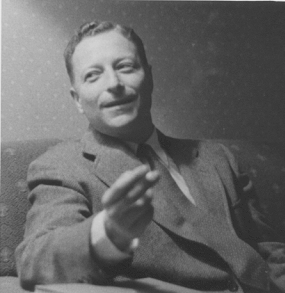
George Packer remembers Irving Kristol’s contribution to the GOP:

As the years go by, Kristol’s prose becomes less supple, less complex, more combative, and less persuasive. His animus against the “new class”—essentially, do-gooding liberal IrvingKristol “elites”—grows so malignant that it overwhelms his sense of proportion, as if the greatest force for evil in America is a seventh-grade social-studies teacher. A philosophical inquiry into the role of values in modern, liberal society gradually turns into a culture war, a crusade against liberals themselves—the true, internal “enemy” in what he calls “my cold war,” “the real cold war.” The successes of the Reagan revolution only intensify this narrowing and hardening of thought into ideology. Kristol converts to supply-side economics, turns against governmental reform altogether, and forgets the lessons of his close friend and colleague Daniel Bell’s great book “The Cultural Contradictions of Capitalism”: that the most destructive threat to bourgeois morality is bourgeois capitalism. By the nineteen-nineties, Kristol’s neoconservatism has settled into ordinary conservatism, which allows no room for contradictions, cultural or otherwise.

Eventually, Kristol’s quest for a source of transcendent values in modern society leads him to  champion the Christian right, which he calls “the very core of an emerging American conservatism,” and talk-radio populism, which he calls “the ‘last, best hope’ of contemporary conservatism.” If this is a strange destination for an intellectually distinguished Jewish alumnus of Alcove No. 1, it shows what can happen when a brilliant mind settles on merely partisan political answers to philosophical questions. It suggests that political victory can be just as debilitating as political defeat. And it brings to its present end the story of how intellectual conservatism rose and fell.

A Skeptical Irony

Simon Blackburn, a professor of philosophy, is embarrassed by the current theist-atheist fooferaw. He thinks Hume said it all much better:

Bad things happen when people decorate their bare, inchoate, unstable and inconsistent imaginings with the baser trappings of their culture. They come out of the fog bearing ludicrous beliefs about cosmology or biology, or carrying their envies and fears, their embarrassments about sex in general or certain varieties in particular, their desire to steal some land or make war on their neighbours. Deities then become dangerous, megaphones through which emotions are whipped up and particular moral demands are given a spurious authority. People need prophets and priests to carry the megaphones, and they are often supposed to signal their rapport with the deity by making remarkable things happen.