Print pushes back (and Murdoch must love it):
Month: December 2009
Cardinal: Gays “Will Never Enter The Kingdom Of God”
In direct violation of Catholic doctrine, a leading cardinal has insisted that being gay is a choice and that those who choose to be gay are thereby excluded from God's kingdom. Benedict's church is slowly reversing the reforms of the 1970s that saw gay persons as made in the image of God and inherently not sinful, as long as they remained celibate and lived alone their entire lives. It began with Benedict's own policy of insisting that even celibate gays cannot become priests because they are mentally or psychologically "disordered." The creation of a class of sub-human humans – the early medieval Catholic approach to Jews and sodomites – is making a comeback.
One also notes that the new Ugandan bill that would begin to treat gays as sub-human threats to be identified, informed on, jailed and executed has met no resistance from Pope Benedict XVI. Since the largest religious group in Uganda is Catholic, one has to take Benedict's silence in the face of this proposed Nazi-style law against homosexuals to be consent. The Ugandan Anglican church – closely allied with American Christianists – has this position:
The Anglican Church of Uganda on Nov. 6 issued a press release saying that it is studying the bill and does not yet have an official position on the proposed legislation. However, the release restated the Ugandan church's position that "homosexual behavior is immoral and should not be promoted, supported, or condoned in any way as an 'alternative lifestyle.'"
And AllAfrica.com reported Oct. 29 that the church's provincial secretary told the Monitor newspaper in Kampala, Uganda, that jailing homosexuals was preferable to executing them. "If you kill the people, to whom will the message go? We need to have imprisonment for life if the person is still alive," said the Rev. Canon Aaron Mwesigye, according to the website.
The origin of this law came from American Christianists as much as Ugandans:
Both opponents and supporters agree that the impetus for the bill came in March during a seminar in Kampala to 'expose the truth behind homosexuality and the homosexual agenda'.
The main speakers were three US evangelists: Scott Lively, Don Schmierer and Caleb Lee Brundidge….
The seminar was organised by Stephen Langa, a Ugandan electrician turned pastor who runs the Family Life Network in Kampala and has been spreading the message that gays are targeting schoolchildren for 'conversion'. 'They give money to children to recruit schoolmates – once you have two children, the whole school is gone,' he said in an interview. Asked if there had been any court case to prove this was happening, he replied: 'No, that's why this law is needed.'
(Scott Lively is the author of a book claiming that Nazism itself was a homosexual plot. But he insists that he believes the Ugandan law is too punitive and opposes it, which gives him more moral authority than Rick Warren.)
In the West, core constitutional protections prevent the rounding up, jailing and execution of a tiny minority simply for being public or for mere touching of one another. In a country like Uganda, no such protections exist. And so you see what many Christianists really believe: the terrorization of a minority that offends religious authority and majority prejudice.
Quote For The Day II
"You're assuming there's some morally superior aspect to health care than there is to a house [on the beach]," – Rush Limbaugh to William Shatner.
Surveying The Right The Day After
Douthat is glib:
Broadly speaking, it struck me as one of Obama’s least effective speeches. I can’t imagine any anti-war liberal being convinced to favor escalation by his arguments. I can’t imagine any pro-escalation conservative feeling confident that Obama is really committed to the effort he’s embarking on. And above all, I can’t imagine any up-in-the-air, uncertain American being reassured that we have a military strategy capable of delivering a successful outcome — because Obama barely seemed to talk about military strategy at all.
Gerald F. Seib spins this Peter Wehner post as supportive of Obama because Wehner, like much of the right, agrees with the underlying policy. A sample from one of the more forgiving reviews of Obama’s speech:
[O]ne cannot help but get the sense that Obama is dealing with Afghanistan only with great reluctance, that he views it as an unwelcome distraction from his domestic agenda. He does not seem to view this war in the context of any great cause, whether it is the liberation of captive peoples or prevailing against men of almost unimaginable cruelty and malevolence. The president came across last night as clinical and detached, somewhat distant and weary. He seemed to be reporting to the nation rather than trying to rally it. You do not sense that this is a man whose heart has been touched by fire.
NRO has run an editorial in favor of withdrawing from Afghanistan by John R. Miller. He defends the Iraq war at the same time:
We did not start the conflict in Afghanistan. The Taliban
and al-Qaeda did. We punished them. We overthrew their government. These were reasonable, attainable, low-risk objectives. Setting up a Taliban-free government in Afghanistan — let alone the peaceful and democratic one that may be necessary to achieve this objective — will be costly, unlikely, and focused on a country in no way strategic to us. And, just as important, a substantially increased effort — including the half-hearted, almost-no-chance-of-success Obama initiative — will just make it more dishonorable to withdraw later and lead to greater loss of credibility when we do so.
Only Kristol seems chipper:
Obama is now saying: We’re surging and fighting for the next 18 months; see you in July 2011. That’s about as good as we were going to get.
The Permanent War
A reader writes:
The way our politics of fear is now constructed, there is no limit to the costs involved in nation-building in every conceivable failed state that could be a safe harbor for Jihadists. We cannot have the adult conversation about how much terrorist damage the US should tolerate compared with the costs of trying to control this phenomenon at its source. We are not mature enough as a country to have that conversation. And Obama has decided it isn't worth confronting that question now.So the war with Eastasia continues… We've always been at war with Eastasia…
Testing The Weberian Hypothesis
Davide Cantoni finds no relationship between Protestantism and economic growth.
Paying For The War
Yglesias sighs:
I haven’t seen anyone even really attempt to persuade me that this policy makes sense in cost-benefit terms. And I think the reaction to David Obey’s “war tax” idea is telling—nobody seems to really think there are national interests at stake that are critical enough to be worth paying slightly higher taxes for. But if a war’s not worth paying for, how can it be worth fighting?
Ezra Klein has more on the cold reception Obey's "war tax" weathered. And imagine if there were a draft. DO you think anyone would back this surge?
The Ailes Line, Ctd
Greg Sargent shows how my instinct as to the GOP response to a big surge in Afghanistan is being borne out. They are framing all the courageous aspects of this as McChrystal's and Obama as a follower. They want to leverage the military leadership against its commander-in-chief. Why? Because if it works, they can credit McChrystal. If it fails, they can blame Obama. But either way, it is essential to make Obama look "weak."
Quote For The Day
"I mean, I think he might need a new teleprompter with some Energizer bunny batteries in it. You know, look, at the core of tonight was good news, but it was badly delivered in a — you know, in a weak frame," – Karl Rove.
Obama, Trimmer
Massie flags this passage from E.D. Kain:
Conservatism is not only about limited government, and where it seeks to limit government it does so because it sees government as a force of instability. But what about those times when government is instead a force for stability? Defense leaps to mind. Conservatism, I would argue, is first and foremost about preserving or regaining a stable society. Liberty and prosperity are two of the most profound ways we can achieve a stable civilization. Limiting government often leads to both these things, and thus it is a means to an end, not an end in and of itself.
And when limiting government actually brings about social chaos rather than social stability, then it’s outworn its use. Perhaps this is why anarchy is such an impossible goal. At some point the benefit of removing the state from the equation no longer outweighs the cost.
The underlying principle here is an Oakeshottian one: the coherence of a polity matters more than any single ideological approach to politics. This was Oakeshott's critique of Hayek after a fashion. If the market 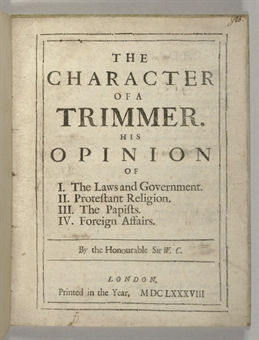 becomes an ideology in itself, it ceases to be conservative. The real conservative tilts from intervention to laisser-faire depending on the circumstances. He may lean in the long run toward less government as a more stable principle in a free, self-reliant and increasingly diverse country than more government. But he is always seeking the right prudential balance from exigency to exigency, from era to era, from year to year. And government is never the enemy tout court. It is a necessary means to an end.
Oakeshott saw the politics of faith and the politics of skepticism as the two core principles guiding modern Western politics. He favored in his own day of government planning, rationalism and left-liberal triumphalism the unfashionable tradition of freedom, mystery, markets and personality. But he was always aware that government needed to act strongly sometimes and swiftly too. He was skeptical of excessive skepticism. A conservatism of doubt might be too sluggish in emergencies, as Oakeshott scholar Paul Franco explains here, or deemed too frivolous at times. It could be incapable of summoning the necessary love or gratitude or patriotism from its subjects. So it can embrace government at times, to save civil society; and vice-versa.
What the conservative is about, in other words, is balance. And that's why Oakeshott's famous metaphor for the kind of politician he admired was a "trimmer." And one of his treasured works of political writing was Halifax's sadly neglected "The Character Of A Trimmer". Today we regard a trimmer as a flip-flopper. But a trimmer in the nautical sense was a man simply tasked with trimming the sails and balancing the weight of a ship to ensure, as different winds prevailed, that the ship stayed upright and on an even keel. The role of the conservative statesman is, in Oakeshott's sense, to do the same thing – sometimes expanding government in discrete ways to ameliorate or adjust to new circumstances; sometimes restricting it for the same reasons. Here's his own description:
"The 'trimmer' is one who disposes his weight so as to keep the ship upon an even keel. And our inspection of his conduct reveals certain general ideas at work…Being concerned to prevent politics from running to extremes, he believes that there is a time for everything and that everything has its time — not providentially, but empirically. He will be found facing in whatever direction the occasion seems to require if the boat is to go even."
I think you can see the critique of left-liberalism in the 1970s as a classic conservative trimming of the excessive delusions of a liberalism become too powerful, too smug and too ideological. That's why the original neoconservatives – Kristol, Bell, Glazer et al – were heroes to me.
But I also think you can see Clinton and Obama as necessary attempts to balance the excesses of this movement which inevitably succumbed to hubris, calcification, and ideological purism over time. What Bush and Cheney then did to the system in panicked response to the emergency of 9/11 – a massive and radical attack on constitutional norms, a conflation of religious certainty and government, and a huge expansion of government power and spending – requires now a very intense period of Halifax-style balancing. Obama's moderation may, in fact, not be radical enough on Oakeshottian grounds. For trimming is not about always finding the middle option. It is about restoring balance, which may sometimes mean radicalism if it is preceded by serious imbalance.
This is a prudential task, not a theoretical one (the other core conservative insight). And we should judge this president and his opponents on the wisdom of their prudential decisions and positions. So far, it seems to me, Obama is the only game in town. Whether his judgment is right will only be determined by history. But his instincts, it seems to me, are genuinely that of a trimmer.
In the best possible sense of that term.
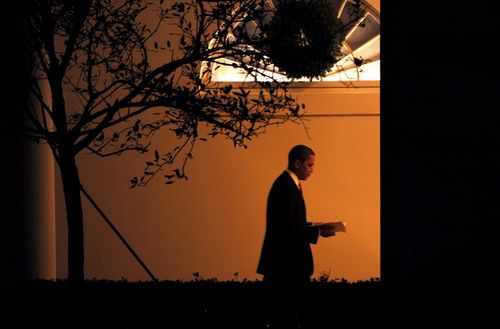
(Photo: Obama leaving for West Point last night by Tim Sloan/AFP/Getty.)
 The Dish