Stop Feedin’ Off Him

by Conor Friedersdorf

Sam Tanenhaus writes:

More than ever before the celebrity, in particular the sports celebrity, is trapped in a transactional relationship with his fans, who regard him less as a person than as a commodity — an enormously skilled competitor on the field, but off it just another pitchman selling himself on television and in back lit displays in airport
terminals.

Quite right.

Though I normally write about political controversy at The Daily Beast, my column suggesting that sports fans would be better off ignoring the personal behavior of Tiger Woods — I told you so — teed off more readers than any other argument I've pitched.

The rough counterargument is that Mr. Woods ceded any right to privacy in his personal life by voluntarily appearing as a highly paid spokesman in advertisements. As Kashmir Hill wrote at True/Slant, "Woods has profited mightily from people’s fascination with him. Having accepted over a billion dollars for the marketing and selling of his personal brand, it’s hard for Woods to now make the argument that his brand is entitled to privacy, or for anyone to argue that he is not a public figure."

Is anyone else alarmed that conventional wisdom now treats human beings as though they're synonymous with the "personal brand"? Or that defining someone as a "public figure" is meant to imply, without further argument, that we're entitled to investigate, publicize, and discuss the most intimate details of their personal lives?

Mr. Woods isn't arguing that his brand is entitled to privacy, he is saying that he and his family are entitled to it. Forgive me for putting it so crudely, but anyone who argues that celebrities cede all privacy rights when their private behavior conflicts with the image they cultivate had better be prepared to defend it when someone asks Mr. Woods how often he masturbates. I'd much prefer to abet the illusion that the men who fill my flat screen as I eat dinner all take cold showers.

The reigning fetish right now in American culture is consumer rights. A famous man too weak or arrogant or immature or sought after to resist the temptation of extramarital sex should be privately understood as a disappointment and a tragedy. Mr. Woods stands to lose an enraged, devastated wife, and almost certainly damaged the future happiness of his children (all awful outcomes that the ongoing media frenzy exacerbates).

Perhaps it is only human, like all things cruel and fallen, that we treat it as a spectacle — that we're fascinated because "we thought we knew Tiger," though we ought to know better, and disabuse ourselves of these celebrity illusions. If we're determined to ignore the tragedy and embrace the spectacle, however, must we simultaneously pretend that this nosiness is our due as a member of the Gillette advertisement watching public? As though we'd have passed on the five-blade razor if only we'd known the spokesman's dark secret? "His skin is smooth, sure, but unbeknowst to the razor executives he cheats on his wife at every opportunity. Ergo it's Schick for me."

Of course, the car-commercial-watching public has even less claim to the truth about the pitch man: an athlete selling razors owes it to us to shave with them. The guys selling Nike shoes actually demonstrate that the product is capable of performing at the highest levels. Whereas it is immaculately obvious that if the Virgin Mary herself appeared in a commercial for the Cadillac Escalade, her lack of sin wouldn't signify better cornering, enhanced reliability, or five-star performance in side-crash test collisions.

Anyone who let a "Tiger drives a Cadillac" advertisement affect his car purchase was being willfully ignorant, or else enjoys driving what a famous athlete drives — that is to say, he was a willing participant in a transaction, and he benefited from it. The way this affair is being covered, you'd think that America is instead filled with helpless-in-the-face-of-pr consumer-bots, people too blinded by highly paid image managers to see that Brand Tiger Woods was a creation, not a real person, and so conscientious that they would've bought their razors and cars from the Dalai Lama but for that cad golfer whose duplicitous brand management convinced them that he, rather than his Holiness, was the most moral spokesman in the McWorld.

Our orgy of anger and schadenfreude when the famous fall betrays self-contempt. We enjoy feeding off the talent, image and charisma of celebrities, just like the guys in the prison yard who idolized Cool Hand Luke before they turned on him: Dazzled by exceptional qualities, we indulge in the prideful illusion that humans aren't fallen after all; persisting in this folly, we are more than sorely disappointed when human flaws emerge, as they inevitably do — their appearance throws our naivete in our face, and we react all too often by punishing the sinner not only for his transgression, but to avenge or distract from how foolish we feel.

The masses in America once read and even discussed popular fiction. It isn't a time I know much about, as it preceded my birth by many years, and I don't want to romanticize it. But it occurs to me that we'd all be better off if our national characters were undeniably fictional, rather than whatever senses of celebrities we feel like we know. By filtering our discussions about infidelity, ambition, love, moral behavior, and achievement through these constructed phantasms, we condemn ourselves to inquiries into human matters conducted without the benefit of human beings.


The Limits Of Rationality

by Patrick Appel

Bryan Caplan quotes this passage from Leon Kass's The Wisdom of Repugnance:

[R]epugnance is the emotional expression of deep wisdom, beyond reason's power fully to articulate it. Can anyone really give an argument fully adequate to the horror which is father-daughter incest (even with consent), or having sex with animals, or mutilating a corpse, or eating human flesh, or even just (just!) raping or murdering another human being? Would anybody's failure to give full rational justification for his or her revulsion at these practices make that revulsion ethically suspect?

Caplan lists some rules for when we should discount our repugnance and defends human cloning against Kass's critique. I side with Kass on human cloning because of unnecessary pain and suffering caused to the numerous unsuccessful or partially successful trial clones:

Reproductive cloning is expensive and highly inefficient. More than 90% of cloning attempts fail to produce viable offspring. More than 100 nuclear transfer procedures could be required to produce one viable clone. In addition to low success rates, cloned animals tend to have more compromised immune function and higher rates of infection, tumor growth, and other disorders. Japanese studies have shown that cloned mice live in poor health and die early. About a third of the cloned calves born alive have died young, and many of them were abnormally large. Many cloned animals have not lived long enough to generate good data about how clones age. Appearing healthy at a young age unfortunately is not a good indicator of long-term survival. Clones have been known to die mysteriously. For example, Australia's first cloned sheep appeared healthy and energetic on the day she died, and the results from her autopsy failed to determine a cause of death.

If cloning were no more dangerous than natural reproduction, I'd probably feel differently.

We Are Not Our Brains?

by Patrick Appel

Raymond Tallis fears the use of neuroscience in public policy:

There is a huge gap between the community of minds and animal quasi-societies. The vast landscape that is the human world has been shaped by the activity of explicit individuals who do things deliberately. Uniquely, the denizens of that world entertain theories about their own nature and about the world; systematically inquire into the order of things and the patterns of causation and physical laws that seem to underpin that order; create cities, laws, institutions; frame their individual lives within a shared history that is recorded and debated over; narrate their individual and shared lives; and guide, justify and excuse their behaviour according to general and abstract principles. Neuro-evolutionary theorists try to ignore all this evidence of difference and have even requisitioned the pseudo-scientific notion of the meme, the unit of cultural transmission, analogous to the gene that ensures its own survival by passing from brain to brain, to capture human society for quasi-Darwinian thought. Just how desperate is this endeavour to conceal the Great Ditch separating humans from other animals is evident from the kind of items that are listed as memes: “the SALT agreement”, “styles of cathedral architecture”, “faith”, “tolerance for free speech” and so on.

Grassley Against The Uganda Bill

by Chris Bodenner

Better late than never:

Grassley said his “commitment to traditional values” and “respect for life” holds true both in the United States and around the world. So with that in mind, after he learned more about the proposed legislation through the U.S. State Department, he was able to conclude that it is wrong and should be rejected. “Based on what I’ve been able to learn about the legislation and from the stand point that I’m a born again Christian, I can tell you that I don’t agree with this un-Christian and unjust  proposal, and I hope the Ugandan officials dismiss it,” he said.

Friendship Isn’t Modern

by Patrick Appel

A reader writes:

I couldn't disagree more with William Deresiewicz. Yes, modernity is about equality — Tocqueville taught us that much for sure. But this means we do not like to make distinctions, declaring one person or set of morals or way of life to be better or worse than another. The radical particularity of friendship, of loving this person more than that person, pushes against our egalitarian sensibilities. The entire trajectory of modernity has been towards the universal, away from the particular: consider our infatuation with "human rights," which are taken to be universal; our humanitarian concern for those half-way around the world; our skepticism towards nationalism and even patriotism; and our cosmopolitanism. To put this slightly differently, there is an intrinsic connection between equality and universality, or what Tocqueville called "general ideas."

Andrew, in "If Love were All," ends up making precisely the opposite point that Deresiewicz makes — that friendship is the form of love, the relationship, we have lost in modern times.

It is true that friendship is predicated on equality (Aristotle teaches us this), but that is only to say that friendship, especially of the deepest sort, is between equals. This notion of friendship between equals can exist amidst the most radical social and political inequality. Two aristocrats can be friends, and their rough equality of station and power and wealth might make that friendship possible (or free it from certain tensions and problems) — but that is because they are equal, not because "equality" is the principle of justice for the society in which they live. So the fact that modernity is connected to a broader equality, the equality of, say, the Declaration of Independence, really tells us very little about the prospects for friendship. Indeed, to refer again to Tocqueville, the broader equality — equality as a principle of justice — may actually undermine the more particular form of equality, that in which two friends, or a small group of friends, see themselves as somehow set apart from everyone else: equals who are unequal with regard to everyone else. That's one feature of the democratic age, the age of equality: no one is set apart from the rest.

Deresiewicz basically makes this point for me in his discussion of "romantic friendship," which he sees as a recapitulation of a classical ideal. Exactly! To the extent friendship persisted into the modern age, it was understood as a retrieval of an ancient notion. It was not defended on modern grounds.

In summary: Andrew's essay is far more nuanced and interesting and simply accurate than the one you link to. How do these people get published in such prominent places?

The Middle Way

88819290

by Patrick Appel

Jonah Leher describes the compromise effect. When presented with three options we are irrationally inclined to pick the middle one. Leher thinks Obama's Afghanistan decision fits this model:

The point is that most of us are natural compromisers, eager to find a middle-way. (There's some suggestive evidence that the tendency to pursue the compromise option is mediated by culture, with East Asians more likely than Westerners to show the compromise effect.) Furthermore, our compromising tendencies can be skewed by the audience: when American subjects were told that they might have to defend their choice in front of a whole classroom, they shifted towards the safety of the middle option. Obama, of course, needed to justify his decision to an entire planet.

(Image: Joe Raedle/Getty Image)

Poseur Alert Nominee

by Patrick Appel

"Her vulva was opposite my face. The small lips protruded slightly from the pale, domed flesh. This sex was watching at me, spying on me, like a Gorgon's head, like a motionless Cyclops whose single eye never blinks. Little by little this silent gaze penetrated me to the marrow. My breath sped up and I stretched out my hand to hide it: I no longer saw it, but it still saw me and stripped me bare (whereas I was already naked). If only I could still get hard, I thought, I could use my prick like a stake hardened in the fire, and blind this Polyphemus who made me Nobody. But my cock remained inert, I seemed turned to stone. I stretched out my arm and buried my middle finger into this boundless eye. The hips moved slightly, but that was all. Far from piercing it, I had on the contrary opened it wide, freeing the gaze of the eye still hiding behind it. Then I had an idea: I took out my finger and, dragging myself forward on my forearms, I pushed my forehead against this vulva, pressing my scar against the hole. Now I was the one looking inside, searching the depths of this body with my radiant third eye, as her own single eye irradiated me and we blinded each other mutually: without moving, I came in an immense splash of white light, as she cried out: 'What are you doing, what are you doing?' and I laughed out loud, sperm still gushing in huge spurts from my penis, jubilant, I bit deep into her vulva to swallow it whole, and my eyes finally opened, cleared, and saw everything." – Jonathan Littell, The Kindly Ones, winner of the 2009 Bad Sex In Writing Award. Other shortlisted passages here.

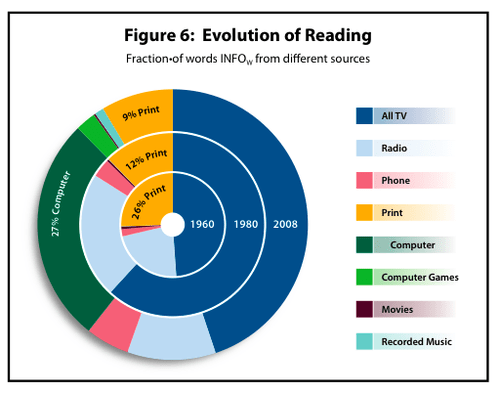
Chart Of The Day

EvolutionOfReading

by Patrick Appel

Derek Thompson thinks that the future of reading is mobile:

Mobile ad spending is expected to grow 15 percent next year. I think that prediction could be conservative. As the smart phone war between iPhone, BlackBerry, Palm, Android, etc heats up, the competition will only drive up their capacity and utility and encourage more people to think of their phones as small computers that can make calls, rather than phones pretending as small computers.