Von Hoffman Award Nominee, Ctd

by Chris Bodenner

Props to Cliff Stoll for owning up to his terrible prediction:

Of my many mistakes, flubs, and howlers, few have been as public as my 1995 howler. Wrong? Yep. At the time, I was trying to speak against the tide of futuristic commentary on how The Internet Will Solve Our Problems. […A]s I've laughed at others' foibles, I think back to some of my own cringeworthy contributions. Now, whenever I think I know what's happening, I temper my thoughts: Might be wrong, Cliff…

Er, a reader writes:

Cliff Stoll was actually wrong even *more* spectacularly than that: he wrote an *entire book* on why everything we have now would never come to pass: Silicon Snake Oil. He doubled down on his crappy prediction. He was just making a living by being a contrarian “expert”, is all. Now? Well, hully gee, he makes Klein Bottles . . . and sells them online.

Buy some bottles here (and you gotta love the Web 1.0 design).

The Daily Wrap

Today on the Dish, Alex Massie sized up the possibility of a hung Parliament, scrutinized the format of scheduled debates, noted the endorsement of Cameron by Mugabe, snickered at the cover of Tony Blair's new book, and guffawed at the victory of a kooky congressional candidate.

Jonathan Bernstein took a long look back at the healthcare reform process, countered Massie over the proper role of debates, mentioned the latest uproar from the fringe right, and discussed budget gimmicks. Graeme Wood pointed out "the perfect tree."

Elsewhere on the Dish, Lieberman put forth a bill to end DADT, Palin came out with a new book and docudrama, Ted Olson displayed integrity in the face of Cheneyism, Mike Potemra defended the inquiries into the detainee attorneys, Douthat defended Mitch Daniels, Noah Pollak knocked Obama's ability to influence Iran, George Friedman argued for a fundamentally different approach to the country, Frum attended a debate between Leverett and Ledeen, Tyler Cowen reviewed Diane Ravitch's new take on education reform, and a bunch of bloggers wondered if we vote too much. A satirical blogger passed away and the Dish received a powerful email from Chile. Christianist watch here and Von Hoffman nominee here. Cool ads here and here. Quintessential MHB here.

Andrew popped in to give props to the Atlantic web team for a rapid response. (He should be back on the grid by tomorrow night.)

— C.B.

A Hung Parliament? Yikes!

by Alex Massie

A new poll of 60 marginal seats Labour won by between six and 14 points in 2005 gives the Tories just a two point lead: 39%-37%. That's good, but not enough to win a majority. No wonder Allister Heath worries that Britain is heading towards the worst of all possible worlds: a hung parliament in which neither party has a majority

It is a calculation that should fill all of us with an immense sense of dread: there is now a 72.2 percent chance of a hung parliament. Or so says Michael Saunders, Citigroup's chief European economist and the one man in the City everybody listens to when it comes to the interaction between parliamentary politics and the financial markets. His model, which incorporates the standard data about the Westminster first-past-the post system, and into which he has fed all of the latest polls, also suggests that there is just a 6.2 percent chance of strong Tory majority, a 19.1 percent chance of a weak one and 2.5 percent chance of a Labour majority. Given the terrible state of our public finances, and Britain's desperate need for a strong government with a clear commitment to fiscal reform, all of this is little short of disastrous.

If no-one wins a majority, Gordon Brown, as the sitting Prime Minister remains in office and has first dibs on cobbling together a coalition with, presumably, the Liberal Democrats (this explains Brown's entirely opportunistic recent conversion to the cause of electoral reform). If that proves impossible then the party with the largest number of seats will be asked if they can form a government, whether it be a majority coalition or a minority ministry.

Suffice it to say, as Allister points out, the markets aren't likely to be enthused by any of this.

So what will the Liberals do? Their difficulty is that while the electorate seems unlikely to be enthused by the idea of their propping up Labour many of their own MPs and local councillors see the Conservatives as a bigger danger (to their own prospects if not the national interest) and are, consequently, more comfortable with a Lib-Lab pact than with sleeping with the Tories.

Relatedly I've a piece at Foreign Policy today marvelling at how Gordon Brown, despite his unpopularity, isn't dead yet.

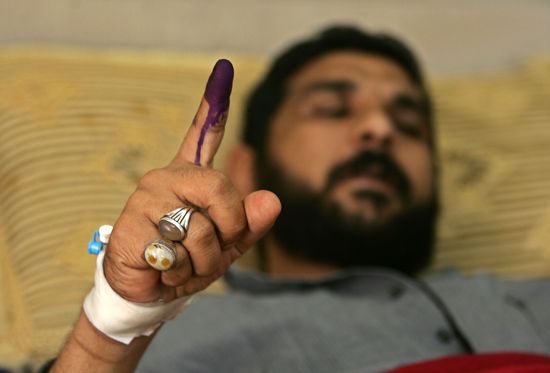
Face Of The Day

97434662

An Iraqi patient shows his inked finger after voting in the country's parliamentary elections at a special polling station on March 4, 2010 in Baghdad, Iraq. Special voting for about 790,000 Iraqi prisoners, hospital patients, doctors and security force members were held in Iraq ahead of the parliamentary elections. At least 17 people were killed in a string of attacks targeting special voting polling station. By Muhannad Fala'ah /Getty Images.

Scandal! Or, Whatever

by Jonathan Bernstein

Here's a challenge for the press: which fringe political nonsense is going to be the next White House travel office scandal (lasts for months if not years before fizzling out) and which is going to be the next Kevin Jennings (bubbles up from the crazy, but fizzles before anyone beyond a narrow group hears about it)?  Take today's kerfuffle, explained ably by Kevin Drum.  Will it still be around after Easter?  Who knows? 

Mostly, however, I agree with Steve Benen, who says:

If Republicans had the congressional majority right now, Congress would literally launch a federal investigation into something like this. Come 2011, it's likely any nonsense published by the Weekly Standard (or related outlets) in the morning, will produce subpoenas by the afternoon. This was the model from 1995 to 2000, and it would be just as ridiculous next year.

Which brings me to the real reason for this post, which is to encourage everyone to predict the first Member of the House to file for impeachment against Barack Obama, and the date that he or she will do so.  I'm afraid that Bachmann, Brown-Waite, Joe Wilson, and Ron Paul are already taken, but that leaves plenty of others to choose from — including the possibility that none of them will do it.

The Iran Debate, Ctd

by Patrick Appel

Noah Pollak opines:

[A]cknowledging Russia and China’s unwillingness to help [with sanctions] would strike the most powerful blow yet to Obama’s central foreign-policy message: that his personality and eagerness for engagement would open up doors for America that were slammed shut by the Bush administration’s alleged arrogance and quickness to go to war. Acknowledging that the Security Council will never allow strong sanctions would be tantamount to admitting that the very logic and premises of Obama’s foreign policy is flawed. Thus, this isn’t really about Iran. It’s about the politics of failure and Obama’s increasingly desperate attempt to shield his presidency from the hard realities of the world.

And there is a practical reason why Obama may never admit that the Security Council is a dead end: doing so would force him to move to a new strategy — and there is no new strategy.

has a slightly different view. Larison thinks that US "objectives are unrealistic and unreachable":

Obama wanted to change the means the U.S. used to pursue the same unreachable end, namely the elimination or severe limitation of Iran’s nuclear program. What the administration and its hawkish critics have been unable to see is that it is the end, not the means, that needs to be changed.

Debates and Elections

by Jonathan Bernstein

I see that the British elections are emulating those of us over here in the colonies by holding debates between the candidates for Prime Minister as the centerpiece (centrepiece?) of their campaign, and my fellow guest-blogger Alex Massie is upset about it for all sorts of good reasons (Presidentialism is as good a reason as any, in my opinion).  But he also doesn't like the format:

There will be no cheering from the cheap seats, no back and forth, no direct interrogation of the other candidates, nothing but the dreary recitation of policy positions so tired and familiar and hackneyed that we're all more than sick of them already. No wonder they're likely (one could be wrong about this) to prove a massive, crushing disappointment…it's hardly likely that there will be any substantive revelations, nor any interesting insight into how they actually think or approach problems or see the world.

What would he like to see?  A real debate.

Well, sure.  Who wouldn't want to see, as Massie suggests, "John McCain propose the motion That this House Thinks Brutus Was an Honourable Man or Gordon Brown defending the idea that This House Would Rather Be Keynes than Hayek."  It would be entertaining.  No question.  But I don't think it has much to do with what elections are about.  In fact, I think such complaints about debates reveal a mistakenly goo-goo version about how elections "should" work that's pretty widespread in America, and perhaps the Brits have imported it as well.  If so — too bad. 

Let me explain.  How do voters make decisions in an election?  The goo-goo model says that ideally, one would learn "the issues" thoroughly, and then carefully compare the policies of Candidate One against the policies of Candidate Two.  One set of policies is, in this conception of things, right.  The other is wrong.  The job of the electorate should be to figure out which candidate has better policies, and elect that person.  Debates are good if they become a clash of ideas, and the winner should be the one with better ideas, better policies.  In that world of pure ideas, as Massie quotes Mr. Eugenides as saying:

In the debating I know, it's usually the quality of a team's arguments that wins the day, not their style. Beyond a certain level of competence, everyone in the final of the Oxford Union intervarsity (say) is assumed to be confident, quick on their feet, at ease in front of an audience.

Sure, delivery matters, but when it comes to deciding who has won, the main focus of judges' discussions is the debaters' content. What did he say? Did he give any evidence for that claim? Did he explain that clearly, and was I convinced? These are the things that "real" debating hinges on, more often than not.

Yes — but they are not the things that real elections hinge on.  Voters are not debate judges, nor should they be.  Instead, voters are citizens with preferences and interests, and elections are about matching those preferences and interests with the proper set of candidates.  Yes, those preferences may change as a result of campaigning, and those preferences might be about public policy issues.  But often they're not, and there's nothing wrong with that.  One preference might simply be to punish the incumbent party because the economy stinks.  Another might be for some form of descriptive representation, as when an immigrant population seeks to have one of their own elected to Congress from the local district.  Or, it may come down to group interests, whether for economic or social benefits, as when factory workers support the candidate endorsed by unions or an abortion opponent supports a candidate endorsed by pro-life organizations.  All of these are perfectly good reasons in a democracy for someone to vote for one candidate or the other.  Debates can help inattentive voters match themselves up with the "correct" candidate for their preferences and interests, but that's about all.

Well, not entirely.  Debates also force candidates to make promises, and that's an important part of representation.  Of course, because campaigns (especially in the US) are long, often the promises made by candidates at high-profile events such as debates will sound to close observers as merely repeating talking points, but that's OK; the fact of repeating those particular talking points when everyone is paying attention makes those promises more important to whichever candidate takes office.  So that's an important and proper part of high-profile debates, although it doesn't have much to do with which candidate "wins" the debate."

"Real" debates would do no better job of filling those functions, and might well do a much worse job.  They would be more entertaining to those of us who watch campaigns very closely, but that's not, alas, the audience.
Door Number Three

by Patrick Appel

George Friedman's view of the Iran-US relationship:

As long as the problem of Iran is defined in terms of its nuclear program, the United States is in an impossible place. Therefore, the Iranian problem must be redefined. One attempt at redefinition involves hope for an uprising against the current regime. We will not repeat our views on this in depth, but in short, we do not regard these demonstrations to be a serious threat to the regime. Tehran has handily crushed them, and even if they did succeed, we do not believe they would produce a regime any more accommodating toward the United States. The idea of waiting for a revolution is more useful as a justification for inaction — and accepting a nuclear Iran — than it is as a strategic alternative.

He calls for an Iranian and American alliance:

Consider the American interest. First, it must maintain the flow of oil through the Strait of Hormuz. The United States cannot tolerate interruptions, and that limits the risks it can take. Second, it must try to keep any one power from controlling all of the oil in the Persian Gulf, as that would give such a country too much long-term power within the global system. Third, while the United States is involved in a war with elements of the Sunni Muslim world, it must reduce the forces devoted to that war. Fourth, it must deal with the Iranian problem directly. Europe will go as far as sanctions but no further, while the Russians and Chinese won’t even go that far yet. Fifth, it must prevent an Israeli strike on Iran for the same reasons it must avoid a strike itself, as the day after any Israeli strike will be left to the United States to manage.

(Hat tip: Ben Katcher)

The Romney Doctrine, Ctd

by Chris Bodenner

Contra Romney, who completely dissed the role of the State Department:

Adm. Mike Mullen, chairman of the Joint Chiefs of Staff, said Wednesday evening that there are limits to American military power and diplomatic efforts must be just as important if not more so. But despite recognition of this, the military has become the default for American foreign policy. “My fear, quite frankly, is that we aren’t moving fast enough in this regard,” he said. “US foreign policy is still too dominated by the military, too dependent upon the generals and admirals who lead our major overseas commands and not enough on the State Department.”