by Patrick Appel
Month: March 2010
A Tale Of Two Earthquakes
by Chris Bodenner
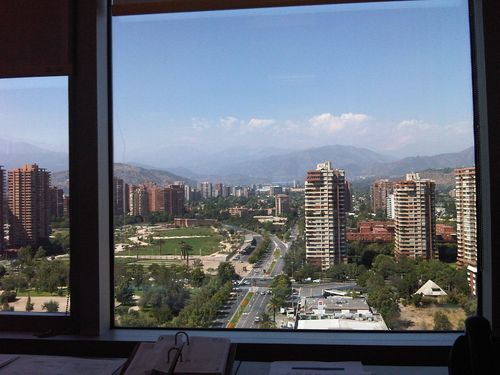
Last Friday, in a random and eerie coincidence, the Dish published a View From Your Window from Santiago, Chile – just hours before the earthquake hit. I followed up with the reader and asked if he could send us an updated version. He writes:
Thanks for your prayers and support. Thankfully, all of my family and friends are OK, just a little scared. Regarding the picture, I could definitely send you an updated shot, but it would look exactly the same as the one you posted last Friday; there is absolutely no damage to be seen there. This reflects the fact that the earthquake affected different parts of the country in completely different ways.
I live and work in the eastern part of Santiago (the picture was taken from my office window), which is the richer, more developed part of town. Life here was pretty much back to normal on Sunday, with people going about their daily lives with little or no interruptions. Walking around here, you'd have a really hard time noticing that we had just gone through one the biggest natural disasters in this country's history.
This, of course, represents a stark contrast to what has happened to the older, poorer parts of Santiago and to other cities to the south such as Talca and Concepción, where the damage has been tremendous and where looting and social unrest are starting to become a major problem. I suppose you could post the updated picture as a statement to the huge inequalities that still remain in this country, despite all of the prosperity and growth of the past few years.
For fresh photos of the devastation in Chile, head to The Big Picture.
Before Colbert
Texas’s 22nd Congressional District Wakes Up
by Alex Massie
Oh no! We've been rumbled!
The victory in the 22nd Congressional District yesterday by LaRouche Democrat Kesha Rogers sent an unmistakable message to the White House, and its British imperial controllers: Your days are numbered. Kesha's campaign hit relentlessly at a single theme, that President Obama must go, that his attacks on this nation – with his dismantling of the manned space program, his efforts to ram through a fascist, killer “health care” policy, his endless bailouts for Wall Street swindlers, while demanding budget cuts which will increase the death rates among the poor, the sick, the elderly and the unemployed – are not acceptable, and will not be tolerated.
Skeptics said that LaRouche's approach is impractical, it won't work, that Democrats will never support someone who is calling for the President's impeachment. Obviously, the voters of the 22nd district disagreed with those skeptics, as Kesha received 53% of the vote against two opponents. As Kesha told the Galveston Daily News last night, when a reporter asked if she expected support from the Democratic Party in the fall election, “I am leading a war against the British Empire. I'm not worried about what Democratic Party hacks say or do.”
I assume that Obama's "Kenyan birth" is further evidence that he's actually an MI6 mole.
The only other people, I think, who still believe in the Empire are some of the kookier elements within the Iranian regime for whom the United States is always being manipulated by the dastardly Machiavellians at the Foreign and Commonwealth Office. Clearly, now that Democrats in Texas's 22nd Congressional District have woken up our days are numbered. But, hey, we had a fine run and it was good while it lasted…
What other countries are still running? Nominations to alexmassieATgmail.com
[Via Yglesias]
Playing Nice With Iran
by Patrick Appel
Frum attended a debate on Iran between Michael Ledeen and Flynt Leverett:
[Leverett] acknowledges past attempts at engagement – but those attempts narrowly focused on some specific tactical issue. Leverett claims Iranians have in fact cooperated on the issue on which engagement was sought. They thought by doing so they might prompt us to rethink our willingness to live with the Islamic republic. The historical record: typically its the American administration that pulls the plug on tactical cooperation, either because of domestic political blowback or in reaction to some other Iranian provocation unrelated to the area of cooperation. Leverett claims this is what happened in 2002: The Iranians were helpful on Afghanistan – their reward was to be labeled part of the axis of evil – and to see Afghan cooperation cut off. Leverett argues that no president has ever proposed a “grand bargain.” He asserts that Iranians would accept such a bargain – but his evidence for this proposition is lacking.
Full transcript of the debate here. Michael Ledeen's outlook is that every "American president has eventually come to the conclusion that we could make a grand bargain with Iran and has tried to do it." Ledeen:
What has changed? Why would you think you could get a deal today when you couldn’t get a deal for 31 years? I mean, surely none of us – even though everybody in Washington is famously egotistical – I doubt that anybody here thinks that he or she is more brilliant, more profound, more talented and so forth than all of the people who, for the past last 31 years, have tried to do this.
So why? That’s my rhetorical question to the people who only want to engage or negotiate or try to strike a deal. And, as I say, I’m not opposed to trying to strike a deal. And if you can get one, god bless you. I’m pessimistic.
Looking Back
by Jonathan Bernstein
Virtually everyone who supports health care reform, and I think Washington conventional wisdom in general, now blames Barack Obama, Harry Reid, Max Baucus, and the Democratic Party in general for taking too long to finish it off last year. I don't think that's entirely wrong, but I do think it's massively overstated. For example, Marc Ambinder says that part of what he considers a "perfect storm" that prevented health care reform from passing to date was "an elongated process [and] weak leadership from the White House."
There are really three issues here. First, how long would a quick process take? Second, was the Gang of Six a pointless delay, or a successful tactic? Third, when did the Democrats have 60 votes?
On the first part, I think it's just wishful thinking to believe that the Democrats could have put a bill on the floor of the Senate before August recess. The House, which had no supermajority rules constraints, wasn't ready before August recess. The final House committee reported the bill out just before the break. Realistically, it would take a minimum (barring emergency conditions, which do not apply here) of three weeks for the House to merge the bills, get a CBO score, get a rule, and complete floor action. The Senate would take longer. While people did note that the president's original schedule had slipped by then, I'm aware of no reporting that attributed the delay to anything other than how long it took for Democrats themselves to reach a deal. So let's say that, without the Gang of Six, both House and Senate might have been ready to act immediately after the August recess (had they finished all committee work before the recess and then used August to merge the bills and ready them for floor action).
The Gang of Six drama seemed to last forever, but in fact it was essentially just a two month delay, with Max Baucus producing a bill to take to committee on September 16. Now, I continue to believe the delay was (deliberately or not) a very successful strategy; I think marginal Democrats are desperate for cover from attacks that they are partisan liberal Democrats, and the Gang of Six functioned to demonstrate that Democrats were trying hard to reach a partisan deal, and so it wasn't their fault that Republicans rejected them. So I think it was two months well-spent. I could be wrong…but at any rate, it was two months.
Sort of. I said above that there was no chance to bring the bill to the Senate floor before August recess. But they also couldn't have moved forward in the first half of September. Ted Kennedy died on August 25, and Paul Kirk was not sworn in until September 24. Indeed, given the Al Franken delay (sworn in July 7) and Kennedy's illness, it's not clear whether the Democrats could ever have counted on having 60 votes at any point before September 24.
The actual vote on the motion to proceed to the bill was on November 21, just before Thanksgiving. So, the entire delay that we're talking about here is just under two months.
I do think that once the Democrats knew the Massachusetts timeline, they should have pushed to get the bill done just a little bit quicker, worked through the winter break, and produced a final House/Senate compromise that could have been ready to go to both Houses of Congress in the first or second week of January. By then, Harry Reid knew about the Massachusetts election, and given how close they were anyway he should have used that deadline to force quicker action. As far as I can tell, the Democrats did not try particularly hard to move quickly after the Finance Committee markup ended, and I think that was a mistake.
But the rest of it? There was no way for them to know back in July that mid-January was going to be a deadline. There's no way at all for us to know if Ben Nelson, Joe Lieberman, and the rest would have signed on to a bill that really would have been rammed through by a partisan process in late September. And this entire perspective overlooks how difficult it was always going to be to find a compromise that all sixty Senators (and a majority of the House) could live with. No, it didn't require a perfect storm to stop health care reform — it took quite a bit of skill to get reform as far is it did get last year, and the White House and Congressional leaders deserve credit for it.
Christianist Watch
by Chris Bodenner
"If the counsel of the Judeo-Christian tradition had been followed, Tillikum [the killer whale] would have been put out of everyone's misery back in 1991 and would not have had the opportunity to claim two more human lives. Says the ancient civil code of Israel, "When an ox gores a man or woman to death, the ox shall be stoned, and its flesh shall not be eaten, but the owner shall not be liable." (Exodus 21:28) … But, the Scripture soberly warns, if one of your animals kills a second time because you didn't kill it after it claimed its first human victim, this time you die right along with your animal," – Bryan Fischer, director of Issue Analysis for the American Family Association. Perhaps he is consulting with the Japanese.
Cool Ad Watch
John Adams And The “Gitmo Nine” Ctd
by Chris Bodenner
Mike Potemra makes a valid point:
But there is also a very serious policy dispute here, about how our government should treat those accused of terrorism. If Justice Department nominees have a view on that that is highly controversial, this is a perfectly legitimate area of inquiry. Even the issue of potential conflict of interest can be raised, without its being an instance of mere guilt by association. Look at it as analogous to the case of a former lawyer for polluters being hired by the EPA: His prior work is not prima facie evidence that he wants to act as a covert agent for polluters in his new job, but it is not illegitimate or unreasonable to ask what his personal views on the issue are, and what that means for his work at the EPA. I have a visceral distaste for the complex of attitudes that are referred to by the shorthand term “McCarthyism.” But sometimes tough, pointed political questions can be not McCarthyism, but a legitimate call for transparency.
Senator Grassley's request for names – which were just uncovered by Fox News – may indeed be a good-faith demand for transparency. As Adam Serwer notes:
[Grassley] argued that "this prior representation creates a conflict-of-interest problem for these individuals." Holder said he would consider Grassley's request and assured him that "we're very sensitive to that concern and mindful of it, and people who should not participate in certain decisions do not do so."
So getting those names could ensure that Holder sticks to that standard. Nevertheless, Grassley's rhetoric is still a far cry from the disgusting insinuations of Liz Cheney, the Washington Times, and Potemra's colleague, Andy McCarthy. Now that they have their names, what next?
The Re-Design, Ctd

By Andrew Sullivan
Just a note to say thanks to the tech team who have so swiftly restored those small but critical details that have helped restore the Dish's readability to almost back to normal. It's amazing what font-coherence can do, no?
There are still a few small things to adjust and fix to improve reader usability, but your helpful response (about as frustrated as mine) was greeted with pretty amazing action from the small and massively over-worked redesign team. I want to thank them personally – and you too. It was a great example of how readers and designers can operate collaboratively in a matter of days – something that the web can do that no other medium can. So thanks again.
(Image from Graphic Design Blog.)
 The Dish