Should We Clone A Neanderthal?

Zach Zorich explores the question:

The ultimate goal of studying human evolution is to better understand the human race. The opportunity to meet a Neanderthal and see firsthand our common but separate humanity seems, on the surface, too good to pass up. But what if the thing we learned from cloning a Neanderthal is that our curiosity is greater than our compassion? Would there be enough scientific benefit to make it worth the risks? "I'd rather not be on record saying there would," Holliday [a paleoanthropologist] told me, laughing at the question.

"I mean, come on, of course I'd like to see a cloned Neanderthal, but my desire to see a cloned Neanderthal and the little bit of information we would get out of it…I don't think it would be worth the obvious problems." Hublin [another paleoanthropologist] takes a harder line. "We are not Frankenstein doctors who use human genes to create creatures just to see how they work." Noonan agrees, "If your experiment succeeds and you generate a Neanderthal who talks, you have violated every ethical rule we have," he says, "and if your experiment fails…well. It's a lose-lose." Other scientists think there may be circumstances that could justify Neanderthal cloning.

"If we could really do it and we know we are doing it right, I'm actually for it," says Lahn [who studies the evolutionary history of the genes that control human brain development at the University of Chicago]. "Not to understate the problem of that person living in an environment where they might not fit in. So, if we could also create their habitat and create a bunch of them, that would be a different story."

Secularism And Data Sets

Stanley Fish argues that secular discourse isn't possible while reviewing Steven D. Smith's The Disenchantment of Secular Discourse:

While secular discourse, in the form of statistical analyses, controlled experiments and rational decision-trees, can yield banks of data that can then be subdivided and refined in more ways than we can count, it cannot tell us what that data means or what to do with it. No matter how much information you pile up and how sophisticated are the analytical operations you perform, you will never get one millimeter closer to the moment when you can move from the piled-up information to some lesson or imperative it points to; for it doesn’t point anywhere; it just sits there, inert and empty.

Once the world is no longer assumed to be informed by some presiding meaning or spirit (associated either with a theology or an undoubted philosophical first principle) and is instead thought of as being “composed of atomic particles randomly colliding and . . . sometimes evolving into more and more complicated systems and entities including ourselves” there is no way, says Smith, to look at it and answer normative questions, questions like “what are we supposed to do?” and “at the behest of who or what are we to do it?”

Norm Geras counters. So does Russell Blackford.

A Different Kind Of Freedom

Weeds

"Because here's something else that's weird but true: in the day-to-day trenches of adult life, there is actually no such thing as atheism. There is no such thing as not worshipping. Everybody worships. The only choice we get is what to worship.

And the compelling reason for maybe choosing some sort of god or spiritual-type thing to worship–be it JC or Allah, be it YHWH or the Wiccan Mother Goddess, or the Four Noble Truths, or some inviolable set of ethical principles–is that pretty much anything else you worship will eat you alive.

If you worship money and things, if they are where you tap real meaning in life, then you will never have enough, never feel you have enough. It's the truth. Worship your body and beauty and sexual allure and you will always feel ugly. And when time and age start showing, you will die a million deaths before they finally grieve you. On one level, we all know this stuff already. It's been codified as myths, proverbs, clichés, epigrams, parables; the skeleton of every great story. The whole trick is keeping the truth up front in daily consciousness.

Worship power, you will end up feeling weak and afraid, and you will need ever more power over others to numb you to your own fear. Worship your intellect, being seen as smart, you will end up feeling stupid, a fraud, always on the verge of being found out. But the insidious thing about these forms of worship is not that they're evil or sinful, it's that they're unconscious. They are default settings.

They're the kind of worship you just gradually slip into, day after day, getting more and more selective about what you see and how you measure value without ever being fully aware that that's what you're doing.

And the so-called real world will not discourage you from operating on your default settings, because the so-called real world of men and money and power hums merrily along in a pool of fear and anger and frustration and craving and worship of self. Our own present culture has harnessed these forces in ways that have yielded extraordinary wealth and comfort and personal freedom. The freedom all to be lords of our tiny skull-sized kingdoms, alone at the centre of all creation. This kind of freedom has much to recommend it.

But of course there are all different kinds of freedom, and the kind that is most precious you will not hear much talk about much in the great outside world of wanting and achieving…. The really important kind of freedom involves attention and awareness and discipline, and being able truly to care about other people and to sacrifice for them over and over in myriad petty, unsexy ways every day," – David Foster Wallace.

A Mood To Fit The Problem

Jonah Lehrer on the power of mental states:

The moral is that emotions influence how we process and pay attention to information, and that different kinds of cognitive tasks benefit from different moods. When we're editing our prose, or playing chess, or working through a math problem, we probably benefit from a little melancholy, since that makes us more attentive to details and mistakes. In contrast, when we're trying to come up with an idea for a novel, or have a hit a dead end with our analytical approach to a problem, then maybe we should take a warm shower and relax. The answer is more likely to arrive when we stop thinking about our problem. (It should also be noted, of course, that the same mental states can be induced with drugs, which is why so many artists experiment with benzedrine, marijuana, etc. They self-medicate to achieve the ideal mental state.)

I was talking with a fine artist the other day and he was telling me how blocked he was on a piece, and how he then smoked some pot and everything came together.

It unleashed what he wanted to express, by suppressing the analytic portion of his mind that was inhibiting him. I know this is the bleeding obvious to anyone who has a brain and an ounce of human experience but it is a truth we are somehow circumscribed from uttering in public.

There's a reason why jazz would be impossible without weed. And why much religion would have been stymied without the profound mental shifts that take place in deep meditation, or the revelations that come from long-time fasting, or the insights that emerge from psilocybin.

The West's ego still refuses to understand or own these things, out of fear or repression or a persistent category error. But repressing such things makes them no less true – for art or faith or all those modes of experience where rationalism is doomed to fail.

Hatred Against Atheists And Gays

Razib Kahn compares:

The typical hostility toward atheism emerges out of ignorance, and preconceptions. Most Americans are at least moderately religious, and take it is a given that morality comes from God. It does not take a logician to infer from this model that those without God are particularly amoral and lacking in character, and because most Americans do not know anyone who is an atheist, or more accurately, they do not know that some of the people they know may be atheists, all they have to go on is a superficial model.

When I was younger and socialized mostly with conservative white Protestants and Mormons (because of the demographics of where I resided) my atheism had an initial shock effect, in part because I was notably “straight edge,” and did not exhibit the amorality which was expected. But this issue quickly faded into the background, as the lack of religion had little pragmatic consequence.

In contrast, the few open homosexuals at my high school were subject to a far greater level of harassment.

Atheistic Reincarnation

Jonathan Rowe:

If time is infinite on both ends, then we have infinite rolls of the dice of probability. That means, however infinitesimally small the probabilities that brought “you” into existence, with enough rolls of dice, “you” will come into existence again, and again and again forever. And if time is infinite in reverse, “now” isn’t the only time “you” existed.

Accordingly, “you” have always existed and always will.

Discuss. But get some coffee first.

Face Of The Day

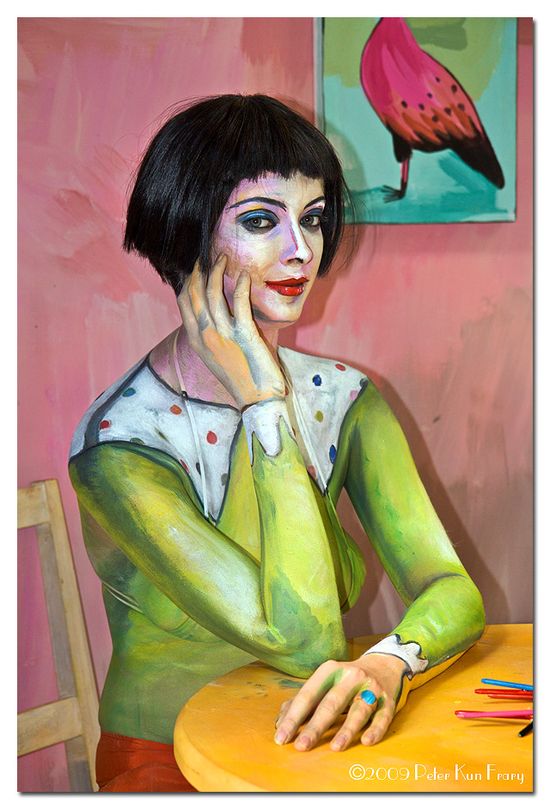
Makeup_girl1089

A photo of a model taken by Peter Kun Frary outside of a MAC cosmetics store at Ala Moana outdoor shopping center in Hawaii. Frary:

Although carrying a heavy SLR can be a drag, it's worth it when a great image leaps out and bites you on the arse. Recently I walked by the Ala Moana Mac cosmetic store and noticed a crowd of Japanese tourists gawking and snapping pics. Amazingly, a model in full body paint was posing against a set. She was a darn good simulation of a late 19th century oil painting. At first I though she was nekid–wearing only makeup–but she sported a few scrapes of cloth in the right places. Also, she hardly ever blinked…

(Hat tip: URLesque. More of Frary's work here.)