The Predictable Hazing Of Rand Paul (See: Ron)

Weigel shrewdly observes:

Before the younger Paul became a Senate nominee, he was an emissary for a brand of Republican politics less threatening than the Dick Cheney kind — anti-Fed, anti-war, pro-drug legalization. (Paul is not personally pro-drug legalization, but many of his supporters are.) After he won the nomination, it was open season on his more extreme politics.

We saw this happen in 2008 with Ron Paul. In December 2007, the New Republic ran a piece on Paul by Tucker Carlson, the most glowing of several fun pieces it ran about him. Weeks later, the magazine ran an exposé by Jamie Kirchick of racist passages in newsletters that went out under Paul's name. "If you are a critic of the Bush administration," Kirchick wrote at the top of his article, "chances are that, at some point over the past six months, Ron Paul has said something that appealed to you." Hint, hint — it was fun to indulge the libertarians for a while, but the time had come for good liberals to take them seriously.
Curmudgeon Of The Day

"As I sit through my third commencement in two weeks, I note, somewhat dyspeptically, that these affairs now combine the sartorial splendor of the medieval university with behavior adopted from the rowdiest of high-school basketball games. When did it become socially acceptable for adults to shriek like banshees when their graduate’s name is announced? There seem to be no ethnic, racial, or class identifiers of this obnoxious and idiotic behavior: with rare exceptions, just about everyone does it.

The award of a degree ought to mark a point of passage into adulthood. Parents, siblings, and friends who understand that might want to stop acting like berserk adolescents on these occasions," – George Weigel.

(Couldn't agree more.)

The Wealth Of Presidents

Douglas A. McIntyre, Michael B. Sauter, and Ashley C. Allen calculate the net worth of all 43 commanders-in-chief, ranging from less than $1 million to around $1 billion. The good old days:

From Fillmore to Garfield, American presidents were distinctly middle class. These men often retired without the money to support themselves in a fashion anywhere close to the one that they had as president. Buchanan, Lincoln, Johnson, Grant, Hayes, and Garfield had almost no net worth at all.

They Still Don’t Get It, Ctd

A reader writes:

I appreciate what you're saying about sexuality being a pertinent question, but here's something to consider. I'm a woman in a committed relationship with another woman.  If someone were to ask me if I'm gay or straight, I'd say I'm straight.  I suppose technically I should label myself bisexual, but until I fell in love with this woman, I'd never even been attracted to another woman before. And I don't think I'm alone in this experience. Maybe Kagan is in my category.

Believe you me, this is tough to explain to even the most understanding audience.  So she says she's straight and this woman pops up; that makes her a liar.  So she says she's gay or bisexual and is untrue to her own experience of herself; that puts her in her own kind of closet.  We've finally gotten more-or-less to the point where gay or straight is a non-issue, but what if yes or no doesn't really answer the question?  That's what I see when I see the knots people are in over her sexuality. 

You're writing powerfully from your experience of growing up understanding you're gay and making that known.  But for me, my same-sex relationship was a "small, final detail" that I came to in my 30s.  Does it color my experience?  You bet.  Is the question worth asking?  You bet.  But the answer may not be as clear-cut as "are you or aren't you?"

I do think my own experience of sexual orientation is limited in so far as it is about male sexual orientation, which seems to be much more binary and rigid than female sexual orientation. But I think being in a committed long-term relationship with someone of the same sex does not suggest heterosexuality.

One of my oldest lesbian friends would always answer: "I reject labels." That is a salient answer. It's just not the one Kagan decided to give. Or Obama apparently wanted to hear.

A British Realignment?

CAMERONAndrewParsons:Getty

Martin Kettle reads the life line of the British coalition:

There may be coalition tears before bedtime. But, if not, there is an intriguing alternative. Four years down the line, if the economy is reviving and the liberal programme is secured, will the coalition partners run against each other in 2015, or will they be tempted to run for the coalition's re-election? An electoral pact to support one another under the alternative vote system would make a lot of sense. If that happens, then the May 2010 political realignment could last for a decade and more.

Massie nods. What has struck me is the evident delight both leaders exude in forming and presenting this deal. Why? They won't say this in public, but the election result hit a sweet spot for both men. Cameron has a trump card against his own right wing, and is obviously happier debating with Liberal Democrats than with ornery Euro-skeptic back-bench Tories. Clegg gets a chance to govern and reform, and doesn't have to return to the perennial bearded backwater of Lib-Dem fractiousness.

In other words, Clegg has done for the Tories what Blair did for Labour and Cameron tried to but couldn't quite achieve for the Tories. He has re-branded the party by association. Without Cameron, it would never have worked. With Cameron, it's a strangely perfect and unpredicted match. For Whiggish Tories like me, who want a balanced budget, civil liberties, de-centralization and a strong environmental policy, its hard to think of any other formula that would have delivered that result more comprehensively. And yet few of us saw it coming.

The Clegg-Cameron team reminds me a little of the young Clinton-Gore team in 1992. It's more than the sum of its parts. 

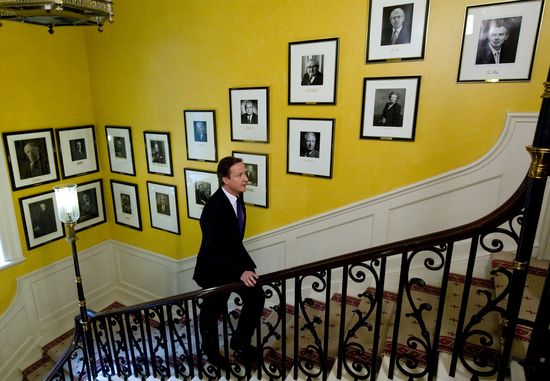
(Photo: David Cameron climbing the stairs in Downing Street. By Andrew Parsons via Getty.)

Outrage Isn’t A Cognitive Deficit

Chait responds to Peter Beinart by struggling to agree with him on everything, while distancing himself with more pop-psychoanalysis about Peter being "bug-eyed with alarm." I know this technique – you call the straight ones "over-wrought" and the gay ones "hysterical." But world-weariness is not an argument.

Beinart's essay has broken through – despite underground smear tactics against Peter by AIPAC (yes, I've read the ad hominem emails). It has done so not because it is not open to dispute or debate or more nuance. It has done so because there is too much truth in it to ignore. 

So when does the Wieseltier hit-piece come out?