An early victim.
Month: May 2010
What Rekers Represents
I have not dwelled on the Rekers scandal, because the man is a human wreck. But the wreck is instructive. Sometimes I wonder how much of the most aggressively anti-gay campaigning is done by closeted and tortured gay men, who seek to extirpate from others something they could not banish from themselves. The list of the closeted gay-baiters is long. From Roy Cohn and J Edgar Hoover all the way to Larry Craig and George Rekers. I have no doubt that the primary anti-gay forces in the Vatican are gay themselves, and working out their tortured psyches by demonizing others more honest and principled than they are.
These are men terrified by their own inherent orientation, who equate it with emasculation, and end up, in some cases, raping children and in others, merely abusing them, to keep their own demons at bay. This is one exercize that Rekers imposed on a child who was acting effeminately:
In 1974, Rekers, a leading thinker in the so-called ex-gay movement, was presented with a 4-year-old "effeminate boy" named Kraig, whose parents had enrolled him in the program. Rekers put Kraig in a "play-observation room" with his mother, who was equipped with a listening device. When the boy played with girly toys, the doctors instructed her to avert her eyes from the child. According to a 2001 account in Brain, Child Magazine, "On one such occasion, his distress was such that he began to scream, but his mother just looked away. His anxiety increased, and he did whatever he could to get her to respond to him… Kraig became so hysterical, and his mother so uncomfortable, that one of the clinicians had to enter and take Kraig, screaming, from the room." Rekers's research team continued the experiment in the family's home. Kraig received red chips for feminine behavior and blue chips for masculine behavior.
The blue chips could be cashed in for candy or television time. The red chips earned him a "swat" or spanking from his father. Researchers periodically entered the family's home to ensure proper implementation of the reward-punishment system.
After two years, the boy supposedly manned up. Over the decades, Rekers, who ran countless similar experiments, held Kraig up as "the poster boy for behavioral treatment of boyhood effeminacy."
At age 18, shamed by his childhood diagnosis and treatment, Rekers's poster boy attempted suicide, according to Gender Shock, a book by journalist Phyllis Burke.
This kind of stuff kills people. And it's based on a lie. It's time we took a stand against tortured gay men abusing children to vent their own demons. In saying that, by the Wieseltier rule, I am dangerously propagating anti-gay tropes. But when the tropes are true in some cases, they are simply true.
The Failure Of The American Conservative Establishment
From the liberal wing, Peter Beinart has been challenging the AIPAC narrative; from the conservative wing, Conor Friedersdorf is demanding an end to politicized sophistry among the “conservative” intelligentsia:
Marriage, In Better Shape Than We Think?
Salon interviews Tara Parker-Pope, the author of a new book on marriage:
The 50 percent divorce rate is really a myth. The 20-year divorce rate for couples who got married in the 1980s is actually around 19 percent. Everyone thinks marriage is such a struggle and it’s shocking to hear that marriage is actually going strong today. It has to do with how you look at the statistic. If the variables were constant, then a simple equation might work to come up with the divorce rate. But a lot of things are changing. And it is true that there are groups of people who have a 50 percent divorce rate: college dropouts who marry under the age of 25, for example. Couples married in the 1970s have a 30-year divorce rate of about 47 percent. A person who got married in the 1970s had a completely different upbringing and experience in life from someone who got married in the 1990s. It's been very clear that divorce rates peaked in the 1970s and has been going down ever since.
Why We Like Stocks
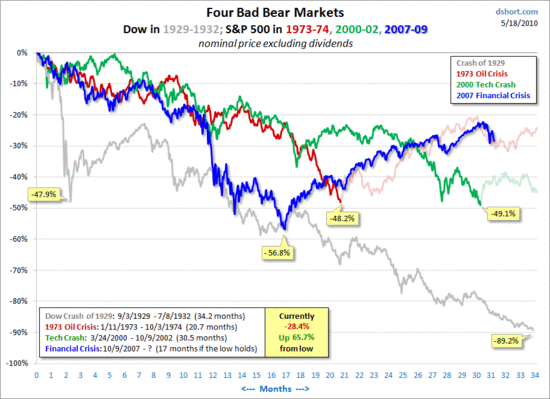
Felix Salmon continues to advise against investing in stocks. He acknowledges that most people won't heed his warning:
My feeling is that people like to invest in stocks because they like knowing that there’s a chance that the stock market will solve all their financial problems when it rises. Think of it as a three-pronged strategy: buy a house, invest in stocks, and work hard. Any one of these three things can pay off with lots of money at retirement, in the way that investing in TIPS won’t.
What’s more, an entire generation of Americans started working and saving and buying a house in the early 1970s — and millions of them hit the trifecta, becoming successful in their careers even as their stocks rose and the value of their real-estate soared. I doubt that particular combination is going to happen again in the U.S., but the experience of that generation is so powerful as to give a lot of people a lot of hope. Even if that hope isn’t particularly rational.
McArdle nods:
Modern retirement planning should probably focus more on putting away an unreasonably large chunk of your income.
Chart from Doug Short.
A Cost Benefit Analysis On Defense
Walker Frost wants to cut military spending:
Over the last decade, an admittedly small but most relevant sample size, any correlation between military spending and the prosperity of Americans, and non-Americans, seems negative. The relative slide in US power has, if anything, been accelerated by excessive military spending and record deficits. Our $900 billion budget is at least six times more than China’s defense spending, which is probably the greatest potential long-term counterbalance to US military dominance.
The opportunity costs are the real killer here. Military spending alone doesn’t necessarily detract from US power, though its irresponsible use probably does. But think about what we could have done with all that money, at time when unemployment hovers around 10%, budget deficits (state and federal) are out of control, high-school graduation rates are below 80%, and the US is ill-prepared for an impending energy and environmental crisis. Like it or not, these are the issues that will probably determine the fate of Americans and our national priorities. Not terrorists.
He ends the post by asking:
Why hasn’t this become a bigger issue for conservatives? Shouldn’t they be at the forefront challenging self-perpetuating, unnecessary establishment spending that doesn’t empower the people?
Guilty Of Being Gay

Malawian couple Steven Monjeza and Tiwonge Chimbalanga are convicted of “unnatural acts." BTB has more:
The Magistrate had denied bail to the couple, which is an extreme rarity for a non-violent crime. The Magistrate also permitted witnesses from the gallery and court personnel to abuse the couple during official court proceedings.
Their sentencing on Thursday could lead to 14 years of hard labor. Previous Dish coverage here.
Original Green
Kevin Redmon interviews Andres Duany,"the father of New Urbanism":
Our take on environmentalism is what I call the "original green." Which is really about quite simple, economical things. One thing I don't like about the current environmental movement is that it's been captured by a very high tech ethos, which actually turns out to be more expensive. I think its absolutely absurd that people say that LEED-certified buildings might cost two, three, four, five times as much. And I say, "What are you talking about? How did you get there?" This thing about triple glazing and 8 inches of insulation and green roofs, my God it's so expensive. You can't say, "Yeah, I'll do it just to be popular." We have to go back to the original green–not the gold plated green.
Drugs Win Drug War, Ctd
Steven Taylor continues the conservation:
[T]he key metrics that end up being used by the US government (as well as the UN and others focused on the supply side of the equation) are hectares under cultivation, hectares eradicated, amount of drugs seized, the price of the drugs in question, and arrests. These are not my metrics chosen to make the policy look bad, they are the metrics used by the designers and defenders of the policy.
As such, when I pointed out that from 1990-2007 that the wholesale price of cocaine has declined, the reason for doing so is to demonstrate that despite the considerable expenditure of taxpayer dollars that the policy is not achieving one of its goals. Price is indicative of supply. Yes, as some have noted, it is not the only factor. However, the basic parameters of the black market in drugs (which inflates the price by itself) were well in place by 1990 and there was reason to assume that the pressure placed on producers and traffickers over a sustained period of time would constrict supply. While there has been some, often temporary, effects on supply, the policy has failed to produce the desired results. Pay attention next time that there is even a small spike in price, and the likelihood is that the ONDCP or some other organization will cite it as evidence of drug war success.
The Daily Wrap
Today on the Dish, Patrick Winn reported on the violence in Bangkok and readers commented. Andrew sounded off on the new Iranian deal and looked inward over the Kagan controversy. More details on her emerged. Netanyahu did a good deed and the Church not so much. A big dose of Palin gossip here and a close scrutiny here.
In assorted commentary, Larison gave props to Rand Paul, Reihan was bullish on a conservative comeback, Douthat revised his case for decentralization, Ezra prodded him, Aravosis examined Obama's record on gay rights, Gary Wills conversed over his Catholicism, and Dave Barry talked about his craft. More on the Zionist crisis here and here.
Readers continued the "Treme" thread and bloggers did so for NYC's alleged tyranny. More life-and-death musings here, here, here, and here. A dispatch from the Cannabis Closet here. Cool ads here, here, and here. Stoner-and-bear blogging here.
— C.B.
 The Dish