The Existential Atheist, Ctd

A reader writes:

The full quote from Prem Rawat is as follows:

"Some people say, In this big universe, you're just a speck of dust.
You may be a speck of dust.
But oh, what a speck of dust.
In this speck of dust, the infinite and the finite are fused.
And you are the threshold of the two.
Here, the mortal being comes as close
 as it possibly can to the immortal.
The same power that drives the universe breathes us.
We have been chosen to be the platform for life."

Bell Curve Update, Ctd

Avent's sensible take on over-education:

Who do you suppose is feeling better about job prospects now: the 85% of mail carriers without college degrees or the 15% with them? In a volatile labour market, the flexibility of a credential is of crucial importance.

America's education system could certainly use more flexibility, particularly where adult education and retraining is concerned. But the American economy could use more college graduates, and the pursuit of flexibility shouldn't detract from the goal of increasing overall educational attainment.

He follows up here.

The Decentralization Push, Ctd

Ezra takes issue with Douthat's broad brush:

Douthat doesn't get into specifics here. Instead, he uses a rhetorical move that I've noticed fairly frequently among conservative commentators sympathetic to Obama's agenda but discomfited by the growth in government. "Taken case by case," Douthat writes, "many of these policy choices are perfectly defensible." Or, to put it in David Brooks's words, "Each of these projects may have been defensible in isolation, but in combination they created the impression of a federal onslaught." Taken case-by-case, those lines may be perfectly defensible. But together, I think you're seeing something less defensible.

It's a sentence that absolves the writer of having to say what he or she would've done differently, which makes broad-brush criticism a lot easier. "Centralization" sounds like a bad thing, and maybe it is. So does a "federal onslaught." But maybe not! Just as these decisions were made on a case-by-case basis, they have to be critiqued on one, too.

Faces Of The Day

CygnetsMattCardyGettyImages

Cygnets sit beside their mother who is nesting at Abbotsbury Swannery – the only publicly accessible colony of nesting mute swans in the world – on May 18, 2010 in Dorset, England. The arrival of the cygnets is traditionally seen as the start of summer and local traditions claim the Benedictine Monks who owned the swannery between 1000 AD and the 1540s believed the first cygnet signaled the season's first day. Abbotsbury Swannery's mute swans – up to 1,000 in total – are all free flying, and are not kept in cages. By Matt Cardy/Getty Images.

The Tyranny Of NYC, Ctd

David Schaengold protests:

What Conor is complaining about is just that we have a cultural capital. Admittedly, having a cultural capital can be galling for provincial cities, even if ours doesn’t loom nearly as large over our country as Paris or London or Toronto or Lagos or Buenos Aires, say, do over theirs. But this isn’t an unusual set-up. The concept has a wikipedia page. In fact, national cultures without such dominant cities, Germany for instance, are quite unusual and usually indicate a fairly late or incomplete degree of cultural unity. Is it really so terrible that we have one?

Mark Thompson agrees:

New York is not only our biggest city/metro area, it’s also always been our biggest city/metro area. This is important – for the amount of time that New York has been a major center of American population and business, it has been able to develop deep cultural roots from which to build. To complain as Conor does about the lack of cultural import of San Diego, Houston, San Antonio, Phoenix, and Dallas is to ignore the recency of their development. Until about 1950-1960, not a single one of those cities was even in the 20 largest American cities, much less the top 10, and none was even regionally dominant like New Orleans was.

Asking The Question

Last week, the Daily Beast ran a piece lacerating me for asking a factual question about the identity of someone about to assume enormous power over our lives. Monday night, the Beast ran an interview of Edie Falco by my friend Kevin Sessums. He asks about her addiction, her recovery, her depression, her adoption of two children, her cancer … but then he goes too far for many of the commenters on the blog. He asks about the character Falco is playing in a new play:

One is never sure if it is a substitute mother/daughter relationship for them or if they were lovers in jail.

I think it’s meant to be unclear.

But you do play it a bit butch.

Yeah, it’s begun to get more like that. And the words lend themselves to that. I mean, she’s been around the block a few times.

You do have a whole lesbian fanbase. You are aware of that.

I know. I’ve been told about that. It’s thrilling. Maybe it’s because my character on Nurse Jackie doesn’t take a lot of shit. Not that that means that’s a lesbian thing.

But they were your fans back during your Carmela days, too.

Really! Wow! Then I don’t friggin’ know why.

Have you ever buttered that side of your toast?

I beg your pardon! I am so not going there. Wow. I’ve never heard it put that way either. But no. I’m afraid I like boys.

Good for Kevin. If someone's entire private life is on the table except that, it's a function of homophobia. Period. A gay person is free to adopt such a homophobic veil; but a reporter need not enable it. So when does Benjy Sarlin write a piece on his own magazine's "ethics"?

Bangkok Burning, Ctd

A reader writes:

In your post about the mayhem in Bangkok you have a quote from a report by Patrick Winn where the word terrorist is put in quotes.  I do not believe it is improper to refer to the "red shirts" as terrorists. During protests last year the same organization of protesters hijacked natural gas trucks and threatened to blow up a mosque.  This occurred at Phetchaburi Road Soi 7.  I used to stay in a condo that my wife's family owns at Phetchaburi Road Soi 11.   (A soi is a smaller road off of a main road.)   Furthermore, the former general who was killed during a NYT interview recently had threatened an insurgency similar to what is going on in Southern Thailand, where Islamists have been waging a terror campaign for several years targeting teachers, schools, police and the military.  If that does not qualify them as terrorists I am not sure what does.

I might also draw your attention to two recent editorials in the Bangkok Post: "Red leaders all miscalculated and are losing" and "Put an end to this rebellion."

Another reader takes a different side:

I’m perplexed about the complete absence of any mention of “democracy” in the coverage of what is happening in Thailand.  The Red Shirts are motivated by the belief that Abhisit’s government is illegitimate, and from the standpoint of democratic principles, they have a strong case.

Whatever his ethical failings, and regardless of what one might think of his policy approach, Thaksin’s political difficulties stem from the fact that he posed a threat to the interests of the military and the monarchy.  The military intervened in 2006 to remove a government that unquestionably enjoyed a popular mandate, and the courts have twice dissolved parties connected to Thaksin on grounds that could just as easily be applied to Abhisit’s party.  A lawfully elected prime minister was smeared by the establishment as “Thaksin’s mouthpiece,” and ultimately was forced to step down because…no joke…he received compensation for an appearance on a televised cooking show.

The current government has no basis for claiming a mandate, and its legitimacy has been further undermined by a widespread belief that it was formed as a result of military pressure on the junior coalition partners.  The chief demand of the Red Shirts is the dissolution of the Parliament and the holding of an early election, which would settle the question of legitimacy.  Abhisit and his military sponsors have refused to accede to that demand because they fear (with justification) that Thaksin’s allies would win again.

The current battle will decide whether the people of Thailand will be free to choose their own leaders, or will be forced to accept as their leaders only those who are willing to safeguard the privileged position of the traditional establishment.  This is a classic struggle for democracy, and it is only right that it should be framed as such.

Bell Curve Update

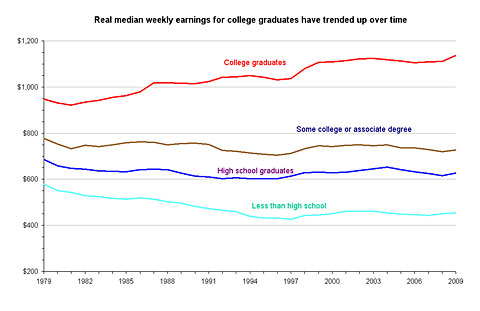
CollegeChart
Leonhardt examines the payoff from going to college. Daniel Indiviglio adds:

From this, college definitely looks like the right choice. But what does this chart actually show? Not that a college degree was necessary — just that employers prefer them. The value of a degree has become something of a self-fulfilling prophecy: it's become worth so much because people assume it should be.

Let's do a quick thought experiment. In the example above, it's not unrealistic to assume at least 10% of the jobs of "college graduates" didn't actually need the degree for the skills their job requires. Imagine if those 10% of individuals hadn't gone to college. There would still have been demand for the jobs that they took, so who would have got them? Easy — people without college degrees, possibly even the same ones. Just because college graduates earn more doesn't mean that their degree provides them any additional knowledge necessary to succeed in their jobs; it just means that employers found them more attractive because of the degree.

The Race In Kentucky

Larison applauds Rand Paul's fiscal austerity:

I want to make a few observations about the importance of Paul’s candidacy and the apparent failure of party and movement establishment figures to defeat him. First of all, Paul is one of a very few Republican candidates in the country who is truly serious in his desire for fiscal responsibility. In his hostility to expansive government and reckless spending, he does not make exceptions for military spending, and he is appropriately skeptical of government power whether it comes in the form of military adventurism and empire-building or sweeping social legislation and bailouts. Paul is the candidate of both austerity and peace, which is why he is particularly terrifying to David Frum, who has spent many years arguing for an agenda that values neither.

Josh Green is on the campaign trail with Paul:

Of the two major GOP candidates, Paul has been by far the purer: Trey Grayson wants to balance the budget eventually, but Paul wants to do it in a single year. Grayson wants to rein in earmarks without banishing them outright (Kentucky benefits greatly from earmarks, especially given McConnell's seniority), Paul wants to do away with them altogether. It's almost unfair to Grayson that this is costing him so dearly–he is being responsible in saying that the budget is not going to get balanced in one year (it's not), and he's looking out for the state's interests by wanting to bring home the pork. But it's clear, just as it was in Utah last week when Sen. Bob Bennett lost, that voters are angry and far more interested in a candidate who speaks in absolutes.