Portraying New Orleans

John McWhorter isn’t a huge fan of David Simon’s new series, “Treme”:

A main message from this sultry pageant of a show is that New Orleans is an occult matter that you can never truly “get” unless you’re a native or pretty close to it. The perky, hopelessly “white” tourists from Wisconsin with their nasal voices, the ones who get schooled by the street musician, can be taken as stand-ins for the viewer. Which makes the whole enterprise strangely unwelcoming. … What’s especially challenging is a damned if you do, damned if you don’t quality: criticize New Orleans, or even don’t pay quite enough attention, and you’re a chump—but praise it and you’re probably doing it wrong.

Ruth Franklin offers a sunnier take on the show, framed around the question, “When art is created out of catastrophe, where do we draw the line between inspiration and exploitation?”

Scenes From The Drug War, Ctd

Horton comments on the Missouri raid:

Another work that makes the case effectively is Bill Haney’s film American Violet, which was released one year ago but lamentably drew little attention. It tells the story of a twenty-four-year-old African-American mother of four whose life is turned on its head when she is caught up in a similarly absurd drug raid. The film offers an inside look at the American criminal justice system and shows how the tremendous power it vests in prosecutors can be horribly abused. It is based on events that actually occurred in Hearne, Texas, in the fall of 2000—one of a great number of “anti-drug” campaigns in Texas that were used as cover for racist harassment. While these campaigns were raging, George W. Bush was governor of Texas and John Cornyn was the state’s attorney general. Both distinguished themselves by their abject indifference to the abuse.

Balko gets an e-mail from a soldier:

I am a US Army officer, currently serving in Afghanistan.  My first thought on reading this story is this:  Most American police SWAT teams probably have fewer restrictions on conducting forced entry raids than do US forces in Afghanistan.

For our troops over here to conduct any kind of forced entry, day or night, they have to meet one of two conditions:  have a bad guy (or guys) inside actively shooting at them; or obtain permission from a 2-star general, who must be convinced by available intelligence (evidence) that the person or persons they're after is present at the location, and that it's too dangerous to try less coercive methods.  The general can be pretty tough to convince, too.  (I'm a staff liason, and one of my jobs is to present these briefings to obtain the required permission.)

“No Place In This Process”

SCOTUSMarkWilson:Getty

[Re-posted from yesterday.]

The White House position:

Senior White House adviser David Axelrod told reporters earlier this week that he and President Obama agree. A nominee's sexuality "has no place in this process," he said. "It wasn't an avenue of inquiry on our part and it shouldn't be on anybody else's' part."

The president's initial statement, describing why he picked Kagan:

Elena has also spoken movingly about how her mother had grown up at a time when women had few opportunities to pursue their ambitions and took great joy in watching her daughter do so. Neither she, nor Elena’s father, lived to see this day.  But I think her mother would relish this moment.  I think she would relish — as I do — the prospect of three women taking their seat on the nation’s highest Court for the first time in history.  A Court that would be more inclusive, more representative, more reflective of us as a people than ever before.

Let's move this debate off Kagan entirely. That issue remains closed here. She's straight.

But, as a general principle, if taking account of gender is part of creating a Court "more inclusive, more representative and more reflective of Americans as a people than ever before" then why does sexual orientation "have no place" in the process of selection?

I should clarify my own view. I do not favor the use of racial/gender/sexual orientation/religion identity as an official criterion for picking a Justice (it cannot but be a human factor in assessing people's lives and characters and experiences, but that's different). I think the criteria should be judicial competence and excellence and a person who reflects the sitting president's judgment about what kind of Justice he or she prefers. But if gender is an active and legitimate category to consider, why is sexual orientation out of bounds of even inquiry?

Or let me put it this way. I find Axelrod's casual bracketing of sexual orientation as somehow different – and lesser – than gender to be offensive. I don't think it was meant to be, and I think it was said out of a legitimate concern to be fair to people's privacy. But if identity matters in selecting a Justice, and if that identity is obviously a way in which nominees really do understand the impact of the law (and discrimination) on ordinary lives, and if all this has been explicitly stated by the president as integral to his vision of the Supreme Court, then why is sexual orientation off the list?

Of all minority identities in this country, gay people are currently dead center in a formative period of jurisprudence. Having a member of the court right there as a gay person would do a huge amount to shift the court's understanding and conversation about these topics. There have been women before, and Jewish Americans before, but we have never had an openly gay Justice before. This has to matter if we are to believe the president's own words on the criteria for his selection. It's offensive, in my view, to insist it doesn't. I know this comes from a well-meaning place. And it may well be that the diffidence with respect to this issue is a function of Kagan and Obama not wanting to seem to treat the issue as some kind of "charge" or negative. But we live in the world we live in. And they really should have known this. At this level of public scrutiny, the goal must be total candor and transparency from the get-go. There cannot be anything like code or winks or nods.

Total transparency matters, even if it does make the lives of public officials more difficult. It matters particularly now because in the current populist climate the last thing anyone should want is a nominee whose successful confirmation could subsequently be described as a function of some kind of deception.

In the paranoid mindset of the populist far right, it's enough for a nominee to be appointed as a blank slate within a coterie of Ivy League cultural elitists. But to seem to "sneak" a gay Justice on the court without being totally transparent about it would pour gasoline on this populist culture war fire. This does not apply to Kagan. But it could apply in future and we should try and figure out what lessons to learn from his confused kerfuffle. One of them is simply candor.

And less fear, please.

(Photo: Mark Wilson/Getty.)
By The Foot

Christopher Leinberger looks at housing trends:

Housing comes in two basic types. The first is the now-classic Ozzie and Harriet–style single-family house on its own large lot, from which nearly every trip is taken by car. The second is similar to what we predominantly built before the Great Depression: small-lot single-family houses, townhouses, and apartments that are within walking distance of most everyday needs and are typically connected by public transit to work, shopping, and entertainment—housing that is built at least five times more densely than that in conventional suburbs.

Ten years ago, conventional large-lot housing in wealthy suburbs was the highest-priced housing, per square foot, in nearly all metropolitan areas. Today, housing in walkable neighborhoods is typically the most expensive; the lines crossed in the 2000s.

“Porn Has Become De Facto Sex Education”

TED captions this NSFW talk:

At TED2009, audience member Cindy Gallop gave a 4-minute presentation that became one of the event's most talked about. Speaking from her personal experience, she argued that hardcore pornography had distorted the way a generation of young men think about sex, and talked about how she was fighting back with the launch of a website to correct the myths being propagated.

Gallop also points to several stats compiled by Michael Castleman. Money quote:

Why would social ills decline as porn becomes more widely available? No one knows. But the one thing porn really causes is masturbation. Internet porn keeps men at home one-handing it. As a result, they're not out in the world acting irresponsibly – or criminally.

Askers vs Guessers, Ctd

Julian Sanchez weighs in:

I’m fairly solidly in the Guesser camp on the whole—though I can’t hold a candle to my late maternal grandmother, a paragon of New England reserve.  As was explained to me before one of her visits as a young child, I should not expect her to be so unspeakably gauche as to ask that I “please pass the potatoes” (say) during dinner. One might as well just leap on the table and plunge one’s head directly into the bowl. No, if the potatoes were down at my end of the table, she would say something along the lines of: “Oh, do have some potatoes” or “Have you tried the potatoes?”—it being understood that the civilized response was “Oh, no, you have some.” As I say, I don’t take it quite that far, but I do think I internalized the association between civility and indirectness.

Outlawing The Burqa, Ctd

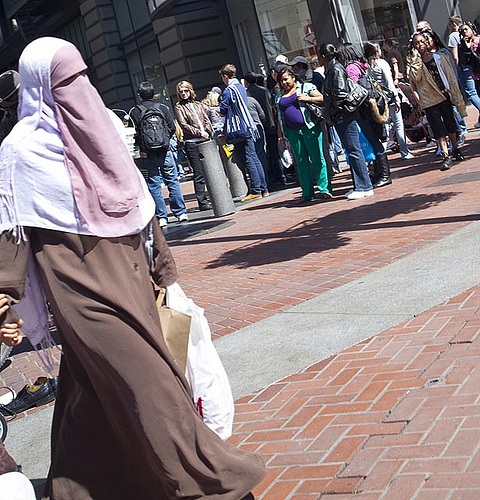
3571668853_1b8ea03d88

The campaign isn't confined to France. In Australia, an armed robber who used a burqa as a disguise has kicked up a political storm. In Belgium, the lower house of parliament recently voted 136-0 to outlaw veiled garments. In Italy, where face-covering has been illegal but unenforced since the '70s, a woman was just fined for the very first time. Alex Wilhelm wades through the debate:

For the Italian woman mentioned above, the fine for her attire (a steep 500 Euro) is the least of her concerns. Her husband has decided that if she cannot wear the burqa outside, then she cannot go outside. The woman is now effectively under house arrest for committing no crime. She will not be able to go outside to take a morning walk or an evening stroll. Her sentence is life in prison. […B]anning the burqa as an ancient hulking relic of sexism can backfire and take away what modicum of freedom that these women had enjoyed previously.

Below is more commentary and firsthand experiences from readers. One writes:

I am a modern, liberal, Muslim woman who has never worn a scarf on my head, let alone burqa. There is nothing Islamic or religious about it.

There may be some idiotic women who choose to wear it because they don't want others to look at them but please, they need to grow up and be a part of western society if they want to live here. Men in Pakistan (where I am from) are crazy and often sex-deprived and I can understand why some women would want themselves covered and not get stared down by scary men in public places. My understanding is that Islam says don't attract undue attention toward yourself and dress modestly. But in western society, they are attracting undue attention to themselves by wearing this burqa. I just don't get why these people are incapable of thinking and take the Quran so literally.

Another:

One of your readers said that the burqa communicates and reinforces the idea that "women are dangerous and that they belong to men.  It says 'you are allowed out of the house only if no one can see you.  Only if you are invisible.'" But this is only part of what it communicates. It is not only a religious symbol, but a traditional one as well. Its traditional importance is to communicate and reinforce the idea that men are uncontrollable sexual beasts who must be kept from seeing the female form in too much detail lest he, understandably, lose control over himself and act out his desires. It's something of a preventative measure for the sake of the young woman's honor and, often times more importantly, the honor of the family.

I'm an American living in a Muslim country for over two years now and have had this explained to me by both men and women again and again, and it never makes any more sense. Otherwise respectable men will go on about how they just doesn't know what they would do if they saw an overly exposed woman, and how this is just part of our nature. My response of "You're a man, be one, control yourself," is shrugged off as naive.

As it has been explained to me in the past, feminism is not only for the improvement of the status and understanding of women, it is also for the improvement of the status and understanding of men. Men are hardly the victims in this situation, but views on masculinity are definitely linked to this issue and need to be brought up.

Another:

I live in Minneapolis and spent a lot of time during the last few years volunteering in adult basic education classrooms, where our students are primarily learning English, and many of the attending are Somali women, all wearing a burqa or hijab.  The women I've worked with are smart, passionate, engaged with learning about their new country and home.  Usually I'm a very cynical – came of age during the Bush years and all – but these women absolutely inspire me with their firm belief that America is about freedom of expression and opportunity.  It's incredible.  They don't fit the stereotype of a Muslim woman who has no identity and is indoctrinated to believe in her own subjugation.  I never saw one of the shirk from a man during an argument in class.  They wear their traditional dress and want to enroll in business classes.  They hope their daughters go to med school.  But they still hold to their religion, it's deeply important to them, and are keenly aware of the choice they're making. 

This blew my mind as a young feminist in college. I was so surprised to find such strong women when I started teaching English.  If a ban on burqas was ever proposed in my city, I'd be the first protester in line.

(Photo by Flickr user deepchi1)