“An Exquisite Curator Of Her Own Career”

A reader sharpens my point:

The experience of failure, not the embrace of risk, is the missing element in Kagan's biography.  You wrote that you were concerned because she had never once taken a risk during her life.  That standard recommends Evil Knievel rather than Elena Kagan for the Supreme Court.

What is striking to me is the disconnect between Kagan's life experience and Obama's stated desire to add someone to the court with life experience.  Most people I know have suffered from failures and setbacks.  Indeed, most people find such adversity to be a path towards wisdom, self-knowledge, self-improvement, and even compassion for others.

Consider, for instance, that Justice John Paul Stevens was shaped by his family's bout with failure and prosecution.  Indeed, that experience shaped Justice Stevens' approach to criminal law and federal power.

The greatest figures in American history have overcome failures and adversity.  Lincoln lost several political campaigns.  Franklin D. Roosevelt lost a vice-presidental election and was afflicted with polio.  And though Obama has not entered these ranks, it is notable that he, too, tasted political failure before rising to the presidency.

And Kagan?  Nothing but a gilded path.  Like the Chief Justice John Roberts – the "compassionate" jurist who supposedly calls ball and strikes but has never experienced being called out – the only "failure" on Kagan's resume is a nomination for an appeals court slot that expired for lack of a Senate vote.  Never fired, never rejected, never sick, never (so far as we know) even spurned in her personal life.

The Supreme Court can do without failed people and without mediocrities.  But it should not do without people who understand that suffering and setbacks are central to the human experience. 

I think the Kagan nomination really rips off the bullshit of the "life-experience" argument that Obama has deployed (and manifestly failed to substantiate in the case of his second pick). Compared with Sonia Sotomayor or Clarence Thomas, Kagan is a very privileged member of a very privileged elite she has done everything she can to placate and flatter at every turn.

My provisional view is that she is, in fact, probably far more left-liberal in terms of enabling the federal government to reshape the lives of Americans than is currently understood. I don't buy Sean Wilentz's argument that she was once fascinated by socialism out of scholarly disinterest. Where left-liberal executive power is concerned, she's Obama's redistributionist enabler over the long run. I suspect she is a calculated check on Roberts – and as radical as he, on the other side. Her family and background are obviously saturated in left-liberalism. She has the chops. But her ultra-caution is an almost text-book case of the quite march through the institutions, beloved of the left whence she comes. That makes a robust grilling of her positions all the more important. After all, she asked for it.
Safe To Vote Against Her?

Josh Green suggests another reason that Kagan will get fewer votes than Sotomayor: race. Ramesh's logic:

She will get fewer votes than Sotomayor. But I suspect ethnic politics is a bigger factor than the mood of conservatives. Several Republican senators didn't want to vote against the first Latina nominee. They're not going to have a similar reason to vote for Kagan. Moreover, they probably don't want to explain why they voted against Obama's liberal Latina nominee but for his liberal non-Latina nominee.

Is non-Latina now code for Jewish? Careful now. The Foxman cometh.

Tragic Atheism, Ctd

Drum responds to Linker:

[T]he prospect of a Godless world is more salient for some than for others. Nietzsche wrote about this in the broader cultural sense…and Linker talks about it later in the personal sense: "There are no disappointments recorded in the pages of [New Atheist] books, no struggles or sense of loss. Are they absent because the authors inhabit an altogether different spiritual world than the catastrophic atheists?" Speaking for myself: yes. I have never in my life felt the need to believe in God, and that lack simply doesn't inspire any emotional resonance in me. I don't know why this is, but I do know that I don't feel empty inside, I'm perfectly capable of feeling wonder and awe, and there's no sense of loss or anything else involved in any of this. Linker might regard that as unfathomable, finding the tortured brooding of the catastrophic atheist more to his liking, but it's so. And I have no idea how you discuss this. Linker feels the pull of the supernatural and I don't, and all the conversation in the world won't change that or make it any more explicable.

I totally respect Kevin's position, even though I could not share it if I tried. If I may intrude, and ask a questoin I do not mean to be loaded, just curious: I wonder what Kevin thinks happens to him when he dies? And how does he feel about that – not just emotionally but existentially? These questions can be addressed without talking of God. And yet they reveal something about what it is to be human.

The Oversharing Backlash

Jessica Grose follows the abstinence arc of former sex blogger Lena Chen:

People just a micro-generation younger than Chen are wise to the downside of overexposure and already seem less inclined to reveal themselves. According to a recent Pew study on Internet habits, only 14 percent of teens now blog, down from 28 percent in 2006. Even on social networking sites like Facebook, millennials are becoming protective of their privacy: Most have put privacy boundaries on their online profiles, and a New York Times article from last month discussed the lengths to which striving high schoolers go to keep their Facebook activity hidden from college admissions officers. Just this past weekend in an article called "The Tell-All Generation Learns to Keep Things Off-Line," the Times discussed the myriad ways in which teens are keeping their online profiles squeaky clean.

Just A Kiss

Mf0d8341c730253ef0133ed710e95970b-800wi

TDW jumps aboard a new cause:

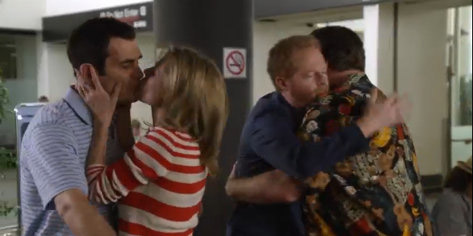
Not a single episode of ABC’s uproarious new sitcom Modern Family goes by that I don’t find myself ranting and raving over the pseudo-progressivism of having an openly gay couple on a primetime TV show, and going out of your way to avoid having them show real-world physical affection toward one another. Happily, I am not alone in my diatribe: A Facebook campaign was recently launched to convince ABC to let the adorable duo smooch to their hearts’ content on national television. […It's] about recognizing that when two people are in a committed relationship, they kiss each other on the lips.

Good As You, which provided the screenshot, still finds the show "funny, sweet, progressive, and genuinely pro-family (no quotes)." The shot is, perhaps, a perfect distillation of where the culture now is on gays: fine but not equal.

What Would Voting Reform Mean?

VotingReform

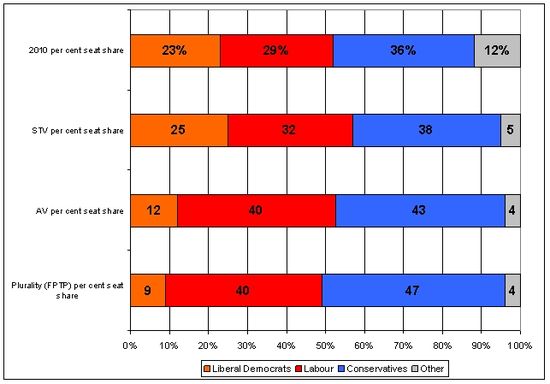
LSE explains various voting systems and provides the graph above showing how they would have changed the 2010 British election. More clarity here. As I understand the current Con-Lib referendum plan, it would be a move to AV, slightly increasing Liberal representation, and slightly reducing Tory representation. I'd vote for it. I care about maintaining a one-member-one constituency relationship. But I do think it has become deeply unfair under the current rules, and it's time for a change.