An Animated Short For Mothers, Ctd

A reader writes:

I've been a reader for a few years now, but this one post is the one I'll remember when I think about how special your blog is. However, it should have come with a NSFW warning – tears are streaming down my cheeks as I type this, face averted so the boss can't see. I have a 14 year old with Asperger's and this son could be mine and this mom could be me.

Another writes:

Thanks for running this.  I lost my mother when I was 7.  My father died three years later. I lived in an orphanage in Chicago from shortly after my mother's death until I was 12. They didn't have a syndrome name for it back then, but I was a shy boy. I'm 54 now, married, no kids. After watching that piece two things occurred to me: I couldn't remember ever having that kind of conversation with a female elder in my life. And I had forgotten what it was like to have a mother.

And that brought me to tears.  Belated happy Mothers Day.

The Soul

Stephen Asma tries to get a handle on it:

[T]he soul is meaningful to many of us without any scientific verification of its existence.

That is not the same as just having faith in the soul despite a lack of evidence. I'm not suggesting that familiar view. What I'm suggesting is more sly—the soul can be deeply meaningful whether it exists or not, and it can be deeply meaningful even if you disbelieve in its literal, metaphysical existence. That is not the usefulness of fictions and delusions. It's the usefulness of an expressive folk language that can't be replaced by a scientific language.

Picturing Disaster, Ctd

Oilcoverage

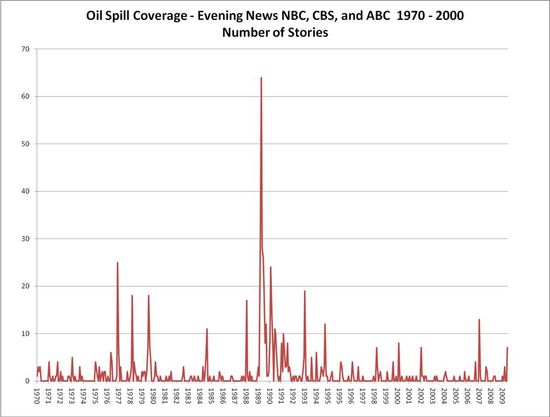
Contra Jesse Smith, Plumer argues that there aren't enough pictures of oil-covered birds:

After the Exxon Valdez disaster, you had scores of images of ducks and otters slathered in crude. There were pictures of dead whales washed up against gleaming black rocky beaches. It was lurid—and impossible to ignore. By contrast, [Drexel sociologist Robert Brulle] points out, not a lot of oil from the BP has reached the shores of the Gulf Coast yet. Even groups like Greenpeace have only been able to rustle up a handful of pictures of a few of ducks covered with a little bit of oil. That's not the sort of thing that drives TV coverage. And it may mean that the current spill makes far less of a dent in public opinion than past disasters have.

Now, part of the explanation here is that BP has been quite deft at managing appearances. For one, they're using hundreds of thousands of gallons of chemical dispersants to break up the oil before it can reach the beaches, causing it to sink down to the sea floor. In some cases, these dispersants could be more harmful, ecologically speaking, then letting the oil wash ashore. We don't know what's in these chemicals and there's a very high potential that they could do a lot of damage to the food chain in the Gulf. Indeed, that's why Exxon was constrained from using dispersants in Prince William Sound back in 1989. But, from BP's perspective (and the Obama administration's), avoiding the sort of graphic imagery that Exxon had to deal with in Alaska seems appealing.

Dissents Of The Day

More uproar in the inbox over Kagan, this time for "The Purity Of Her Careerism." A reader writes:

Since when does taking risks make someone a good judge?  Judges are tasked with determining outcomes based on a clear interpretation of facts as it applies to the law.  To expect a judge, especially a judge on the highest court in the land, to take risks completely misunderstands both the position and the law.  Your qualms that Kagan did not stake out any controversial or even clear cut positions politically actually makes her more appealing as a judge, not less. Passion and risk have always been the opponents of a proper application of the law, going all the way back to Aristotle.  And it should remain so today, even if we insist on politicizing everything else.

Another writes:

Your qualms about Kagan are easily distilled: you wish she acted more like a blogger.

Another:

I think you are wrong about her. I listened to a Toobin interview and I was gobsmacked by one line: "She got along with everyone in college." Now I don't know about your college, but my college experience involved passionate intellectual duels with fireworks and explosives over competing ideas. I think that is why Obama wants her. After all, he was the same way at Harvard Law. And didn't you endorse him because of it?

Another

You indicate that you felt uneasy about the fact that she had wanted to be a Supreme Court Justice since childhood.  However, back during the 2008 election campaign, when Republicans were criticizing Obama’s “careerism” for just the same thing (writing an essay in grammar school about wanting to be President), you lambasted them for being unreasonable.  I think you’re being inconsistent here.

Another:

As for her "careerism", it's a bit unfair to say she has never made any hard or isolating decisions in her career.  What about her desire to bar military recruiters from campus for which she is now taking flack, or for pushing to hire more conservative faculty at Harvard? But the real unfairness in this criticism is that her nomination to serve as a federal appellate court judge was blocked by Republicans a decade ago.  She WOULD have made many decisions by now, and left a paper record for conservatives to dissect, if she was confirmed to the job that she was obviously qualified for and desired at that time. 

Another:

What risks were taken by Roberts and Alito?  Is that really the standard?  And where did they experience professional life outside of the same type of East Coast elite community that you and Brooks discuss?  The only difference is that they were conservative and she is not.  Roberts and Kagan's careers are almost eerily similar in their progression — Harvard, presidential administration, nominated young for circuit court and being held up by politics, pursuing other highly abstract career (appellate lawyer at fancy firm vs. HLS dean), time in SG's office.  I think that a test is being written for Kagan that is very different from what has been expected of other nominees.

Another:

Living a life, particularly as a minority woman even in liberal corridors of power, does not necessarily get you confirmed for any jobs, let alone with the Supremes.  In fact, the past few hearings have been nothing if not a fuzzing and fudging of the candidate's life and opinions to make them more palatable for the confirmation process and the Senate.  I say this not as a PC attempt to cry victim on behalf of women lawyers and judges. But the fact is, there have been only three women Supremes compared to how many men?  It is a different playing field for women in the law, one that does particularly reward radicals or even strong opinions.

The Right And The Debt

Cameron should be an example here. For all the reasons David Leonhardt lays out today and Jon Chait patiently explains here, we need to make stiff entitlement and defense cuts – but we must also raise some taxes. The debate should not be whether but how – and I agree with Jonah that tax simplification should be the spoonful of sugar to make the medicine go down. It's time to end the supply-side craziness, the tea-party looniness and the ideological fixity of Bush-Cheney economics. Obama needs bipartisan support to do the conservative and responsible thing. Which means that the real war for this country's future must be waged within the GOP. I fear, alas, that war is already being lost in the thickets of Southern populism. So the damage that today's Republican party can still do to America's future remains as real as the wreckage it has already accomplished.

Will Google Help Save Journalism?

From Fallows's cover story, which is worth reading in full:

Online display ads may not be so valuable now, [Neal Mohan of Google] said, but that is because we’re still in the drawn-out “transition” period. Sooner or later—maybe in two years, certainly in 10—display ads will, per eyeball, be worth more online than they were in print.

How could this be? In part, he said, today’s discouraging ad results simply reflect a lag time. The audience has shifted dramatically from print to online. So has the accumulation of minutes people choose to spend each day reading the news. Wherever people choose to spend their time, Mohan said, they can eventually be “monetized”—the principle on which every newspaper and magazine (and television network) has survived until today. “This [online-display] market has the opportunity to be much larger,” he said. It was about $8 billion in the U.S. last year. “If you just do the math—audience coming online, the time they spend—it could be an order of magnitude larger.” In case you missed that, he means tenfold growth.

Another Cartoon Attack

Radio Free Europe has details:

Lars Vilks, a Swedish cartoonist whose sketch of the Prophet Muhammad enraged many Muslims, was head-butted today while giving a lecture about freedom of speech. Vilks, who depicted the Prophet Muhammad with the body of a dog in 2007, said he was assaulted by a man sitting on the front row as he spoke at the University of Uppsala, about 70 kilometers from Stockholm. A spokesman for the Uppsala police said about 20 people tried to attack Vilks after interrupting his lecture, adding that the police had to intervene to stop them.

Hamilton Nolan fumes:

The fact that so many American media and academic institutions have caved into the imagined fear of such religious fascists is shameful. If the free societies of the world can’t stand up for a person’s right to draw a fucking cartoon without becoming the victim of a multinational assassination plot, well, we lose. And if people’s faith in their god is not strong enough to allow them to laugh off and dismiss an offensive little drawing, they lose.