by Chris Bodenner
Palin is off to climb a non-existent mountain peak.
by Chris Bodenner
Palin is off to climb a non-existent mountain peak.
by Patrick Appel
This Noah Millman post is excellent:
I don’t actually expect revival of full-throated anti-interventionism on the American right, something like the pre-World War II America Firsters. I don’t think even Daniel Larison expects that. But some kind of tendency to counter militarism is necessary, and right now, with Sarah Palin and Mitt Romney trying to outdo each other in their appeals to the militarist tendency on the right, I kind of despair of any counter-dynamic getting traction.

by Chris Bodenner
Lauren Indvik explains:
Passersby can use their smartphones to snap a picture, which will pull up an exclusive, 40-second commercial featuring models Lara Stone, “A.J.,” Sid Ellisdon, Grayson Vaughan and Eric Anderson. After the spot plays, viewers can then share the code with their Facebook and Twitter networks. The billboard marks the official premiere of Calvin Klein Jeans’s Fall 2010 advertising campaign.
by Chris Bodenner
Dana Goldstein looks at the possibility:
Experts expect the Department of Health and Human Services, led by pro-choice Obama appointee Kathleen Sebelius, to spend the next six to 18 months researching women's health before releasing new guidelines for women's "preventive health care." Under the new law, services and medications defined as "preventive" must be offered to customers of new insurance plans free of co-pays—whether that insurance is employer-provided or purchased on the individual marketplace, whether inside or outside of the new, subsidized health insurance exchanges.
So does Tracy Clark-Flory:
It's yet to be decided whether birth control will be one of those services — even though the so-called Mikulski amendment was intended for that very purpose — and experts say it's unlikely a decision will be reached by late September when the rule goes into effect. (No rush — I mean, the outcome only potentially impacts the estimated 3 million unplanned pregnancies each year.) … Not only do planned pregnancies tend to result in healthier children, but fewer unplanned pregnancies mean fewer abortions. That's something everyone can get behind, right?
Of course not.
As you might recall, roughly a year ago, abortion became the focus of the Senate debate over the Mikulski amendment. Despite the fact that the amendment focused specifically on contraception, conversation nonetheless turned to Planned Parenthood and the possibility of required coverage for abortions. Normally, I would flippantly point out the inappropriateness of treating Planned Parenthood as a synonym for abortion, seeing as the vast majority of the care the organization provides is preventive — but it's exactly that disagreement over the definition of preventive care that is at issue here. It might appear that birth control is obviously preventive — it prevents pregnancies, end of discussion — but many anti-abortion activists believe that contraceptives that can prevent a fertilized egg from implanting are actually abortifacients.

by Patrick Appel
Argentina became the first Latin American nation to legalize same-sex marriage at about 4 am this morning. The list:
2001 Netherlands
2003 Belgium
2005 Spain
2005 Canada
2006 South Africa
2008 Norway
2009 Sweden
2010 Portugal
2010 Iceland
2010 Argentina
(Image: A girl spray paints figures of male and female couples in front of the Congress building during a demonstration supporting the gay marriage bill, while Senators discuss said bill on July 14, 2010. By Juan Mabromata/AFP/Getty Images)
by Chris Bodenner
This reader responds to Savage:
I don’t and didn’t mean to make moral judgments about sexual non-monogamy. If I were making moral judgments, they would be about honesty, trust or lack thereof, abusiveness of various kinds, etc. I ended my comments with “More power to them,” which Dan Savage seems to have missed or chosen to ignore. It wasn’t meant sarcastically.
One point I was trying to make, and perhaps didn’t make very well, was that sexual monogamy is something of a red herring. Other readers who wrote in with stories of making non-monogamy work — whether in practice or, so far, just in theory — included what I came to think is the crucial element: what I call monogamy of decision-making. For me, sexual non-monogamy was the apparent problem, but it was lack of clarity and consensus about what the relationships really were that was the real problem.
I don’t suppose Dan Savage has any intentions of shutting up; why should I? In my earlier years, it was the non-monogamists who wouldn’t shut up about how superior open relationships were. I could spend the rest of my life talking about this without redressing the balance.
by Chris Bodenner
Litbrit's rebuttal of Weigel is the most comprehensive I've seen.
by Chris Bodenner
The aspiring senator from Nevada has become a keen disciple:
David Brody: I just want to understand. You’re saying that you’re not willing to play this mainstream media “gotcha” game basically? Is that what you’re saying?
Sharron Angle: No. There’s no earnings for me there. We’re looking at how can we best benefit from the media. We get so many requests. I do sometimes 7 interviews a day so it’s not like we’re running from the media. It’s just that we’re earning with that media.
David Brody: Not to harp on the point but when you’re on Fox News or talking to more conservative outlets but maybe not going on “Meet the Press” or a “This Week”, those type of news shows, then the perception and the narrative starts to be like you are avoiding those mainstream media outlets.
Sharron Angle: Well, in that audience will they let me say, "I need $25 dollars from a million people, go to Sharron Angle.com, send money?" Will they let me say that?
Steve Benen shows her in action:
Angle chatted with Fox News' Neil Cavuto this week, and the very first words that came out of her mouth were, "Well, first of all, Neil, it's great to be on your show to talk about this campaign against Harry Reid who needs $25 million — and I have been saying I only need a million people to send $25 to SharronAngle.com." Eric Hananoki notes that Angle "also made fundraising pitches on Hannity and Fox & Friends."
Whether Sharron Angle could function as a United States senator is unclear, but her future as a televangelist appears bright.
by Patrick Appel
I'm not sure what to make of this:
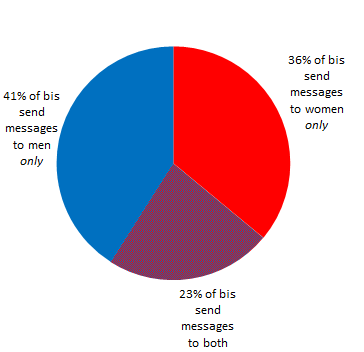
OkCupid is a gay- and bi-friendly place and it's not our intention here to call into question anyone's sexual identity. But when we looked into messaging trends by sexuality, we were very surprised at what we found. People who describe themselves as bisexual overwhelmingly message either one sex or the other, not both as you might expect.
This suggests that bisexuality is often either a hedge for gay people or a label adopted by straights to appear more sexually adventurous to their (straight) matches. You can actually see these trends in action in the chart below. Again, this is just the data we've collected. We'd be very interested in our bisexual users' thoughts on this single-sex-messaging phenomenon…
by Patrick Appel
A reader writes:
As a hardcore meat-eater who recently went vegetarian, I wanted to chime in on this debate.
Until January, I was eating meat at least once a day, usually twice, and never in small quantities at a time. I always admired vegetarians, but I never thought I could handle it myself. Even six months into this new diet, I have never in my life eaten a salad.
But early this year, I moved from Philadelphia to Georgia and in doing so decided to give this whole vegetarian thing a shot. I had to start a new routine anyway, so I figured I would see how long I could last without meat. Prior to this, I genuinely cannot remember the last time I went more than two or three days without a piece of flesh. My plan was to see if I could last a month, and then eat meat a couple times a week. It is now July, and even as barbecue pork and fried chicken abound in this carnivore's paradise, I haven't had a bite of meat.
I get cravings now and again, but it's always for stuff like wings or chicken fingers or burgers. And that's sort of my point: I quit meat not for ethical reasons (which I mostly empathize with but find murky in general) but for health reasons.
I've had high cholesterol since I was first tested in high school, and while increased exercise, medicine, and minor dietary modifications all helped, I needed to do something dramatic. Meat was a big reason my cholesterol was as high as it was. I know there are other health concerns that stem from cutting out meat (like iron and B12 deficiencies), but I've taken steps to ensure those are taken care of (namely, by not going full-bore vegan yet).
Anyway, I'm still shocked at how easy this has been, given how much I like meat. I definitely take issue with the claim that vegetarians don't typically like meat in the first place. I've found — in my case, and in the case of most of my meat-eschewing friends — that the inverse is true: the longer you're a vegetarian, the less you like meat. I suspect that most of the people who make the claim that the switch would be "too hard" for them are people who haven't even tried.
Another reader:
I am one of those vegetarians who made the shift in my late teens, over 20 years ago. It was NEVER a hard choice for me. I grew up not liking meat very much, and I lived in a kosher house. The combination of my household's dietary restrictions and my own natural preferences meant that I ate a wider variety of appealing (to me) foods after I went vegetarian than I did before.
Does that make my choice less moral? In my case, moral issues, environmental concerns, and basic taste equally informed my decision. On the other hand, my choice has been very, very easy, so I don't get any extra points for exercising will-power. I wonder if the switch is easier for all of those who, like me, never enjoyed totally unrestricted eating.
As for your own situation, I think it is great to reduce your own meat consumption, and I don't think you need to agonize over not going full-throttle vegetarian. I always tell people that if it's really that hard for them, it may not be the right choice. Meanwhile, today's options for humane animal products are better than they have been since big agriculture took over our food supply. You can get grass-fed beef, free range foul, wild-caught (and sustainable, but it's tricky) seafood, and pastured eggs.
So with no disrespect to those whose religious and/or philosophical beliefs preclude any animal consumption, I would advocate for a middle path of less and more humane consumption of animal products. For me, it's never been about the food-chain; it's always been about sustainability and suffering.
 The Dish