Pakistan’s Tourism Deficit

by Patrick Appel

Laura Freschi asks why so few are paying attention to the Pakistani floods:

The difference in initial death toll reports may be one obvious explanation. The early figures for Haiti were 200,000 lives taken, compared to the 1,600 people reported to have died so far in Pakistan. But less than ten percent of the variation in amount of TV news coverage given to foreign natural disasters can be explained by severity, according to one academic study.

The same study found that one third of the variation in how much TV attention a disaster gets is explained by how popular the affected country is with US tourists. Sadly for the flood victims, Pakistan is nowhere on the list of top destinations for US travelers in Asia and the outlook’s not great: the World Economic Forum ranked Pakistan 113 out of 133 countries in its latest Travel and Tourism Competitiveness Report.

Freschi suggests places to donate.

That 20%

Tumblr_l7f4t2Nojq1qz83umo1_1280.jpg (JPEG Image, 632x354 pixels)_1282282962078

by Chris Bodenner

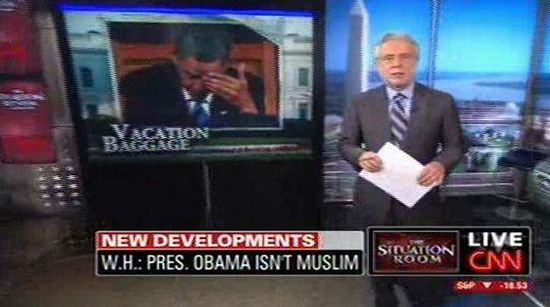
Allahpundit says all that needs to be said about new polling on the perception of Obama's religion:

It’s all very lame and obnoxious, especially given the testimony from pastors that Obama takes his Christian faith seriously, but much like the Birther thing, there’s virtually nothing you can say to convince someone who’s sure that O is what he thinks he is. I recommend re-reading Karl’s post from earlier this month on the phenomenon of polling Birthers, as it holds plenty of applicable wisdom in this case too. Essentially, when polling people who dislike candidate X, the specifics of the questions are almost irrelevant. As long as they’re negatively inclined — e.g., “Is Obama a werewolf?” — you’ll get a certain core percentage willing to say yes.

South Park put it more succinctly.

(Cable news fail via Pareene)

The Wrong Man

by Patrick Appel

Kathryn Schulz interviews Innocence Project co-founder Peter Neufeld:

About 30 or 40 years ago, the Supreme Court acknowledged that eyewitness identification is problematic and can lead to wrongful convictions. The trouble is, it instructed lower courts to determine the validity of eyewitness testimony based on a lot of factors that are irrelevant, like the certainty of the witness. But the certainty you express [in court] a year and half later has nothing to do with how certain you felt two days after the event when you picked the photograph out of the array or picked the guy out of the lineup. You become more certain over time; that's just the way the mind works. With the passage of time, your story becomes your reality. You get wedded to your own version.

And the police participate in this. They show the victim the same picture again and again to prepare her for the trial. So at a certain point you're no longer remembering the event; you're just remembering this picture that you keep seeing.

Chart Of The Day

by Patrick Appel

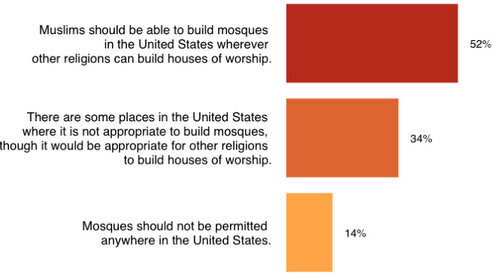
This is depressing but not surprising:

Mosquebuilding 

Serwer chimes in:

I'm going to reiterate what I said earlier about same-sex marriage, which is that prejudice does not cease being prejudice because it is widely held. Among both parties, prejudice against Muslims is widely held, and instead of tamping down this kind of sentiment, Republican leaders are exploiting it for political gain, and many Democrats are following along.

The Future of Labor

by Conor Friedersdorf

Reihan is thinking about less skilled workers:

One wonders if the deterioration of the labor market position of less-skilled workers might lead to a more "Confucian" arrangement in the United States, in which shared cultural practices are used to mitigate sharper economic inequality. The increasing cultural heterogeneity of U.S. society suggests otherwise.

Another possibility is that skilled workers will continue to consume more in-person services, thus creating an incentive to invest in the noncognitive skills of the future labor force. In a postmodern economy, most "needs" are invented. An abundance of relatively low-cost labor will presumably lead to the consumption of more labor-intensive services, just as the influx of less-skilled Mexican workers has kept the agricultural sector in the arid Southwest afloat. The problem, of course, is that the market wage for this kind of work might prove unacceptably low, as Greenspun suggests, thus creating pressure for expensive forms of redistribution.

In Defense of Talk Radio Listeners, Ctd

by Patrick Appel

A reader writes:

I share Conor's belief that by having civil, reasonable dialogs, we can try to resolve or at least clarify our disagreements. My main beef with Talk Radio is that its stars pointedly do not share this belief. They thrive on endless conflict and illusions of persecution. It is more entertaining for them to pretend that the Left is not motivated by a desire to make the country better, but a desire to destroy it and enslave much of the population, so that's what they say. I listen to Limbaugh, Hannity, and Levin regularly, and all three promote some version of this canard, Levin being by far the worst offender.

Beyond refusing to seriously consider the other side's concerns and proposals, these stars also never have guests who disagree with them or challenge their assertions. They almost never have guests who are not reliable, mainstream conservatives. All that we get are occasional liberal callers. For whatever reason, these people tend to be more stupid and ill-informed than most liberals I know, so the stars usually trounce them in debate. Limbaugh can be persuasive when engaging in this ritual, but Hannity simply cuts people off if they turn out to be smart and have some point he cannot counter, and Levin dispatches liberal callers with a storm of invective.

The upshot is that their listeners don't have an accurate picture of their opponents, and don't know what the Left actually thinks and stands for. It's in this atmosphere that we get a bunch of talk about "socialism" and "government takeover," and demands to cut taxes without specifics on what spending to cut.

The Daily Wrap

Today on the Dish, Palin had chutzpah (or something else entirely) on the First Amendment, and then got schooled by Linda Holmes. Ross responded to Andrew, and Patrick parried with the heart of a Sullivan response until his return. 

On the Mosque, Conor accounted for both sides of Imam Rauf while Goldblog continued to bat for him. Conor tallied up post-9/11 Muslim backlashes; Dreher acknowledged we have trouble talking about controversial issues and Bush evaded comment entirely. Steinglass responded to Ezra; Wendy Kaminer warned liberals about criticizing Dr. Laura and the critics of the Mosque; and this reader flipped the 9/11 porn hawkers merch on them.

Conor countered McCain on combat operations ending, again, in Iraq; Patrick argued Dems dominate domestic issues while the GOP focuses on foreign policy. NASA showed us Pakistan, before and after the floods, and some parts of Mexico weren't racked by violence. Conor reflected on the nature of political leanings (towards libertarianism) and he wished Dr. Laura well in the future, while pointing out her mistakes. David Post questioned copyright; and Matt Lewis rounded up the right's responses to Coulter at Homocon. 

The Internet may be dead but Reihan glimpsed a future of coordinated clothing and devices. Buses got a boost, and another wordy wonder here. Tracy Clark-Flory asked if sex is a fundamental right (for a disabled man on the taxpayers' dime) and Jonah taught us popularity leads to power and then power leads to some unpopular tendencies. A cop threatened rape, unemployment ticked up; librarians fought back over tenure and made this reader's day. Quotes for the day here and here, charts of the day here and here, cool ad watch here, MHB here, Yglesias award here, VFYW here,and FOTD here.

Readers let the dogs out over Cesar Millan; we guessed over dog or sex toys; and this butterfly was very, very lucky. 

— Z.P.

The Unique Quality Of “Lifelong Heterosexual Monogamy” Ctd

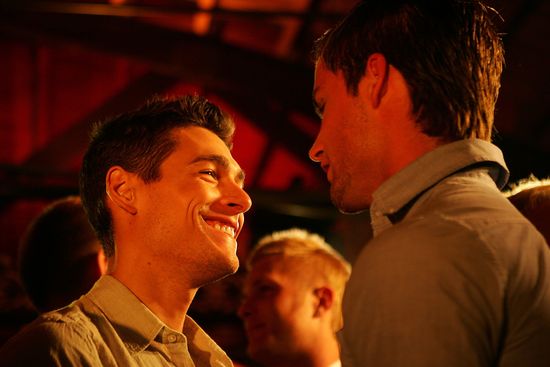
DavidMcNewGettyImages
by Patrick Appel

As promised, Ross has responded to Andrew's defense of marriage equality. He mentions that a second post is in the works. I imagine Andrew will respond to both posts when he returns, but for now I'd like to focus on this bit:

[Conservatives in the 1970s] tended to interpret the spread of HIV as a case of an inherently self-destructive culture reaping what it had sowed. And that “inherently” assumption led them to ignore or downplay the conservative turn in gay culture that the disease inspired — a turn that led, eventually, to the arguments for gay marriage as the most stable and plausible alternative to the closet.

So what should conservatives have done instead? Basically, they should have pushed (in, let’s say, the early 1980s) for what Ryan Anderson and Sherif Girgis have urged as a contemporary compromise: A domestic partnership law designed to accommodate gay couples without being sexuality-specific. (In other words, it would be available to any couple who couldn’t legally marry each other: A pair of cohabitating siblings or cousins could enter into it as well, for instance.) This would have provided potential institutional support for gay monogamy, and a firm legal foundation for property sharing, visitation rights, and so on. It would have provided a legal standard for non-heterosexual households seeking to adopt a child. And no doubt various cultural forms and commitment rituals would have sprung up around it in the gay community. But at the same time, it would have maintained a real distinction between the general value of commitment and the specific and more societally-important value inherent in the traditional understanding of marriage.

Joe Carter has proposed a faux "civil union" along the same lines:

To me the civil unions should cover a broad range of domestic situations, such as two elderly sisters who share a home or a widowed parent of an adult child who has Down’s syndrome or other potentially disabling condition. Such legal protections should be completely desexualized and open to any two adults who desire to form a contractually dependent relationship.

Andrew's response at the time:

This is not support for civil unions. It is a simple codification of laws that enable any two people to make legal contracts. Every heterosexual already has access to both civil marriage and any or all of these other potential relationships. Homosexuals are uniquely discriminated against. Carter's proposal is actually designed to render gay relationships invisible and asexual. They are neither. It is designed to entrench the inferiority of the commitment of a gay person to his or her spouse in the law. It codifies inequality.

Beyond questions of inequality and asexuality, the introduction of a new social institution "available to any couple who couldn’t legally marry each other" strikes me as far more dangerous to heterosexual marriage than allowing gays into the institution. There are states and nations that allow civil unions, domestic partnerships, and same-sex marriages. I know of no nation or state that has adopted the sort of "domestic partnership" Ross promotes. The closest thing I can think of is France's civil union law, which has undermined marriage to a degree no marriage equality bill ever has.

The decline in the marriage rate worries Ross to no end, but his plan would only accelerate that trend. Marriage bundles financial and romantic interests together in one package. By unbundling, Ross makes marriage less attractive. Under Ross's proposal I'd be able to get a domestic partnership with my business partner, my neighbor, my housemate, my uncle, my cousin, my best friend – anyone who I can't marry already. By giving a non-romantic partner a financial stake in my life, and me in his, I've erased a primary motivation for marriage.

Ross says that this domestic partnership would allow for adoption. Following Ross's guidelines, let's pretend that I'm a heterosexual male in a domestic partnership with my heterosexual best friend. We decide that we want to adopt a child together, a right it appears we would have under Ross's law. What happens, several years later, when one of us meets a woman we want to marry? How do you resolve the domestic partners' financial obligations to each other and the custody battle? In what universe are the likely untended consequences from creating such a new social institution less worrying than allowing gays into an existing one?

(Photo: David McNew/Getty.)