“Jobs Plans”

by Patrick Appel

Weigel finds the economic platforms of congressional candidates wanting:

The new jobs plans consist of ideas the parties always trot out, ideas that repeal unpopular things Obama has done, and, occasionally, numbers. In his plan, [Rep. Roy Blunt, R-Mo] suggests that stopping cap-and-trade legislation will save "more than 32,000 Missouri jobs." Of course, that legislation is stalled in the Senate, so there's nothing to save that hasn't already been saved by the filibustering talents of Mitch McConnell. Blunt also joins candidates like Illinois Democrat Alexi Giannoulias in calling for extensions to the homeowner tax credit. According to the CBO, a dollar spent on this credit adds only 40 cents to the GDP. But voters still like the sound of the homeowner tax credit.

Disincentivizing Dissent, Ctd

by Chris Bodenner

A reader writes:

My perspective differs from your previous commentators; I am a doctoral student in psychology. As a graduate student, I have had a front row seat into the life of professors seeking tenure and how that affects classroom learning.

The tenure process is constantly spoken about among professors. Students become privy to the high-stake political games that have to be played, which causes many of us to reject academia. To be honest, i have no desire to enter academia because of the rigorous process and the politics that accompany it. The process stifles your freedom of speech. You risk your job by speaking your mind, discussing things from a novel perspective, or even speaking about what is right. Not only that, professors in the race for tenure de-emphasize teaching (the university I attend is research focused) and spend the majority of their time on writing grants, manuscripts, conference presentations, and devising research projects.

Because of this, the teaching duties fall squarely on the shoulders of students, who are subjected to teach two classes or three labs. Yes, students receive a stipend for teaching, but it takes away much needed time for us to focus on other parts  of our graduate experience, such as our dissertations and attending to our therapy clients. Furthermore, the money is not even enough to live on in this major US city. So not only does the stress affect the junior professors, it trickles down to the students. It causes us to neglect areas of our graduate program that are vital to our professional development.

What I have noticed is that when professors finally earn tenure, the desire to publish or get grants dissipates.

This of course affects students because it allows less and less of them to receive tuition (grants provide tuition for many students) and does not permit future students to gain experience in research. And students enter a PhD program to gain research experience!  Thus, it causes students to become disgruntled and resentful of the program.

The tenure track allows certain professors to slack in other ways. Because some professors have already gotten theirs, they couldn't care less about mentoring students in research. They become elusive in the department. With all the inherent obstacles in obtaining a PhD, ferreting out a professor so you can speak to them at least once every two weeks makes the process even more difficult. This process is new to many of us, and we need guidance. I have seen a number of students fall behind in the program or just leave because their professor is inaccessible. It becomes frustrating and angering when you hear from older students or alumni that Prof X was such a wonderful mentor and doing so much research when they were in the fight for tenure.

Even more, because they know they cannot be fired or that getting fired is an exhaustive process, some tenured professors do not even do the minimum to adequately teach a course. They arrive late. They have subjective criteria about how they grade students. They don't have office hours. They don't answer emails. They are only on campus at the time they teach. Even worse, they don't teach the subject matter they are assigned to teach! 

I see the value and benefits in the tenure process, but it really must be reworked to improve our system of higher education.


Kinds of Moral Reasoning

by Conor Friedersdorf

Rod Dreher writes:

The Ground Zero mosque controversy is actually a perfect illustration of the difficulty we have in our culture discussing controversial issues, because, if moral psychologist Jonathan Haidt is correct, people on opposite sides of the political spectrum analyze these issues using somewhat different criteria. 

Though I disagree with what Dreher says is the conservative reasoning against the mosque, I wonder if his explanation of it is partly correct. If you click over, do check out other articles on the Big Questions Online site. It's relatively new, and I've been enjoying it immensely.

Email Of The Day

by Chris Bodenner

A reader writes:

One of my favorite things about the Daily Dish is that when a subject comes along where I know I disagree, but don't feel either the gumption to respond or don't have the advanced knowledge of the area required to say anything smart about it, I can just sit back, and trust that in a few days there will be a bevy of reader responses so informed they'll make me just grin down to my toes.

That's how I felt with your reader responses on tenure for librarians. 

When I read that mean-spirited attack on all things librarian, I was pissed, in part because as a master's student myself, I have depended heavily on the specialized knowledge and expertise of the specific research librarians I have gotten to know here at my University.  Having someone around in a well-paying job they are happy in — and who therefore can with a smile and a grin help you find the english translation of a tamil-language article on environmentalism in Buddhism — well, that's not something to yell about.  The person attacking librarians sounded, if I may guess, like someone who had just gotten out of a really bad marriage with a librarian.

That aside, though, I don't really know about tenure.  I guessed that librarians had to work hard to get it.  I figured that there were reasons behind it.  But I knew that if I just waited patiently, your brilliant readers would come through with a spirited, reasonable, and compassionate defense. And when they do, it's always a pleasure to have waited.

Free the Buses

by Conor Friedersdorf

Matt Yglesias writes:

Bus lines don’t have the power to transform neighborhoods that rail construction possesses. But buses are by far the cheapest and simplest way of adding mass transit, and municipal leaders should always have their eyes on potential ways to improve things. One possibility that naturally suggests itself is to let entrepreneurs start private intracity bus lines just as we have inter-city buses running from New York to DC, Philadelphia, Boston, etc.

Unlike the barbering field I would want to see regulation of this kind of activity since there are genuine public safety issues and it would be useful to consumers to impose some kind of uniformity so that buses are recognizable, have interoperable farecards, etc. New York City features sufficient demand for this kind of thing that the local authorities sporadically find themselves doing “dollar van” crackdowns. I’m not sure real market opportunities for this kind of thing would exist anyplace else, but it would probably be worth other cities’ while to try to find out. Ultimately, instead of a publicly-operated and publicly-subsidized set of bus lines, you could have a set of competing private bus companies with government subsidies provided directly to the consumer.

Or it could even work without subsidies! In any case, breaking the government monopoly on mass transit is a good idea. And so is doing away with a lot of the taxi cab restrictions in municipalities. GPS and smart phones would seem to open up better ride-sharing possibilities too — the drivers could even be compensated (which would be illegal under current law in, e.g., Los Angeles).

A Plague On Both Their Houses

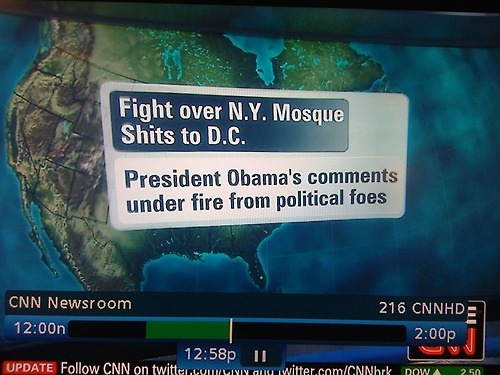
Tumblr_l79n181VEl1qzpwi0o1_500

by Chris Bodenner

Beinart despairs over national politics:

[T]he mosque fiasco hasn’t only exposed the pretensions of the GOP. It’s exposed the pretensions of the Democrats as well. In important ways, it has revealed that the Obama administration, too, is a false dawn. After all, what did Obama promise liberals when he ran against Hillary Clinton? He promised that if he won, Democrats would no longer consult polls to decide what they believed. That’s what made Obama’s 2002 Iraq War speech so significant: when Washington Democrats were ducking for cover, taking positions that they manifestly did not believe, he did what he thought was right.

Regarding the screenshot above, Neetzan Zimmerman notes, "You misspelled 'on.'"

Did The Stimulus Work?

by Patrick Appel

Manzi thinks it's unknowable:

First, we should treat anybody who states definitively that the result of stimulus policy X will be economic outcome Y with extreme skepticism. And weaseling about the magnitude of the predicted impact such that all outcomes within the purported range of uncertainty still magically lead to the same policy conclusion doesn’t count; we should recognize that we don’t even know at the most basic level whether stimulus works or not. Second, “boldness” in the face of ignorance should not be seen in heroic terms. It is a desperate move taken only when other options are exhausted, and with our eyes open to the fact that we are taking a wild risk.

Actual science can allow us to act on counterintuitive predictions with confidence–who would think intuitively that it’s a smart idea to get into a heavy metal tube and then go 30,000 feet up into the air? But we don’t have this kind of knowledge about a stimulus policy. We are walking into a casino and putting $800 billion dollars down on a single bet in a game where we don’t even know the rules. In general, in the face of this kind of uncertainty, we ought to seek policy interventions that are as narrowly targeted as is consistent with addressing the problem; tested prior to implementation to whatever extent possible; hedged on multiple dimensions; and designed to be as reversible as is practicable.

What I am trying to describe here is not a policy per se, but an attitude of epistemic humility.

Yglesias Award Nominee

by Chris Bodenner

"[S]he does make one reasonable point—when anyone (liberals or conservatives) creates a feminist litmus test, it cuts off the possibility of real, fruitful discussion. … I think liberals must cede this round in the debate to the sassy Ms. Palin. The Emily's List video wasn't gathering liberals around an electrifying idea—it was attempting to co-opt Palin's very effective rallying cry. As Hanna said yesterday, Palin gets to be the cool one in this situation, the one the other ladies are sweating. The List, and liberals in general, would be better served creating a stunning, galvanizing idea of our own. Also, that burn about Piper and Trig is pretty good," – Jessica Grose, XX Factor.

I had to look away watching that ad. I feel the best approach to Palin is simply giving her the chance to self-immolate (there is no shortage of opportunities). Trying to engage her on her own terms and imitating her schoolyard taunts just make her critics look like, well, children.

(Video via C4P)