by Conor Friedersdorf
Month: August 2010
The GOP Yawns At Domestic Policy
by Patrick Appel
Robert Stacy McCain doesn't think that Republicans care about elections. Frum differs:
I think conservatives do pay attention to elections. What is neglected is governance. How much do we discuss what went wrong with the US economy in the Bush years? If tax cuts are essential to pulling the economy out of recession, why didn’t Bush-enacted tax cuts prevent the US economy from tumbling into recession in the first place? Why did incomes stagnate between 2000 and 2007? Why did health cost inflation suddenly accelerate after 2001? What went wrong in the energy markets? How can we do better next time?
Interest in these questions varies from slight to negligible. Even our leading think tanks prefer culture war to policy analysis.
Frum is half-right. In my experience, liberal think tanks and intellectuals dominate most domestic issues while conservative think tanks and intellectuals dominate foreign policy. This was made clear during the health care debate; there were certainly conservative pundits arguing against "Obamacare" but conservative health care experts were seriously outgunned. The opposite is also true: liberal foreign policy experts were undoubtedly outnumbered during the lead-up to the Iraq war.
Democrats have traditionally held an advantage on domestic issues while Republicans have traditionally held an advantage on foreign policy. The intelligentsia of both parties reflect this divide.
Mental Health Break
by Chris Bodenner
Another Cartman nightmare:
From The Jaws Of Death
Quote For The Day II
by Chris Bodenner
"Only a complete moron doesn't know that a cackle is a group of hyenas," – Ian Lazaran, Conservatives4Palin, schooling us all.
Here is a list of animal groupings to study up on, morons. (My favorites: a romp of otters, a parliament of owls, a smack of jellyfish.)
Combat Operations Have Ended, Again
by Patrick Appel
Bernstein asks why liberals don't trust Obama on Iraq:
Case in point is the news that the last of the "combat troops" have left Iraq. Now, those reluctant to celebrate this development certainly have strong grounds for doing so, with 50K troops remaining, plus private security forces and civilians, so more American casualties are certain (although the pace seems to have slowed again in the last couple months). And I can certainly understand a reluctance to celebrate a retreat, even if it's orderly and good policy (as Obama's supporters presumably believe). …
[But it] does strike me that few liberals, at least few liberals who are speaking up right now, really appear to trust that Obama on Iraq. I'm not sure why — is it because of Obama's policy in Afghanistan? The disappointment of 2007, when a Democratic victory in 2006 failed to produce rapid results? The residue of Obama's defeat on Gitmo? His other policies on secrecy and rule-of-law issues? Something inherent in liberals when it comes to trusting even liberal pols? I don't know, and perhaps I'm reading things that aren't there, but I just don't see much trust there. Support, yes, when he does something they like, and perhaps even general support. But trust? Not really.
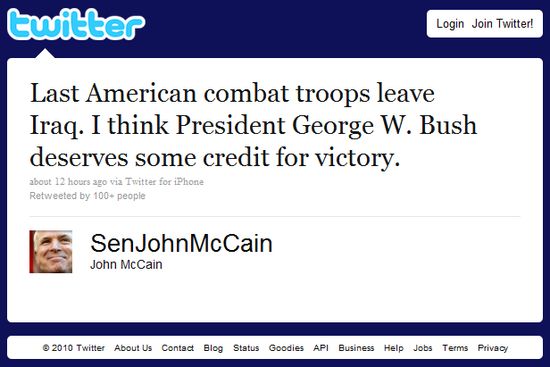
Opponents of the war, myself included, tend to trust very few – if any – politicians when it comes to the Iraq war. The reasons Jonathan Bernstein lists are part of it, but this distrust has less to do with Obama and more to do with politicians, both Republican and Democrat, consistently bending the truth on Iraq. McCain's latest declaration of victory is as good an example as any of exaggerated success. The Onion has more along these lines. It's extremely difficult to unwind a war once we've established the sort of footprint we had in Iraq. In that context, the draw down thus far has been more than impressive, but in a war marked by rhetorical victories ("Major combat operations in Iraq have ended", etc) it's hard to summon much enthusiasm for the declaration that the last "combat troops" have left, especially when 50,000 soldiers remain on the ground. Here's Captain Hyphen:
Those advisers are likely to continue to patrol the streets with Iraqi units in the embedded Military Transition Teams (MiTTs – at least that was the term when I was last there), and the United States isn’t going to commit 4,500 SOF solely for the training mission. There will still be counter-terrorism operations in coordination with the Iraqis that could also result in American casualties.
As Eli Lake notes, there were more than 144,000 troops in Iraq when Obama entered office. Cutting that number to 50,000 is a tremendous success. But that accomplishment doesn't redeem the Iraq War – no matter how much Sen. McCain would like to think so.
“Hawkers Of 9/11 Porn” Ctd
by Chris Bodenner
A reader writes:
I was a student in NY art school at the time of 9/11, and shared the same disgust over the
strange commercialization of the WTC site in the aftermath of the tragedy and based a senior project around those feelings. It was the best way for me to express the complicated feelings I had. I made my own postcards of the vendors at the WTC site and then sell them to the general public amongst all of the other vendors down there, in the same manner in which they sold them, so that the only difference between me and them would be the product. (I donated all of the money gained to the Red Cross.) I got a lot of double-takes at the time, and actually sold a few to people who agreed with the awkwardness of selling something so obviously offensive.
Threatening Rape
by Conor Friedersdorf
Radley Balko has some disturbing video:
An undercover New York City cop threatens a man taking cell phone video with arrest for being disrespectful. He then explains that an arrest means a weekend in jail, where he’ll probably be raped.
The confrontation appears to have occurred during an undercover bust of a suspected “illegal social club,” which judging by its use in other other raids appears to be a law that criminalizes weird artist types who freak out the neighbors.
He's also posted another item on asset forfeiture.
Now Syncing T-Shirt With iPhone
by Patrick Appel
Chris Anderson and Michael Wolff's new article is getting a lot of link love. The thesis:
The Internet is the real revolution, as important as electricity; what we do with it is still evolving. As it moved from your desktop to your pocket, the nature of the Net changed. The delirious chaos of the open Web was an adolescent phase subsidized by industrial giants groping their way in a new world. Now they’re doing what industrialists do best — finding choke points. And by the looks of it, we’re loving it.
Reihan imagines the future internet. I'm not sure that I completely agree with him here:
My guess is that the great driver of appliancization in the years to come will be the rise of ubiquitous computing. Powerful smart phones are just a first steps towards a world in which most of our products, including our clothes and perhaps even sensors embedded in our bodies, will be in constant communication. It is going to take a long time to establish standards and protocols in this space, and there will be a huge first-mover advantage for firms that create reliable, dead-simple applications. The Internet will be the backbone of this new universe of services. But that’s about all we know.
On Backlashes and Avoiding Them
by Conor Friedersdorf
Jonah Goldberg writes:
…there’s one point that I haven’t seen made that I think is really worth reminding people of. Simply: This is an incredibly tolerant country and, it has shown remarkable tolerance since 9/11. There has been no “anti-Muslim” backlash.
It's actually an oft-made argument, but never mind that. In my estimation, the American people have behaved better to its Muslim minority than the citizens of a lot of countries would've after an attack like what we suffered on September 11, 2001, but it is demonstrably inaccurate to say that there has been "no backlash."
Several reports have found an increase in anti-Muslim hate crimes post 9/11. Here's a 2002 brief from the New York Times, reporting from California:
A wave of anti-Arab hate crimes after the Sept. 11 attacks drove hate crimes up 15 percent last year, reversing an otherwise downward trend, a report from the state attorney general's office showed. Hate crimes would have dropped 5 percent if not for assaults and threats against Muslims or those who appeared to be of Middle Eastern descent. Crimes against Middle Easterners quintupled to 501 last year from 99 in 2000. Reports of hate crimes rose to 2,261, up from 1,957.
Here's a longer piece from the San Francisco Chronicle that reports a similar conclusion, citing an FBI report.
Of course, the backlash wasn't limited to full blown hate crimes. Surely Mr. Goldberg remembers Ann Coulter professing a desire to invade Muslim countries, kill their leaders, and convert them to Christianity. It seems fair to count that as an anti-Muslim backlash to 9/11. I won't bother to link a bunch of other anti-Islamic rhetoric that specifically cites the 9/11 attacks and didn't exist prior to them — we all know it's out there and it's ugly.
When an angry crowd mistook this Coptic Christian man for a Muslim, did that count as a backlash? What else explains the Koran burning event this Florida church is planning (guess what day the event is scheduled). Or consider the Temecula, California mosque project that is also apparently too close to Ground Zero.These are all very recent news items. So what can this assertion that "there has been no “anti-Muslim” backlash actually mean? That it hasn't been as bad as some people feared? If that is what Mr. Goldberg means he should say it.
The closest he comes is this later line:
Whatever excesses, real or alleged, that have come from the justice system or from main street, are by any historical standard — including any previous analogous period in American history — trivial.
Perhaps he has forgotten the anti-Muslim backlash at the Abu Ghraib prison, or the Muslims held for years on end as enemy combatants only to be cleared of wrongdoing by our government, or the innocent Muslims tortured by the CIA. Were none of these non-trivial excesses explained at least partly by an anti-Muslim backlash after 9/11?
Later in the same post, Mr. Goldberg writes:
…listening to all of this talk about “crowd” politics from liberals these days, you get the distinct impression that there are a lot of 20-something liberal bloggers, MSNBC talk-show hosts, and newspaper editorial writers who honestly believe that they are not only better than the American public but that they are in fact the duly anointed conscience of this, our embarrassingly backward and bigoted nation. They must stand ever vigilant, lest America's deep reservoirs of hatred and bigotry burst their levees and spill out through the sluices of the Republican Party.
How does this river of hate manifest itself? The supposedly anti-Muslim 70 percent of Americans who don’t like the idea of building the Cordoba House near Ground Zero mostly also believe the owners have the right to do it if they can’t be persuaded otherwise. Wow, that’s some crackdown on Muslims.
As one representative of writers who believe that vigilance against an anti-Muslim backlash is necessary, let me congratulate Mr. Goldberg for demolishing the weakest argument of his least defensible adversaries. Having done so, it's only fair that he get a shot at a stronger contender. It's 5 am as I write this, and being the only one awake, I'll enter the ring: Expressing concern that a religious group might suffer a backlash during an ongoing war against its radical coreligionists isn't tantamount to asserting that America is a backward and bigoted nation. The vast majority of concerned journalists, like President Bush and many others, know that most Americans are going to refrain from outright violence, and are nevertheless prudently aware that within our borders is a fringe of excitable bigots that exist, and will always exist, in every country on earth.
One thing that radicalizes these people is when, for example, magazines with a reputation for good judgment publish credulous articles alleging that the President of the United States himself is allied with Islamist radicals in their grand jihad to destroy America. Mightn't you take extreme action were that actually true?
One needn't be holier-than-thou to observe that sort of scare-mongering hyperbole, or the array of egregiously incendiary propaganda directed at a minority group, and conclude that people of conscience should object (as Mr. Goldberg admirably does on certain occasions himself). Calling on fellow media professionals to exercise more restraint than the average member of the American public doesn't imply that we're better than them, or believe ourselves to be — it merely recognizes that our words are amplified by virtue of the platforms where we write, and that privilege comes with an attendant responsibility that isn't shared by a guy who performs heart surgery or a woman who does TV-DVD repair or death-defying acrobatics for a living.
Moreover, it is possible to assert that 70 percent of Americans wrongly hold a wrongheaded view grounded partly in prejudice without saying that the United States is a bigoted country, or that all the people who hold that view are themselves bigots. I happen to think that there are many opponents of the Burlington Coat Factory mosque who aren't bigots. But all be damned if I'm going to apologize for being overcautious in warning against — and trying to prevent — further backlash against Muslims because some conservatives are aggrieved by the very idea that it is a possibility.
 The Dish