by Chris Bodenner
This ad for the new comedy show "Yes We Canberra" is the only Old Spice parody I've seen that isn't totally lame:
(Hat tip: Towleroad)
by Chris Bodenner
This ad for the new comedy show "Yes We Canberra" is the only Old Spice parody I've seen that isn't totally lame:
(Hat tip: Towleroad)
by Chris Bodenner
This post was bound to elicit backlash. A reader writes:
I was extremely disappointed to see this discussion on tenure take such a nasty turn. It's that not that I necessarily disagree with your reader's post about librarians and tenure – I think the burden of proof should be on librarians if they want to receive tenure. (This article from the Chronicle of Higher Education has a more informed and measured take on the subject.) However, in a truly uninformed and citation-less rant about the uselessness of librarians today, your reader really misunderstands the profession.
There are a number of universities that grant tenure, but the vast majority of academic librarians do not receive or achieve tenure. Of the institutions that do grant librarians tenure, most require that a *second* master's degree be held by the candidate for subject specialty. Indeed, at my own mid-sized academic library, I can easily name a half-dozen librarians with PhDs in non-library/information science fields, just off the top of my head. Furthermore, many academic librarians do teach or co-instruct classes.
As far as librarians "struggling to be relevant" or "find something to do," I literally have never met an academic librarian who has time to spare in their jobs. Yes, the work is shifting from the traditional passive model of information assistance – that is, waiting at a desk for the questions to roll in. And yet, it has shifted to a much more intensive and active role coordinating with IT departments and vendors to make the non-findable-through-Google electronic resources easily accessible to faculty and students. This is not to mention that librarians are at the forefront of digital storage issues, in addition to access and collection issues. Any other "free" time is now spent on outreach and collaboration with others.
And finally, the dig about the salary was really uninformed and misleading. Starting pay for the academic librarian positions in the Midwest are currently in the $35,000-45,000 range (max), depending on experience and qualifications. Given that many of these jobs require additional degrees or certifications, I really bristle at the implication that academic librarians are somehow overpaid and irrelevant.
Another writes:
Leaving aside the question of whether librarians should be tenured, I'd like to address some of the inaccuracies and mistakes made by your reader.
First, the only librarians I know who make the salary your reader states are working within corporate libraries or are at a high administrative level within the university (or have 25-30 years of experience). In addition, many also hold not only the MLS, but PhDs in other disciplines relevant to their work – History, Sociology, English, etc.
And librarians do teach. True, we don't usually teach semester long courses. But in any week, I teach 2-3 classes on finding information, using evidence-based research methods, using citation managers, complying with governmental mandates regarding open access to taxpayer-funded research, etc.
The tenure process for a librarian is no walk in the park, either. One must show scholarship within and service to the profession – and that's usually with a professional travel budget of about $1000/year. A single national conference can easily cost $1500 – between travel, registration, hotel, and meals. It's awfully hard to perform any meaningful service when you can only pay for one conference, so most librarians I know that are on tenure track end up paying out of pocket for another one or two. (Oh, and did I mention that the average pay for an entry-level academic librarian position is approximately $40K?)
A sabbatical does, in fact, generally require a research or service project, culminating in a book chapter, book, or peer-reviewed journal article. True, the publications that come out of these projects may not be read by very many people, but that's sadly true across all academic disciplines.
As for relevance, in a world flooded by information (and colleges populated by students who arrive convinced that they already know how to find anything, but know how to filter nothing), most of my colleagues are busier than they've ever been. When we're not working with faculty to integrate information management skills into their curricula, we're building research guides, helping our students (at all levels) find the information they need to write decent papers, working with administration to evaluate plagiarism-detection tools, and, yes, showing faculty how to use available tools to find research and data in their disciplines.
I'd advise your reader to find out who the liaison librarian or subject specialist is for his or her department or discipline, make an appointment, and find out what the librarian has to offer. Yes, it's true that there are some duds out there – like any profession, we have our share of people resistant to change, or who don't want to be pushed beyond their comfort areas – but most have skills and knowledge to spare, and are happy to work with faculty in whatever way they need.
Another:
Your reader really believes that librarians are irrelevant in academia? Really? From my perspective as a professor, I really cannot imagine someone in academia making this statement. Libraries are far from disposable for my work, especially for my research. Books are still being written, journals are still being published, and electronic resources for academia are multiplying at a rapid rate. Some fraction of this material is freely available online, to be sure, but the lion's share of it is not, and so the job of the librarian in evaluating new materials and choosing acquisitions and subscriptions is still a substantial one.
Another:
Far from needing to "find something to do with [my] time in this Google age," I find myself stretched almost beyond my limits, as do my colleagues. Gone are the days when all we did was answer the occasional reference question and sit around looking at lists of titles to add to the collection. On the contrary, now we are pro-actively involved in collection development, course creation, and digitization projects; creating consortia that leverage the collections of our peer institutions for the benefit of our user community; working with undergrads and grad students to guide them through the thicket of the nearly 1000 databases to which we subscribe so that they need not be dependent on the sketchy, uneven, and un-authoritative content that Google offers; offering reference services in person, as well as via phone, email, IM, and text; training faculty in the use of digital resources for their own teaching and research–and doing all of this while we watch our materials and operations budgets shrinking. Oh, and we also attend a lot of meetings.
If your reader doesn't realize that this is what's going on at his or her own institution's library, then I question how much time he or she is actually spending there.
Another:
The internet and Google are great, but contrary to popular belief, not everything is on the internet. Also, most people do not know how to use the internet effectively when it comes to doing any sort of research. Libraries and librarians have been embracing technological advances and have been earlier adapters. For examples, libraries use tools like instant messaging for answering reference questions. In fact, MLIS and PhDs have been some of the first academic degree programs to be offered totally online by major accredited universities, because technology is so essential to the profession and because the profession has adapted so well to new technologies. Those “lists” are often essential subject guides that are of great help to students and researchers. Librarians curate libraries – they select what should be in the collection and what shouldn’t, which databases to subscribe to, what volumes should be weeded out. Libraries are an essential part of a successful university, and libraries need to be tended to.
Another:
Many librarians don't even call themselves librarians anymore – their roles are changing so rapidly some are calling themselves "cybrarians".
Yet another:
One reason that tenure for academic librarians may have evolved in the first place is a way to regularize benefits for a class of university employees who are not considered equal to administrators. My institution likes to class librarians with faculty and claim that we have equal benefits (housing, child education, etc) although we are usually the first to be tossed over the edge when belt-tightening occurs. We do not make anything even in the neighborhood of faculty salaries, however.
Another:
A 2009 salary survey of mid-level academic librarians (not entry-level, but also not library directors, who tend to earn salaries more similar to administrator than faculty salaries) conducted by the Association of College and Research Libraries found academic librarian salaries running between $38,379 to $58,675.
Perhaps the angry writer needs to learn how to do a better job of checking his or her facts. A librarian could probably help with that.
One more:
Unlike professors, who set their own office hours, most librarians work regular hours with full days. At some universities they also work nights and weekends. Additionally, they do not get summers or other long breaks off like many professors; instead, they get the same holidays and vacation time as staff. After all, most major academic libraries do not close in the summer.
I could write an incredibly long email about how your reader's assertion that academic librarians merely "make lists, answer the occasional reference question, and attend meetings" is incredibly far off the mark and show an ignorance about what goes on in good academic libraries, but I've read the post at the end of my lunch break and I have lots of work to do – in an academic library.
by Conor Friedersdorf
In response to my post about drug violence in Mexico, an expat American argues that I've given an unduly dire portrait of our southern neighbor. The item is enjoyably evocative of life in a part of the country that isn't wracked by violence. It's a useful read for anyone trying to form an accurate picture of Mexican affairs, and you can read it here.
by Chris Bodenner
A reader writes:
Your previous reader criticizing Cesar Millan's techniques clearly has no idea about what those techniques are. The ONLY time I have seen Cesar employ anything closely resembling "punishment" is with what he calls "red zone" dogs, who would otherwise be put down without his intervention. Malcolm Gladwell has a great article on his training methods, "What the Dog Saw". Gladwell has a body-language expert analyze a video tape of Cesar handling one of these cases who concludes that his behavior lacks any aggression and is far from punitive.
Much of his training philosophy – like giving off "calm, assertive energy" – sounds more like new-age hokum than a "spare the rod" mentality (I saw one episode where he prescribed regular sessions of acupuncture and meditation to one owner). Like most trainers, he primarily works with dog-owners, identifying what behavioral changes that they – not the dogs – need to make in order to fix problem dogs. His underlying assumption is that dogs instinctively assume themselves to be part of a pack and that if the human isn't in charge (i.e., acting as pack leader), the dog will take on that role. He basically teaches people to be pack leaders.
Another:
This is a hot-button topic in the dog world. I compete in agility with my mixed breed, volunteer as class assistant in dog training classes, and spend a lot of time around dog trainers and dogs people. It is not an understatement to say that Cesar Millan's methods are reviled in the dog training community.
I see people coming into class with their family dogs and their heads full of his simplistic and wrong-headed notions about "dominance" and "energy." The trainers often have to gently and non-judgmentally steer the owners toward more effective methods of training, the easiest and most obvious being positive reinforcement. Dog advocacy groups have tried to pressure National Geographic into dropping the show, as his methods are scientifically unsound. Apparently it's too much of a cash cow for the network, much to their discredit.
The Association of Pet Dog Trainers has issued a position statement on "Dominance and Dog Training" as a direct result of his unfortunate influence. An excerpt:
The use of techniques such as the "alpha roll" on dogs, which is based on these mistaken beliefs about dogs and wolves, has no place in modern dog training and behavior modification. Dogs often respond to this perceived threat with increased fear and aggression, which may serve to make a behavior problem worse and ruin the dog-owner relationship.
I would encourage your readers to seek out a training facility that uses humane, positive reinforcement training methods that build a bond of trust and understanding between the dog and his/her human family.
Another:
First, any dog trainer's opinion of Cesar has to be taken with a large grain of salt, because he is making them look bad! People who have a difficult dog, who they have struggled for years to "fix", see an equally difficult dog cured in the space of 30 minutes and expect their local dog trainer to perform the same miracle. It's not an entirely realistic or fair expectation, but it causes a lot of resentment that makes it difficult for them to acknowledge that he can do anything right at all. I know this because I have mentioned Cesar to dog trainers I was working with and got a flood of griping in return about how he has ruined their business because people now come to them with impossible expectations.
Second, something that's usually overlooked is that Cesar is not a dog trainer, nor does he call himself one. I forget what words he actually uses to describe what he does, but I would call him a behaviorist. When was the last time you saw him teach a dog to sit? He just doesn't do that sort of thing, so it's an apples to oranges comparison from the start.
Another:
I'm sick of the Cesar-bashing. The one question I have yet to hear answered is this: If his techniques are so terrible and ineffective, how is his pack of 40+ dogs so well-balanced? And how has he been able to rehabilitate nearly every dog he's taken in at his facility (with the exception of two, according to his book, Cesar's Way)?
The truth is Cesar has nothing but the utmost respect for dogs and does nothing more to them than what an alpha dog would do to his pack in the wild. He's only more "physical" with the dogs that are acting out of line, just like an alpha would to one of his subordinates if it wasn't following. He's never abusive and never aggressive. The dogs don't cower in his presence as dogs would around an abusive owner. There is a big difference between assertiveness and aggressiveness.
Positive reinforcement (i.e., using clickers or treats) basically "tricks" the dog into doing something for a reward. Using Cesar's techniques, however, your dogs will do what you ask, not for a treat, but out of respect for you, their leader.
by Chris Bodenner
Goldblog continues to go to bat for Rauf:
In 2003, Imam Rauf was invited to speak at a memorial service for Daniel Pearl, the journalist murdered by Islamist terrorists in Pakistan. The service was held at B'nai Jeshurun, a prominent synagogue in Manhattan, and in the audience was Judea Pearl, Daniel Pearl's father. In his remarks, Rauf identified absolutely with Pearl, and identified himself absolutely with the ethical tradition of Judaism. "I am a Jew," he said.
There are those who would argue that these represent mere words, chosen carefully to appease a postentially suspicious audience. I would argue something different: That any Muslim imam who stands before a Jewish congregation and says, "I am a Jew," is placing his life in danger. Remember, Islamists hate the people they consider apostates even more than they hate Christians and Jews. In other words, the man many commentators on the right assert is a terrorist-sympathizer placed himself in mortal peril in order to identify himself with Christians and Jews, and specifically with the most famous Jewish victim of Islamism.
By Patrick Appel
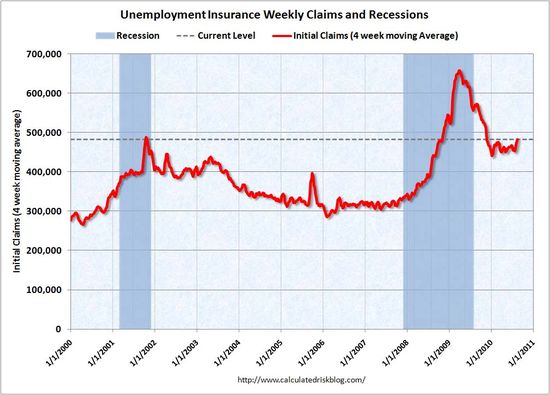
Bonddad worries:
The lack of underlying data means this could be a temporary increase caused by Census/governmental/construction losses, the reality is the total number could not come at a worse time. We've been seeing weakening numbers from the manufacturing sector for the last few months (see today's -7.7 print from the Philly Fed), indicating this sector — which led us out of the recession — is losing steam. Now we have initial unemployment claims at a big, far round numbers: 500,000. That is terrible news with little to [no] upside in my opinion.
After four quarters of GDP growth, we're seeing clear signs of weakness.
Chart from Calculated Risk.
by Conor Friedersdorf
Bob Wright articulates it.
by Conor Friedersdorf
In concurrence with the creed of The Atlantic, I consider myself to be "of no party or clique," and the best insight I can offer into my work is its premise: that a writer's job is to strive for the truth, and to remember that he'll sometimes be wrong. As a result, I am reticent to characterize myself politically on occasions when I'm really being asked, "Whose side are you on?" The answer to that question should never be "the liberal side" or "the conservative side," unless the person being questioned is naive enough to think that one ideology or the other has a monopoly on truth.
A question I don't mind is "Which tradition of political philosophy do you find most useful or persuasive?" In shorthand, my answer is that I'm both a conservative and a libertarian, or some combination. A longer answer is that I embrace aspects of classical liberalism too, and if you find yourself thinking that these terms mean very different things to different people, I agree. That's why I try to be introduced on radio spots as "a California based writer" rather than "a conservative" or "a libertarian," but anyone who attempts it knows these labels are impossible to escape. I sometimes even slip lazily into their use in spite of myself, though I'd banish them tomorrow if I could.
Today is another matter, because I cannot express this thought otherwise: I now think of myself as a libertarian more than a conservative when I reflect on how my ideological beliefs map onto the political coalitions whose success I desire.
This isn't one of those overwrought, more-in-sadness-than-anger essays that true believers write to announce an ideological conversion. The respect I have for conservative insights remains intact, as does my belief that Edmund Burke and friends remain important guides in our pursuit of prudent governance.
I also retain the reservations I've long had about describing myself as a libertarian and leaving it at that. Bruce Bartlett says that he is "basically libertarian but tempered by Burkean small-c conservatism." It's a characterization I find appealing. Were I able to banish government's role in marriage entirely, I'd refrain, though I do want gays to be able to marry, largely for the conservative reasons so eloquently expressed by Andrew Sullivan. I favor legalizing drugs, but slowly, and with lots of attention paid to how my expectations track the real world results of that policy. I regard the family unit as pretty damned important to a functioning society. Existing institutions matter.
These are but four incompletely articulated examples, but I trust you get the idea: I identify partly as a libertarian, but my failure to automatically support the whole libertarian line as a matter of first principles would cause some who go by that label to kick me out of the free state (an improbable project whose success I'd cheer).
It is precisely this grounding in pragmatism and real world consequences that is pushing me toward libertarianism generally, and especially the brand you find at the Cato Institute and Reason (not that there is anything like consensus within those institutions, which helps explain their increasing attractiveness). It may sound strange to advocate for libertarianism as a practical matter, when conservatives and liberals dominate the political landscape, and it's a struggle to elect even a single libertarian (not that any competitive candidate would call themselves that) to the Senate.
Let me clarify.
The pragmatist in me has concluded, after long experience and repeated disappointments, that the conservative movement is never actually going to deliver on its promise to check the growth of the federal government, however superior its rhetoric might be on that issue; and that the progressive movement is never going to deliver on its promise to protect civil liberties, however superior its rhetoric might be on that issue.
Instead, the conservative movement is going to continue advocating for an unsustainable foreign policy and a vision of executive power that is utterly at odds with the checks, balances, and purposeful limits on presidential prerogatives enacted by the founding generation. And progressives who manage to elect their dream president, plus a majority in both houses of Congress? They won't reverse the trend, so much as ignore it — the better to pass agenda items like a health care bill that thankfully covers more Americans, but leaves unaddressed many of the worst pathologies of the status quo and acts as a stark giveaway to influential industry players.
There is our fiscal insolvency too. Is anyone serious about addressing that?
I retain Burkean concerns with pure libertarianism, but the pragmatist in me is confident that they're irrelevant. In a way, that is a disappointment. Libertarians lack the power to pass their most appealing agenda items, never mind the extreme stuff. That aside, there is also the fact that the conservative movement's worst features — its advocacy for foreign wars of choice, catastrophically failed approach to drug prohibition, and radical views on executive power — are themselves Burkean nightmares. And speaking of that trifecta, President Obama and our Democratic Congress are by now complicit in every one of them.
I'll probably go on voting for Republicans and Democrats, barring a competitive libertarian alternative: Gary Johnson before Barack Obama before Sarah Palin, always choosing the least bad option. I'll definitely celebrate the good work being done by places like the ACLU, the Institute for Justice, the NRA, Law Enforcement Against Prohibition, The Claremont Institute's Center for Local Government, and other strange bedfellows. And I'll stay agnostic about the political strategy libertarians should pursue. Build a party? Make alliances of convenience? Reach out to liberals as Brink Lindsey is doing? Hell if I know. For my part, I'll just keep writing what I think is true, whether its short term effect is to hurt or help the political coalition whose greater success I desire.
All the better if this post helps some readers toward what I regard as the most important takeaway: upon reflection, the loose coalition of libertarianism looks pretty damned attractive to pragmatic folks on the right with Burkean sympathies.
(Should anyone respond at length to this item, email me at conor.friedersdorf@gmail.com, or ping me via @conor64 on Twitter.)
by Chris Bodenner
A disabled man in Britain plans to use part of his government-issued allowance to lose his virginity to a prostitute. Tracy Clark-Flory reacts in all the right ways:
Paying for sex in Britain is not illegal — unless it is with a woman forced into prostitution, or if it's done through "kerb crawling" or solicitation — so this isn't a question of whether this man should be allowed to do so himself. It is his legal right. The real issue is whether taxpayers should be paying his way. Since very little is known about this anonymous man, we are left to speculate about his condition. We know he is learning disabled, but we don't know to what degree. Presumably it is severe enough to make employment a challenge and to warrant state assistance; and perhaps his condition makes it awfully difficult to meet women. Assuming that all this is true, the question becomes: Is access to sex a fundamental right? Is it on par with, say, access to medical care? (Remember: We're talking about the U.K., where that is actually the case.)
Sex work can be healing and humane. As a fundamental principle, I think it's possible for money to be exchanged for human warmth and touch without either party being exploited. When I think in such terms, the idea of allowing a disabled man to allocate some of his limited funds toward sex with a prostitute — as opposed to, say, a visit to a masseuse or a physical therapist — makes sense to me.
I wonder if similar controversies have come up with the Make-A-Wish Foundation (not necessarily sex-related, but any dying wish that may be morally questionable to the people who fund it).
by Conor Friedersdorf
I'm confused by news of her impending retirement.
After her controversial exchange with a caller, she issued what seemed to be a forthright apology:
I talk every day about doing the right thing. And yesterday, I did the wrong thing.
I didn’t intend to hurt people, but I did. And that makes it the wrong thing to have done.
I was attempting to make a philosophical point, and I articulated the “n” word all the way out – more than one time. And that was wrong. I’ll say it again – that was wrong.
I ended up, I’m sure, with many of you losing the point I was trying to make, because you were shocked by the fact that I said the word. I, myself, realized I had made a horrible mistake, and was so upset I could not finish the show. I pulled myself off the air at the end of the hour. I had to finish the hour, because 20 minutes of dead air doesn’t work. I am very sorry. And it just won’t happen again.
I happen to think that there are deep, longstanding problems with Dr. Laura's radio show that have nothing to do with racial epithets, and that even in the controversial call itself, the most objectionable element was the lack of attention, courtesy and respect shown to the caller. I've found that tick of hers galling since I was 14 years old.
Still, I have to credit the talk radio host for actually apologizing without the usual weasel words.
And I must concur with much of her followup remarks about what she's learned from the incident:
Now, what makes me sad…what pains my heart deeply…is that, beyond the reasoned letters which I continue to get, I have heard comments from some broadcasters and letters from some people that cannot be described as anything other than hate-filled diatribes. Hate-filled. This does not make me angry, but it hurts my heart.
My hope with my apology, which was true and immediate and uncoerced, was that the silver lining might be that a dialogue be started to stop hate and bigotry. I still hold out some hope… but I am a realist and I fear that there are those who frankly want to encourage hate and anger.
Now, when I first started out in radio, people would disagree…they DISAGREED…they didn’t HATE. They didn’t try to censor, they didn’t try to destroy an opposing point of view. Instead…they just argued and debated, and argued and disagreed, and debated and argued. But our society has changed dramatically. Self-appointed activist types breed hate, breed anger, breed destruction should anyone hold up a mirror or dare to disagree. This environment, as you know, is not only in radio and television…it is in politics; it’s in every area of our society…in your neighborhoods, in your school districts, at work…
All true, and no less so because Dr. Laura herself has been an occasional participant in that culture of ugliness, as her gay listeners in particular know all too well. (She has since apologized for some of her more extreme remarks.)
It seems to me that there is a disconnect between Dr. Laura's remarks above, and the content of her appearance on Larry King.
"I want my 1st Amendment rights back, which I can't have on radio without the threat of attack on my advertisers and stations," Schlessinger said.
She emphasized that she is not retiring. "I will be stronger and freer to say my mind through my books, my YouTube Channel, my blog and my website," she said.
If she regrets the remarks for which she is being criticized, and regards them as a mistake, why does she require more freedom to speak her mind? (And what does the first amendment have to do with it?) Frankly, I'd rather that Dr. Laura retired than continue to treat her callers with such frequent disrespect, but even better would be a chastened host who maintained her various strengths while improving on her more galling weaknesses.
Here's hoping that her hate mail stops, that her post-talk radio career is an improved one, and that the number of people she helps — even her critics can acknowledge there have been many over the years — only increases.
 The Dish