
by Chris Bodenner
The answer, and ten more tricky examples, here.
by Chris Bodenner
In a sharp and nuanced post, Wendy Kaminer warns liberals who both condemn Cordoba critics and want Dr. Laura off the air:
[L]inguistic bans enforced by social disapprobation are not legal bans that violate First Amendment rights, and Schlessinger's critics have their own rights to shame or boycott her and other speakers they disdain. But they have no right not to be offended, and if she should be wary of encouraging bigotry, so should her liberal critics, as the furor over the lower Manhattan mosque has shown.
Muslims have a legal right to build their mosque near Ground Zero, opponents are apt to acknowledge, but, like Dr. Laura, they are excoriated for exercising their rights offensively. "Our position is about sensitivity," the ADL explains, stressing that its opposition to the mosque has been "deeply misunderstood" and expressing pain at being accused of bigotry. But by elevating sensitivity over liberty, the ADL promotes bigotry (perhaps unintentionally but not forgiveably.) The ADL also promotes what John Stuart Mill famously decried as the "despotism of custom." Sensitivity policing by private citizens is protected by the First Amendment but undermines its foundational commitment to freedom of speech and religion. It is sophistry, or self-delusion, to claim that sensitivity-based opposition to a Muslim community center and mosque is consistent with support for the fundamental right to build it.
by Patrick Appel
NASA provides jaw-dropping before and after pictures.
by Conor Friedersdorf
Matt Lewis rounds up some heartening reactions from the right. Says Jon Henke: "In time, conservatives will argue that the positive impact that marriage has on the gay community is further evidence of the importance of the institution of marriage."
Sounds familiar.
by Conor Friedersdorf
Is Imam Rauf of Park 51 “with us or against us” in the War on Terrorism? That’s the stark formulation used by many of his critics, who complain about his various shortcomings. Stephen Schwarz rounds up his most controversial statements in The Weekly Standard:
— On March 21, 2004, he told the Sydney Morning Herald that the U.S. and the West would have to recognize the damage they have done to Muslims before terrorism can end. The Australian daily reported “Imam Feisal said the West had to understand the terrorists’ point of view.” The paper also cited Rauf’s arguments that “the Islamic method of waging war is not to kill innocent civilians . . . it was Christians in World War II who bombed civilians in Dresden and Hiroshima.”
— On June 23, 2004, Rauf told Chris Hedges, then a writer for the New York Times, that, in Hedges’s words, “Islamic terrorists do not come from another moral universe–that they arise from oppressive societies that he feels Washington had a hand in creating.”
— On February 7, 2010, Rauf told the Egyptian daily Almasri Alyaum, “I have been saying since the 1967 war that if there is peace between Israel and Palestine, in time the Palestinians will prevail.”
Excluded from the article, but ubiquitous in public discourse, is his remark about US foreign policy being an accessory to the 9/11 attacks. These statements aren’t exhaustive, but I think it’s fair to say they’re a representative sampling of the utterances his detractors find objectionable. I have mixed feelings about Imam Rauf. In a debate, I’m certain he and I would forcefully disagree on some matters, and I’m sure I’d find some of his opinions wrongheaded and offensive. It is nevertheless noteworthy that these are the most damning things he’s said in public life, that his views about the complicity of US foreign policy in the 9/11 attacks are held by many Americans, including Ron Paul, and that he’s never said anything nearly so radical or violent as Ann Coulter’s post 9/11 remark that America should invade Muslim countries, kill their leaders, and convert them to Christianity. Thus far I haven’t succeeded in convincing Imam Rauf’s detractors that they’re holding him to a higher standard than other Americans because he is Muslim, or that based on the evidence currently available, after intense public scrutiny, he is “on our side” in the War on Terrorism (if we must use the binary formulation). Perhaps it’ll help my case to offer a flip in perspective. Take a look at an imagined conversation between two radical Islamists in Saudi Arabia who are having their own argument about whether Imam Rauf is with them or against them.
Jihadi 1: Maybe he is on our side. He does seem to sympathize with the Palestinians.
Jihadi 2: No more than lots of American liberals. Being pro-Palestine hardly makes him a soldier of Allah.
J1: He is also building a monument to Islam at Ground Zero.
J2: It’s two blocks away. And he has publicly promised that he is going to let Jews in.
J1: Really?
J2: Yes, he even reached out to two rabbis before announcing the project.
J1: Even so, he seems critical of America.
J2: Yes, he is mildly critical once every few years, when he’s not busy doing the bidding of their State Department, or helping to train their FBI agents.
J1: He cooperates with their FBI?
J2: He is very friendly with them. And he lets his wife go on television too. Without a burka or even a headscarf.
J1: I heard he attended a Hizb ut-Tahrir conference.
J2: It turns out that story is false. In fact, when radicals from the group confronted him, he defended the United States Constitution!
J1: Andy McCarthy thinks that he is a radical.
J2: You fool. Andy McCarthy also thinks that President Obama is allied with radical Islamists in a grand jihad against America.
J1: Seriously? That bastard Obama just killed an Al Qaeda cousin of mine with one of his drone strikes. At first I thought maybe he’s just trying to shore up his domestic political support, but then I realized that his administration is taking pains to keep most of them secret. Still, I hear than the mosque being built will signify the beginning of the United States of Arabia, and that it marks their surrender to us.
J2: That makes no sense. Their voters can’t even manage to pass gay marriage bans without them getting struck down and you believe people who say that they’re about to submit to sharia law? And how would the construction of a mosque even be a factor in transforming their legal system. I think you’re listening to too much of their talk radio.
Insofar as this conversation is unrealistic, it’s because every actual radical Islamist would know perfectly well that an imam who works with the FBI, tours on behalf of the State Department, denounces terrorism, defends the US constitution in an Arabic exchange with radicals from Hizb ut-Tahrir, has a good relationship with New York City rabbis, and preaches on behalf of women’s rights isn’t on their side. In fact, he is exactly the kind of imam that Islamist radicals target and kill when they dare to do these sorts of things in other countries.
by Patrick Appel
David Post reignites the debate:
It’s not just that copyright protection lasts absurdly long, still protecting recordings made more than seventy years ago; it’s that copyright, inherently, operates to the detriment of the public when applied in retrospect, to works that have already been created. Lester Young, alas, can no longer be incentivized to produce these performances — they’ve already been created. We won’t get any more brilliant performances by Teddy Wilson if we protect these works. All we — the public — get from applying copyright here is a restriction on our ability to encounter magnificent works of art. Now of course, copyright is only ever applied in retrospect, and if we always ignored it when applied to already-existing works it would cease to exist, and would therefore no longer serve its incentivizing function prospectively.
And there’s your copyright balance; what we seek is a way to give creators enough of an incentive to create, but not too much, because too much gives us, the public, too much of an impediment to actually enjoying the works that have already been created.
by Chris Bodenner
Linda Holmes gives Dr. Laura and Palin an introductory civics lesson:
[T]he First Amendment doesn't guarantee that speaking your mind will have no economic consequences. Proclaiming that those without thick skins probably shouldn't marry outside their race is always going to be, let us say, commercially risky if you're aiming for a broad audience — or if your sponsors are. General Motors and Motel 6 both reportedly pulled their sponsorship over the flap, prior to Schlessinger's decision to leave her show. But whether that's the right thing to do or the wrong thing to do, it doesn't implicate the government; it implicates the profit motive.
In fact, the organization of a boycott is itself the exercise of First Amendment rights — GLAAD, or the American Family Association, or Sarah Palin, or Laura Schlessinger, anyone can publicly advocate for an end to the economic support of someone else's speech. If you want, you can boycott them back — "Okay, if GLAAD is boycotting Laura Schlessinger, then I'm boycotting anybody who donates to GLAAD." It becomes reductive and unhelpful at some point, and it may or may not be justified, and one side or the other may be substantively right or wrong — but all of it, from every angle and every political position, is consistent with the idea of free expression.
Because the "free" in that concept means "free from government interference," not "free from consequences."
by Patrick Appel
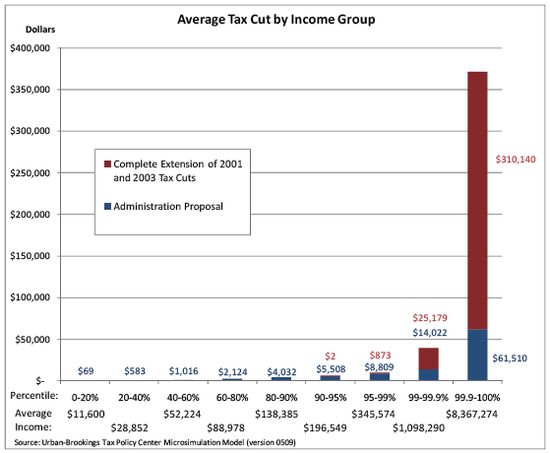
Howard Gleckman reads a new paper (pdf) by Adam Looney on the Bush tax cuts:
Keep in mind that Obama’s plan to extend the 2001 and 2003 tax cuts for nearly all–as opposed to all—would still add trillions to the deficit over the next decade. When Adam says the Obama plan would make a “small down payment toward fiscal responsibility” he means it would make the deficit less bad—relative to current law—than extending the tax cuts for everyone, including the highest earners. Still, in today’s political environment, adding $3 trillion to the deficit over the next decade is better than adding $3.7 trillion.
My view (which Adam does not necessarily share) is that given budget realities, Obama is wrong to propose extending the Bush tax cuts indefinitely for as many people as he does. I'd lower the threshold even further–perhaps to $150,000–and continue the tax cuts for only a year or two. But in any event, do we really want to extend them for a handful of the very highest earners as well?
by Zoe Pollock
Jonah Lehrer gives us both the good news and the bad news. We put people in power who we genuinely like. It's only then that the situation changes:
The very traits that helped leaders accumulate control in the first place all but disappear once they rise to power. Instead of being polite, honest and outgoing, they become impulsive, reckless and rude. In some cases, these new habits can help a leader be more decisive and single-minded, or more likely to make choices that will be profitable regardless of their popularity. One recent study found that overconfident CEOs were more likely to pursue innovation and take their companies in new technological directions. Unchecked, however, these instincts can lead to a big fall.
Jesse Walker adds a grain of salt:
The scholars cited in the piece are most persuasive when they observe actual social hierarchies in action. They are least persuasive when they draw sweeping conclusions from dubious experiments. The article's most ridiculous moment comes when it describes a study whose subjects were asked "to either describe an experience in which they had lots of power or a time when they felt utterly powerless. Then the psychologists asked the subjects to draw the letter E on their foreheads. Those primed with feelings of power were much more likely to draw the letter backwards, at least when seen by another person. [Adam] Galinsky argues that this effect is triggered by the myopia of power, which makes it much harder to imagine the world from the perspective of someone else." That seems about as believable as palmistry.
 The Dish