Waiting Out The News Cycle, Ctd

by Patrick Appel

Steinglass responds to Ezra:

The effect of this [Park 51] nonsense, ultimately, is to discourage people from trying to educate Americans about Arabic language and civilisation, or from setting up interfaith dialogues between Islam and other American religions. Those ought to be near the top of anyone's list of worthy, non-controversial projects.It's not just Islam-related projects that get hurt. USAID offices abroad shy away from organisations that work with prostitutes or drug addicts; some part of their programme might turn out to offer birth-control advice or clean needles, and the next thing you know some congressman accuses you of encouraging prostitution or drug addiction and you're out of a job.

Quote For The Day

by Chris Bodenner

“It may not make me popular with some people, but I think probably the President was right about this. I do believe that people of all religions have a right to build edifices or structures, places of religious worship or study where the community allows them to do it under zoning laws and that sort of thing. And that we don’t want to turn an act of hate against us by extremists into an act of intolerance for people of religious faith. And I don’t think it should be a political issue. It shouldn’t be a Republican or Democrat issue either. I believe Governor Christie from New Jersey said it as well, that this should not be in that political partisan marketplace," – Ted Olson, whose wife died in the Pentagon on September 11, 2001.

From The Annals Of Chutzpah

Drlaura1
Drlaura2

by Chris Bodenner

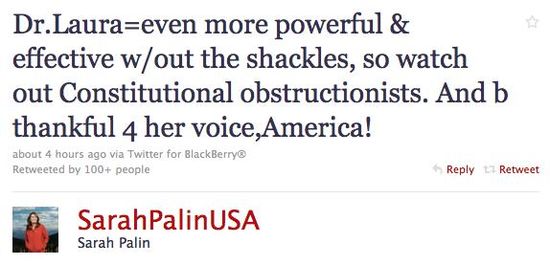
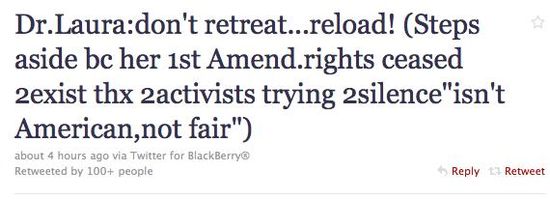
This comes from a person who for the past month has led the campaign to pressure and shame the Cordoba people into leaving their lower Manhattan location, which just yesterday she called a "stab in the heart" to the 9/11 families. To her credit, Palin has not suggested – like lower forms of politician – that the government should actually intervene to block the construction of the Cordoba center. Nevertheless, in her warped view, the spirit of the First Amendment is not meant for a minority religion trying to practice its faith on private property, but rather the feelings of a wealthy radio host who made some controversial comments on air. And for the record:

[Schlessinger] insists, however, that the decision to leave radio was her choice and not forced upon her by her syndicator. "Were you gonna have a new contract?" King asked. "Yeah," Dr. Laura responded. "We've added five stations this week and added sponsors. This is not an issue of I'm losing anything."

So she wasn't even under corporate or financial pressure, let alone "shackles" that made her "1st Amend.rights ceased 2exist." And now we learn that she had been planning to leave radio for the past year anyway.

On second thought, "chutzpah" might be inappropriate for this post, since it implies Palin is conscious of her temerity; she must have no idea what she's saying one moment to the next. Half of what she says is some cognitive version of "Keep your socialist hands off my Medicare!" Like the last time she was on "Fox News Sunday," railing against the budget crisis:

[Mama Grizzlies] have common sense. They know that we have to extend the Bush tax cuts, they have to repeal the budget-busting bills like Obamacare

On the other hand, there is consistency between Palin's defense of Schlessinger and her understanding of the First Amendment, which she spelled out in this timeless quote from 2008:

If [the media] convince enough voters that that is negative campaigning, for me to call Barack Obama out on his associations, then I don't know what the future of our country would be in terms of First Amendment rights and our ability to ask questions without fear of attacks by the mainstream media.

(Correction: I said Dr. Laura was Christian; she's Jewish.)

The Daily Wrap

Today on the Dish, on the Mosque front, Conor weighed in on assimilation and intolerance, Balko tracked the success of Muslims in America, Will Wilkinson disagreed about the intentions of the GOP, and Imam Rauf engaged with the other side. We grappled with Holocaust analogies, disparaged hawkers of 9/11 porn, remembered the Dubai Ports controversy, and Peter Feaver begged us all to focus on the floods in Pakistan.

Pat Tillman's story kept an R rating because of his last words, China developed a "Spider Man complex," and Yglesias debated amateur barbers. Patrick rallied with a reader over the dissent of the day; Conor countered the cult of the presidency, and we got your read on middle class privileges. Conor defended talk radio listeners here and here and Sugrue, in for TNC, reinvigorated the race and education thread. Your Yglesias award nominee here, Malkin award nominees here and here, quote for the day here, VFYW here, MHB here,and FOTD here.

Pirates ate turtles, commuting killed (kinda), North Korea twittered, and librarians were tenured.  We argued about burger prices across the country, health care jobs were growing, and even Ann Coulter and Glenn Beck were punished for getting too close to marriage equality, while the economic equalities of divorce remained crystal clear. 

We featured the last batch of first kisses, and this reader put Cesar Millan in the doghouse.

— Z.P.

Housing > iPods

by Patrick Appel

A reader writes:

Your reader states:

"An Ipod in San Francisco costs the exactly the same as it does in Idaho. This is true for cars, big macs, and a whole range of products that are marketed nationally."

He/she is mistaken on two counts. First of all, housing takes up the a huge portion of a family's income (>30%), so changes to that expenditure have a much more dramatic affect on living standards than does the price of an iPod. Other large portions of a family income are spent on food (>10%), gas (>5%), utilities (7%), insurance and other items. These vary dramatically between regions. We live in San Francisco. A pound of bananas is 79 cents, the same pound of bananas is 48 cents at the store near my in-law's house in Utah. Gas is over 3 dollars a gallon in SF, it's 2.40 here. Etc. Secondly, he's wrong about the cost of cars and other items costing the same between regions. A big mac is more expensive in SF than in Provo, UT. We buy our furniture, cars and other big ticket items in Utah and drive them back to SF because the stores are cheap enough here that it makes it worth the expense. But I'll grant the reader the cost of an iPod is the same in both places.

Another reader contests even the iPod:

Yes, prices of consumer electronics are fairly standardized throughout the country, but health care? Groceries? Clothing? Insurance? Utilities? Taxes? Fast food meals in any big city are noticeably more expensive than they are in the suburbs. This is not to mention the fact that that iPod is going to be more expensive in New York than in Tallahassee due to sales tax.

An final reader:

My wife and I make, combined, just over 100K per year. We have two small children in day care. We live in the suburbs of Chicago. To say we have the same purchasing power for luxury items as a similar couple living in rural TN is kind of crazy. To live within a reasonable commute to our jobs, a small three bedroom house would cost us well over 300K dollars. How much does that leave us for actual purchasing? Not much. Now, we realize that these are choices we make, and we love the variety and choice our location gives us for anything from culture and museums to sports. But, if you'll allow me a bit of all-caps, to the reader that said the above, HOUSING IS A MUCH LARGER PART OF THE NATIONAL ECONOMY THAN IPODS.

Face Of The Day

JosueBolaneJoeRaedleGetty

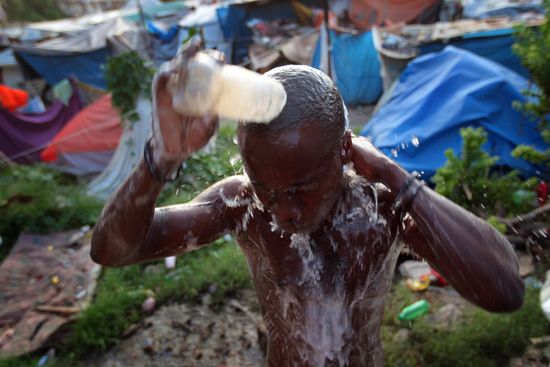
Josue Bolane washes outside the tent he is living in after being displaced by the January 12th earthquake on August 16, 2010 in Port-au-Prince, Haiti. As the country prepares for a presidential election, on November 28, some 1.5 million people are still living in tent camps and less than 4 percent of the rubble created by collapsed buildings has been cleared since the powerfull earthquake that killed some 200,000 people. By Joe Raedle/Getty Images.

One Last Batch of First Kiss Stories

by Conor Friedersdorf

Many thanks for all the submissions.

One day, I got email from a coworker I didn't know who had read my posts to the company "social issues" bulletin board about being gay and Christian. He said that he had been raised a conservative Evangelical, was in the process of coming out, and was trying to figure out how to reconcile his faith and his sexuality.

I asked him out to lunch and we talked, and he accompanied me to my church that Sunday. He had to fly back to Texas right after the service (he worked in the Dallas field office, and had only been at the home office for a visit). We started exchanging email, Long email messages. And then talking on the phone. Every night.

We arranged to spend a weekend in San Antonio, where my brother and his wife were working. He stopped by my brother's house on Friday night, and I made some excuse to take him into the bedroom and kissed him for the first time. It was far from my first kiss, but it was the first time he had ever kissed a man. He was rigid with tension and it was awkward, but the kisses when we got to the hotel were much, much better.

We've been together seventeen and a half years.

* *  *

My first kiss happened at midnight on New Year's Eve in 2001. I was seventeen and shy. My boyfriend was a guy with a sports car who bought me a gold necklace and told me he loved me two weeks into our relationship. I liked him because he was a boy and he was interested, and I kissed him because I'd never kissed anybody and I thought it was probably time I did.
 
Over the next four years I grew increasingly frightened of him. When I tried to break it off, he'd get angry and tell me I couldn't. He hated that I was going to university and warned me I'd never make anything of myself. He flew into rages when I told him about a good grade or a project I'd enjoyed. Sex was painful and terrifying. I closed myself off from family and friends, ashamed that I'd let myself get so stuck.
 
One night when I was twenty and in my second year of university, we went for a drive. He talked about the apartment we'd get as soon as I graduated and I realized, suddenly, that one day I might run out of chances to leave him. We broke up over the phone the next day. Despite a nine o'clock exam the next morning, my roommate sat up with me late into the night. I don't remember ever crying so hard.
 
I had nightmares about him for two years, but I went on to study Shakespeare in grad school, to live on my own in Toronto, to other kisses. Now I start law school in September. He'd have been livid.
 
I think about him now whenever I worry about my future. Ten years ago I could never have imagined my life being what it is today, but I got here because I was strong enough to start making choices for myself. I'm proud of that.

* * *

It was about 1982 and was 14 years old, attending a music camp at the University of Wisconsin-Madison.  At that point I had no experience at all.  Back home in my rural Wisconsin middle school I was considered pretty weird and a "brain" (at age 15 I would cut off all my fluffy Farrah Fawcett hair, start building a Cyndi Lauper-type wardrobe and become a punk rocker as well as a "radical feminist").  Music camp was a place where I could embrace my brains as well as spend lots of time with people who didn't
think I was weird.

I met the guy, whose name I no longer remember – Dave? – in my Basic Keyboard class.  He was a couple of years older and played drums in one of the rock bands that always formed during camp.  (They played a
cover of Sweet Home Alabama at the camp talent show.  Not punk rock, but still a good song, and it certainly got me interested in boys with drums and guitars.)  On July 4 I met him at the campus Memorial Union terrace right on Lake Mendota to watch the fireworks.  The place was packed with people — you could hardly walk.  Somehow, though, after the first kiss we started making out and ended up rolling around on the ground for what seemed like hours.  I don't remember the moment of the first kiss at all, but I do remember how blown away I felt at how unbelievably fabulous making out was.  I'm sure we didn't go very far — he might have put his hand up my shirt or something but that was probably it.  We were right out in public after all.

But I do remember what I was wearing (a green and red striped polo shirt! eeugh) and how fluffy my hair was.  And boy, do I remember going back to my dorm afterwards, so totally high on the utterly new
and totally overwhelming avalanche all those brain chemicals associated with having crushes and being turned on, that I was in an altered state, unable to do anything but babble incoherently to my
dormmates (some of whom had seen me rolling around on the ground with this guy), who just laughed at how completely goofy and delirious and happy I'd become.

Naturally, alas, "Dave" never spoke to me again after that, so my euphoria was almost immediately followed by having my heart crushed. On the other hand, every time I hear Lynyrd Skynyrd on the radio I
remember him and how euphoric I was at how fantastic this new activity felt.  Since then I've had my share of miserable kisses and other things, but I have also had quite a good time with a number of sweet,
sexy, brainy, funny men (I am now in my 40s).  I may be a feminist, but I am definitely not a man-hater…

* * *

As a socially awkward, painfully closeted (to myself, as much as anyone else) yet marginally musically gifted high school senior, I wound up being cast as the Prince in my high school’s production of Cinderella, opposite a girl with whom I had a lovely friendship. I didn’t know it at the time, but her friendship has turned out to be the loveliest and most enduring of my entire life. But my first lip contact of any kind came in a rehearsal for the musical, with the physics teacher/musical director looking on amusedly from ten paces. My dear friend has told me that I didn’t do too badly, but she has always been the generous type.

My second first kiss came the following year at college. I was still painfully closeted, but I found myself the object of a senior girl’s affection. After a few weeks of her swanning around me, and me impersonating a deer in headlights, she caught me behind my first year residence hall and planted one on me. It was horrible; all I remember is feeling like I was attempting to kiss a goldfish, and knowing that I had to extract myself from the situation as graciously as possible. Technique was sorely lacking on both sides.

Finally, in the fall of my senior year of college a cute guy walked up, jimmied the lock on my painful closet door, and gave me the first kiss that fired on all cylinders. Oddly, even though I was so new to the party that I hadn’t even removed my coat, I knew that I was using him. Sure, he was in the right place at the right time, but I somehow had enough perspective to know that I was in no way prepared for a relationship; it would be several more years before I caught up to all the folks who had lapped me back in middle and high school. Still, it was a good kiss, and I wish him well, wherever he is.

I think it’s obvious that my favorite of the three is the absolute first – passionless, but very symbolic in the context of that lifelong friendship.

* * *

I think I was 16 when I first kissed a girl, that was after spending some years when the hormones were high kissing the corner of a wall to get the angle right. There was a girl at school that I was infatuated with and one day I just walked over there and knocked. She was home, her father was home, it was late morning.  He went somewhere, it was just the two of us. We sat at the kitchen table and had a fun conversation for a couple of hours and then it was time to leave. We embraced and then all of a sudden our lips were locked.  It was a deep, long, and seemingly endless French kiss. We broke the clinch and she said something about dates, but I couldn't keep that agenda, no car, no money. We had no classes together and I had no privacy to call.  At any rate, nothing ever came of it.
 
As you may recall, kissing someone new causes a massive chemical high. I went home and listened to the "play of the waves" in Debussy's _La Mer_. That's the feeling, right there.  Making out with someone new is the greatest of highs, in my book. Even more pleasurable than sex, if that makes any sense. 

* * *

It was a dull job, made bearable by an unlimited supply of cream soda in the office fridge and occasional perusing of the finished reports on the superiority of Hubba-Bubba to Bubblicous bubble gum and they like (they did a lot of consumer focus groups). I was an oversexed budding gay boy with an eye for older men.  But no experience, yet.
 
I started in September and had met most of the staff by Thanksgiving.  One Vice President was on a long sabbatical but his return was worth the wait.  He was thirty-seven, short but trim, with a powerful runner's physique, a chiseled face, strawberry blond hair and beard and piercing green eyes (or were they hazel?).  My lust must have been palpable because his initial handshake lingered.  He was brilliant, a PhD with a slight southern drawl, affable and cultured.  Loved the opera, loved the outdoors.  And apparently he liked me.
 
We danced around each other until Christmas week. At the small office holiday party he surprised me with an invite to his townhouse.  His garage needed some straightening up. Would I help him out the Saturday after Christmas?
 
I never saw the garage. We never made it past his living room with its '70s shag carpet and orange velvet sectional. A little awkward small talk, him  expressing admiration for my Timex watch, his strong fingers running up my arm over my flannel shirt, and then a kiss.  My first kiss from a man.  My first kiss, period.  It was delicious. Like eating ice-cream on a hot summer day. Just delicious, that feeling of being possessed, conquered, desired  He'd eaten a breath mint before hand, so his mouth tasted sweet, slightly sticky, but masculine underneath.There was a driving power in his kiss.  Everything I thought kissing a man would be about.

 
***

It was the spring of my 7th grade year (1984) and Doug was beautiful.  He had been my boyfriend since the second week of school at Joseph George Middle School in San Jose, California.  We spent every lunch period together and met at each other's locker whenever we had the chance.  When we were not at school we spent endless hours talking on the phone.  I loved the feel of the spiral cord wrapped around my finger as we talked about our friends or our hopes and dreams.

A couple of older kids, 8th graders, decided that Doug and I had been together long enough that it was time for a kiss.  During lunch we were led to this small wall that was called the backstop.  It was in between the school buildings and the track and it was a great place to hide from teachers or lunch staff.

So there Doug and I stood. Convinced we were madly in love and that we were destined for one another.  I started to close my eyes and wait for what I thought was going to be my first kiss.  Just as he approached with eyes closed I opened my eyes and found that Doug (who had never kissed before either) was moving his tongue side to side rapidly.  It caught me off guard and I laughed. out loud.  The look of horror that washed over his face is one that I have never forgotten.  I did not intend to be cruel but I was un-mistakenly cruel.  I did not have my first kiss with Doug.

I had it shortly after that, with a mean boy, during a relationship that lasted a week.  Doug and I got back together for the remainder of that year and during the summer we moved.  We did not kiss but I have regretted that laugh for my entire life thus far.
Is The GOP’s Pandering Working?

by Patrick Appel

Weigel isn't seeing it:

The new Siena Poll finds that New Yorkers (everyone in the state) oppose the mosque by a 63-27 margin; they defend the constitutional right to build it by a 64-28 margin. At the same time, Lazio trails Cuomo by 34 points. He's down 2 points — within the margin of error, but not what you'd expect if the Great Mosque Debate of 2010 was hitting home.

Disincentivizing Dissent, Ctd

A reader writes:

I am an academic on tenure track, and I want to raise an important point about tenure that I don’t think has been addressed in these conversations yet. Measured on an individual level, I am not sure what the effects of tenure are. Like the historian in a prior post, my own and other junior faculty work is often critical of established stuff. I don’t fear being blackballed on that basis. Really, things aren’t like that (as long as one is intellectually rigorous). Academics themselves are generally interested in shaking things up, and challenges, and so forth (after all, a good challenge to one’s own position represents an opportunity to publish refutations).

The more important role of tenure is protection from vagaries of non-academic opinion. That is, protection of the academic process. There is lots of research that is a nice, fat juicy target for politics, and lots of research that threatens important interests. Consider: embryonic stem cell research, climate science, genetically engineered foods, public health research on tobacco, trans fats, sugar, etc.  Is there any question after “climategate” that people would like to go after climate scientists’ livelihoods?  Tenure means that firings must be for cause – fraud, criminal conduct, harassment, etc.  Not for drummed up reasons in the service of politics.

Attacks can come for all manner political reasons, and the scholar’s field can be anything.

Animal rights folks go after primate researchers (and other animal researchers), extreme pro-lifers can go after stem cell researchers, climate change deniers (or people with vested interests in fossil fuels) can go after climate scientists, feminists can go after Larry Summers (note that one thing that was NOT threatened was his livelihood – administrative positions aren’t protected, only the faculty aspect of one’s position). John Yoo. Elizabeth Warren. Robert Bork. Remember the PC wars in the '90s? Complaints and public excoriation for insensitivity (real or imagined) is one thing; potential loss of livelihood is another.

Note that these kind of attacks on scholarship are MORE likely to come against tenured people because senior faculty have actually had the time to develop powerful research streams and put together programs that are robust enough to be compelling and threatening.

Here’s my best guess: the academic working on projects early in her career probably isn’t too worried about generating enough controversy to get her fired. She pursues interesting and important questions. Controversial papers get published because they are fun to read, and controversy (i.e., academic disagreement, not scandal) gets one’s name out there. But down the road, answers to interesting and important questions (or further, deeper interesting and important questions) piss people off. And we don’t know who they will piss off, and what kind of controversy will be set in motion. That’s the worry: good researchers will get timid because the course of their lifelong research starts to piss people off.

I’ll note, too, that I do not believe that an academic is free to do anything at any time. We can legislate restrictions on stem cells or primates, and grants can dry up or bloom in different places according to our political priorities. Those things can make academics’ careers less fulfilling and fruitful and more stressful, but they don’t threaten researchers’ livelihoods in the same way that absence of tenure does. Such a drastic threat can wreak havoc on the integrity of research, and on the research process as a whole