15 Million People

by Patrick Appel

Peter Feaver begs the nation to focus on the floods in Pakistan:

The stakes in Pakistan are exceptionally high and the international response thus far has been inadequate. The United States has done better than most, but we could do more. The most successful things the Bush administration ever did in the war of ideas were the rapid and substantial responses to the Asian tsunami of 2004/2005 and the Pakistan earthquake of 2005. More than anything, our actions confounded critics in the Muslim world (and elsewhere) and thwarted al Qaeda's goal of fostering a war between Islam and the West.

The current Pakistan crisis dwarfs both of those prior disasters, but the international response, beginning with ours, has not yet been commensurate. There are many reasons for that, but maybe one of those reasons is our national preoccupation with the mosque debate.

Islam and Intolerance

by Conor Friedersdorf

Andy McCarthy's latest asserts that "intolerance is not just part of al-Qaeda, it is part of Islam." It's a piece that gets right to the point:

Non-Muslims are barred from entering the cities of Mecca and Medina — not merely barred from building synagogues or churches, but barred, period, because their infidel feet are deemed unfit to touch the ground. This is not an al-Qaeda principle. Nor is it an “Islamist” principle. It is Islam, pure and simple.

Of course, non-Mormons are banned from LDS temples, and non-Catholics aren't allowed to partake in the Eucharist. And I'm sure there are many more exclusionary religious practices engaged in by non-Muslims, but 9/11 9/11 9/11, so Mr. McCarthy holds Muslims to a higher standard, and waxes darkly about the intolerance of Islam.

The rest of his piece largely consists of the dubious conflation of true Islam with modern day Saudi Arabia, as if the globe and history aren't replete with very different incarnations of Islamic society, and cherry-picking passages from the Koran in order to assert that its least defensible words define the true nature of Islam. 

One reason it's good that I don't work at National Review is that I'd be tempted to get a fake Koran made with Leviticus inserted into it, and provoke Mr. McCarthy into citing all sorts of Bible passages as evidence that the religion they're part of is inherently intolerant. (In case it isn't clear, I do not think Christianity is intolerant.) In the end, my mischievous antics probably wouldn't do much good, so I'm glad that among the magazine's many talented staffers is Reihan Salam, whose admirable capacity for respectful engagement often exceeds my own.

The passage I'm about to excerpt isn't directed at Mr. McCarthy, but it's nevertheless apt:

I think it’s important for people to understand that there really are conflicts within what we call Islam. It is not a single thing. Rather, it is a lot of different things. Some of these things — militaristic, xenophobic, misogynistic Islamism, to name but one example — are by any objective standard noxious forces, and the driver of lethal attacks on Americans and also Israelis, Bengalis, Malays, and many other people. We can all agree on that. 

Islamism, however, is not identical to Islam. Within Islam, there are many other traditions and tendencies, some of which are more compatible with modernity than others.

I’m not sure exactly what’s going on with this new set of controversies over Islam and the role of American Muslims in our public life. I wouldn’t say I’m a very religiously observant person, but the observant Muslims I know best are my parents. Both of my parents have lived in New York city for over thirty years. Both of them worked in the World Trade Center in the 1980s, when I was a kid. Some of my fondest memories of growing up involve visiting them at work, and watching the 4th of July fireworks display from my dad’s office window. They were born in a country (Bangladesh) where Islamist terrorists have killed a large number of people in bomb attacks and acid attacks, and they lived through a savage and mostly forgotten war in which over 1 million Bengali Muslims were tortured and killed in part because they were accused of being “polytheists,” etc. That is, armed cadres of proto-Islamists were killing Muslims who had a different way of seeing the world and practicing their religion.

So that’s part of where I’m coming from: the idea that Islam is one thing or that all Muslims are the same strikes me as highly unlikely.

All Mr. McCarthy can muster is the admission that there are Muslims who are interested in reforming Islam, a true statement, but one he makes as if there weren't peaceful, devout, moderate communities of Muslims already living in many countries throughout the world.
“Depressing Because It Is So Persuasive” Ctd

by Chris Bodenner

Thomas Sugrue, guesting over at TNC's place, complements the Dish reader discussion by putting heat on Obama:

Since the '70s, support for integration, except rhetorically, has plummeted. Many black parents were (and are) rightly skeptical of the rhetoric of some integrationists–namely that mere exposure to whites would somehow magically uplift their children. And most whites tell pollsters and survey researchers that they support racial integration, until more than a handful of minority students show up, and then they bolt. The result is that school districts have resegregated. And more recently, the Roberts Court has struck down even voluntary school integration plans. All but the most hardcore advocates of Jim Crow from the Brown v. Board days would be pleased. 

But, hey, we have a president who supports integration, don't we? Unfortunately, so far, his support also seems to be mostly rhetorical.

Obama has emphasized education, but his administration is walking down the same rutted path as his predecessors. More funding for charter schools. More teaching to the test in a warmed-over version of No Child Left Behind. And Obama–always optimistic about the power of well-turned words–serves up bromides about "self-discipline" and "hard work," believing somehow that he will fire up little Johnny or Jamal and that miraculously, they will make it in a school system where the deck is stacked against them.

One fundamental problem (and there are many more that I can't list here) with the Obama administration's policies is that they take for granted that segregation by race and class is unchangeable. They take for granted that disadvantaged students will remain concentrated together. And they accept as a given the reality of ghettos of wealth in privileged school districts.

Sugrue's solution?

States–even those led by Republicans running against Obama–have jumped into the fray to compete for federal "Race to the Top" funds. They invariably follow the money–and that is right into unproven charter schools and programs to teach to the test that leave racial isolation untouched. Why not add an incentive: set aside funds for districts and states that come up with plans to diversify their student bodies. It's happened on a small scale in metropolitan Boston, where METCO has opened spots (not enough) for city students in some of the region's best-funded and excellent public schools.

Malkin Award Nominee

Hutcherson

by Chris Bodenner

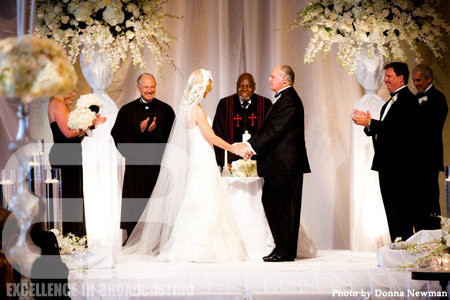
“Legislators around the country are considering banning sugar and fatty foods in schools, removing salt and butter from restaurants and want to control what temperature you can have in your own homes, because they fear the potential of health problems. Perhaps they should consider banning the promotion of a lifestyle that the Centers For Disease Control has determined actually causes HIV/AIDS,” – Ken Hutcherson, pictured between Rush Limbaugh and his fourth wife.

(Hat tip: RWW)

How Is Nobody Upper Class?

by Patrick Appel

A reader takes the thread in another direction:

I'm finding this an interesting conversation that we really need to have as a country. I've thought so ever since I first learned the roots of class theory and what the origins of the term "Middle Class" are. Living as we do in a country that did away with aristocracy (in the pure sense) at its founding, I've often felt that we miss the point in most international socio-political conversations about class. Rather than defining class by social access and privilege, we're left with a rather sloppy and arbitrary distinction of annual income, which often generates misunderstanding about class struggle and revolution (and never seems to experience inflation). Most Americans, even educated ones, fail to understand that, historically speaking, the Middle Class was a wealthy class that often out-earned the aristocracy. What they didn't have was direct access to the tools of political power. That's why they were willing to topple the Ancien Regime, but merely shrugged under Napoleon and again in 1848.

What we are witnessing in today's widening income gap is a collapse of this deliberately elastic definition Middle Class, which can stretch and contract as is convenient. As a white male who grew up in Connecticut and went to a Midwestern private 4-year-college, I've generally considered myself to be lower-middle class, even after earning a doctorate. Never mind that my hometown is one of the poorest in the state, that neither of my parents went to college or earned more than $70k/year collectively. But venture 25 miles west, across the CT River and you could think you have entered a whole new country with a different concept of Middle Class. And of course, *NO ONE* admits to being upper class. In fact, I think the title of this discussion is itself off the mark. It should really be, "How Is Nobody Upper Class?"

Matt Yglesias, Unlicensed Barber

by Patrick Appel

Yglesias has kicked off a debate about professional licensing. Adam Ozimek delves into the literature:

Another problem with occupational licensing as a regulatory tool is that there is a lot of evidence that it does nothing to increase quality. One strain of research shows that malpractice insurance premiums aren’t lower in states with occupational licensing, which you would expect if licensing was increasing service quality. Other evidence comes from research into the effectiveness of nurses in providing primary care services, which has shown they do no worse than doctors. Still other research shows that licensing and certification for teachers does not increase outcomes. While the set of occupations which are licensed is broad, and the evidence for many jobs limited, the balance of the literature on licensing suggests it does not increases quality. Part of this is probably because, as discussed above, in areas where there is no licensing other mechanisms arise or be mandated to ensure quality can be monitored.

Tweets from the Hermit Kingdom

by Conor Friedersdorf

After noting that North Korea is now on Twitter, Rob Long wonders if you can be the last insane despot on earth and be Tweeting:

It's entirely in Korean, which is the only reason I'm not following them.  That, and because I already know that rice production has been stellar this year, Kim Jong Il won the British Open, and workers around the world despise the reactionary American hegemon.

The handle is @uriminzok. And when the inevitable Twitter fight with Andrew Breitbart comes I'll be on the conservative publisher's side for once.

Perspective

by Conor Friedersdorf

Radley Balko writes that Muslim immigration in America is a success story:

In contrast to many of the minority Muslim populations in Europe, American Muslims embrace modernity, are better educated, and earn more money than their non-Muslim fellow citizens. A 2007 Pew poll suggests American Muslims are also doing just fine when it comes to assimilating and viewing themselves as part of America. According to the poll, just 5 percent of American Muslims express any level of support for Al Qaeda, and strong majorities condemn suicide attacks for any reason (80+ percent), and have a generally positive image of America and its promise for Muslims.

According to the poll, the only subset of American Muslims where support for Al Qaeda and suicide attacks gets uncomfortably high is among native-born African-American converts, many of whom converted in prison. To the extent that this particular subset of American Muslims is more prone to radicalism and less optimistic about America, it has nothing to do with immigration/assimilation problems, and seems more likely to stem from lingering hostility about race. That is, it's an American problem, not a Muslim problem.

I'd wager this success is due partly to the fact that the constitutional approach to American assimilation, as articulated by Ross Douthat, is more common than his account of the cultural approach.