The Other Sex Abuse Conspiracy

Eli Lehrer urges Congress and the Obama administration to move faster on efforts to stop prison rape. But they face many hurdles:

Particularly in the most chaotic prisons, turning a blind eye towards sexual abuse helps keep tensions between racial-supremacist gangs under control. In juvenile facilities, furthermore, a growing body of evidence of guards abusing their charges has some guards and administrators rightly nervous that tougher standards will reveal deeper problems. Finally, society’s refusal to take sexual abuse in detention seriously, combined with the utterly distasteful nature of the problem, makes it something that many would prefer to sweep under the rug. The slow pace of the process so far — for example, even though nobody openly opposes the idea of standards, getting Congress to approve exceedingly modest legislation took almost two years of work — shows that many would prefer that it remain sub rosa.

Do Prop 8 Proponents Have Standing To Appeal? Ctd

Be prepared for some fascinating right-wing cognitive dissonance. What happens when a conservative approach to jurisprudence, which often takes a very strict view of who has standing to appeal, meets the Christianist demand that gay people be ostracized in civil society. Walker, as throughout, has represented the real conservative position on this, and his denial of standing to the Prop 8 supporters is one which John Roberts has a history of backing. From Jeffrey Toobin's profile of Roberts last year:

One case that Roberts argued during his tenure in the Solicitor General’s office in George H. W. Bush’s Administration, Lujan v. National Wildlife Federation, seems to have had special resonance for him. The issue involved the legal doctrine known as “standing”—one of many subjects before the Supreme Court that appear to be just procedural in nature but are in fact freighted with political significance. “One of the distinctive things about American courts is that we have all these gatekeeper provisions that keep courts from getting involved in every single dispute,” Samuel Issacharoff, a professor at New York University School of Law, says. “The doctrine of standing says that you only want lawsuits to proceed if the plaintiffs are arguing about a real injury done to them, not simply that they

want to be heard on a public-policy question.” 

Liberals and conservatives have been fighting over standing for decades. “Standing is a technical legal doctrine, but it is shorthand for whether courts have a role in policing the conduct of government,” Issacharoff says. “Typically, the public-interest advocates, usually on the liberal side of the spectrum, favor very loose standing doctrines, and people who want to protect government from scrutiny, who tend to be on the conservative side, want to require more and more specific standing requirements.”

Lujan v. National Wildlife Federation was one of the Rehnquist Court’s most important standing cases. The environmental group had challenged the Reagan Administration’s effort to make as much as a hundred and eighty million acres of federal land available for mining. In an argument before the Court on April 16, 1990, Roberts said that the mere allegation that a member of the National Wildlife Federation used land “in the vicinity” of the affected acres did not entitle the group to standing to bring the case. “That sort of interest was insufficient to confer standing, because it was in no way distinct from the interest any citizen could claim, coming in the courthouse and saying, ‘I’m interested in this subject,’ ” Roberts told the Justices. By a vote of five to four, the Justices agreed with Roberts and threw out the case. According to Issacharoff, “Lujan was the first big case that said, Just because you are really devoted to a cause like the environment, that doesn’t mean we are going to let you into the courthouse.”

As a lawyer and now as Chief Justice, Roberts has always supported legal doctrines that serve a gatekeeping function. In DaimlerChrysler v. Cuno, a group of taxpayers in Toledo, Ohio, went to court to challenge local tax breaks that were given to the carmaker to expand its operations in the city; the Supreme Court held that the plaintiffs lacked standing. In a broadly worded opinion that relied in part on the Lujan case, Roberts suggested that most state and local activities were off limits to challenge from taxpayers. “Affording state taxpayers standing to press such challenges simply because their tax burden gives them an interest in the state treasury, ” Roberts wrote, “would interpose the federal courts as virtually continuing monitors of the wisdom and soundness of state fiscal administration, contrary to the more modest role Article III envisions for federal courts.” As usual with Roberts’s jurisprudence, the citizen plaintiffs were out of luck.

Quote For The Day

"In my own mind, I have the same political philosophy I've always had–basically libertarian but tempered by Burkean small-C conservatism. But I am no longer a member of the Republican Party and no longer consider myself part of the "conservative movement." That's not because I changed, but because I believe that they have. The Republican Party of today is not the party of Jack Kemp and Ronald Reagan that I was once a member of; it stands for nothing except the pursuit of power as an end in itself, with no concern whatsoever for what is right for the country. In a recent interview with The Economist magazine, I characterized the Republicans as the greedy, sociopathic party. I stand by that," – Bruce Bartlett, economic adviser under Reagan and H.W. Bush.

Do Prop 8 Proponents Have Standing To Appeal? Ctd

A reader writes:

Your attorney reader who weighed in on the standing of the Prop 8 proponents is mistaken in his prognosis of appellate outcome. "Insufficient assistance/inadequate counsel" is only an issue for which appellate courts remand in criminal cases, not civil ones such as the Prop 8 trial. Furthermore, Jerry Brown and the other non-intervenor defendants were all agents of California's executive branch, tasked with executing the laws of California as they see fit. There would be an enormous separation of powers issues, and likely federalism ones as well, if federal appellate courts ordered a state executive to change the way in which he executed the laws, especially if the law is of suspect constitutionality to begin with. Yes, Southern executives (governors, attorneys general, sheriffs, etc.) were ordered to change their ways when they were enforcing Jim Crow laws, but the difference between being ordered to stop discriminating and being ordered to start is certainly a salient one.

Vindicated

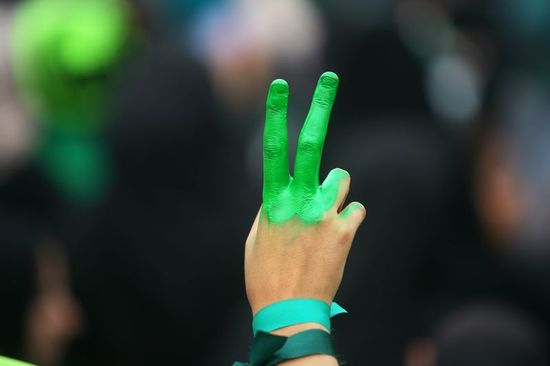
FingersMousaviMajidGetty

An Iranian reader writes:

Last week the audio track of a senior Revolutionary Guard's speech was leaked. In the audio, you hear Gen. Moshfegh, the head of SAR ALLAH military base – which was in charge of "controlling" Tehran in the days after the election – give an extensive and detailed account of their pre-election preparations to stop Ahmadi Nejad's rivals.

Moshfegh describes all the methods employed to achieve their goal, from eavesdropping in every campaign/planning meeting that reformists held months before the election to how they interfered with all the SMS communications of Mousavi and Karoubi's observers on the day of the election. (Every candidate is, by law, allowed to send monitors to every polling station.) Moshfegh proudly brags about how they monitored every move the top Mousavi and Karoubi reformists made and how the Revolutionary Guards were victorious in preventing the reformists from coming to power.  Moshfegh says he believed reformists were trying to "defeat the supreme leader by defeating Ahmadi Nejad" … in their eyes Ahmadi  was not just a president, but his defeat would be a set back for Khamanei.

This is an extraordinary speech. It confirms all that the Green movement has been charging from day one.

The seven top reformist figures who have been in and out of jail over the last year (among them Tajzadeh, the former deputy interior ministry, and Amin Zadeh, the former deputy foreign ministry) made a very smart political move following the leak: In an open letter to the judiciary, they filed a law suit against Moshfegh for admitting to have been part of the orchestration of the election fraud and breaking every law in the book as far as eavesdropping/privacy is concerned. 

This has put the establishment in an uncomfortable position, as they cannot publicly defend the criminal actions this general proudly brags about and they obviously won't go after one their own, who was merely executing orders from the top to change the results of the election. 

On a side note, I wonder if has brought this to the attention of the Leveretts, who spent the good part of 2009 saying, "We don't have enough evidence that this election was stolen." Remember this article?

"Ahmadinejad won. Get over it."

The Unique Quality Of “Lifelong Heterosexual Monogamy” Ctd

A reader writes:

I was so disappointed when Douthat went all Dreher. Just as Dreher did 2 years ago, when even his most devout readers couldn’t find a positive argument in his morass of unfounded worries, Ross has reached for the celibate lesbian, whose choice is really, at the end of the day, the ONLY choice they think we have.

It’s not about protecting hetero marriage; it is about retaining enough social stigma around homosexuality and gay sex that the church and its members can continue to feel comfortable gently loving us with pity. I have to say the “uppity women” analogy is perfect. If we skulked around, chuckling over our funny relationships, and publicly felt bad about ourselves, Ross would feel much more comfortable. Neither Ross nor Rod can come right out and say it: it’s not marriage that falls apart, it’s the moral authority of MY church. It pains me that the faithful continue to draw the battle lines this way: whatever gays get must be a loss for Christianity.

Keep it up. Keep asking the very simple question: “then what can we have?” Then, once Ross answers, I’d like him to explain it to my mother.