The Real Benedict XVI

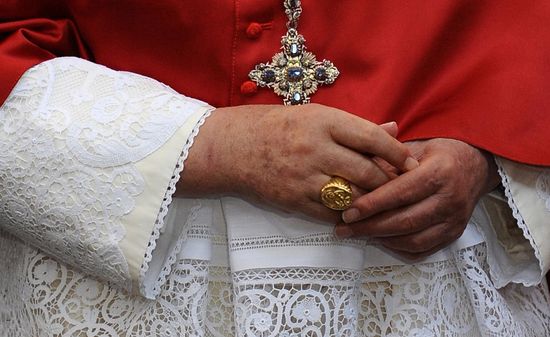
BENEDICTHANDS2JoeKlamar:AFP:Getty

We now know that this Pope was personally involved in enabling the rape of children rather than confronting criminal priests during his time as an archbishop in Munich. We know that while he had jurisdiction as head of the CDF, child-rapists were often allowed to carry on their crimes, and the most powerful rapist, abuser and cultist, Marcial Maciel, was abetted in his behavior. We know also that Benedict has seemed to try to get a grip on the problem as Pope, while never actually relenting on his own authority or the church's own sense of its own immunity from legal or criminal investigation. And we had, for example, his stirring letter to the Irish bishops about the appalling legacy of child abuse, torture and cruelty perpetrated for decades by men and women abusing the power of their religious office.

In this mixed legacy, we now find this. Two bishops in Ireland tendered their resignations to the Vatican in the wake of the ground-breaking and earth-moving Murphy report on church abuse. The Pope has now refused to accept their resignations, setting off a firestorm of outrage in Ireland:

Survivor Andrew Madden, who was abused as a child by paedophile priest Ivan Payne, said the announcement came as no surprise. "Today's announcement also shows how utterly meaningless the instruction was that Pope Benedict gave to Irish bishops to identify steps that would bring healing to victims of clerical child sexual abuse. Victims asked for those who were part of the governance of the archdiocese when sexual abuse was being covered up to resign, and this is ignored," he said.

John Kelly, of SOCA, said he was "bitterly disappointed" the bishops' resignations had not been accepted by the Vatican. "It will do nothing for the church and it will do nothing to help bring closure for the victims, especially in the Dublin Archdiocese," he said.

Kevin Clarke in the Jesuit magazine, America, writes:

It is truly becoming difficult to comprehend the thinking going on within the Curia on this issue. Here were two men making, after some episcopal arm-twisting that no doubt cost Archbishop Martin a great deal, who offered themselves up in a small gesture of accountability—so much more is required—but even this meek effort has been rejected in Rome. Could the Curia truly be so oblivious to the anger and frustration of average Catholics worldwide trying to make sense of the church's response to years of sexual abuse by clergy on Catholic children? It doesn't seem possible.

And yet, tragically, it does.

(Photo: Joe Klamar/Getty.)
Support For Marriage Equality Accelerating? Ctd

I'm a little taken aback by the speed of events. Within one week, all the gay citizens of Mexico can get married and (perhaps) all the gay citizens of California as well. That follows Argentina's move as well. That's marriage equality in three land masses with 180 million people in this hemisphere. And then the sharp uptick in support in the US as a whole. But in some ways, nothing quote compares with this notice from the Prairie Advocate in rural Iowa. It reads as follows:

Donald Fair and Warren “Butch” Dollinger were united in marriage on July 23, 2010 at the chapel in the VA Hospital in Iowa City, IA. The ceremony was performed by Pastor John McKinstry of the First Christian Church of Coralville, IA. A World War II veteran stood up for the couple. The couple are both Navy veterans of the Vietnam War. The couple are surrounded and supported by family and friends. They have been together 40 years and wanted to honor their love for each other by pledging to be “together till death do they part.”

Love wins. In the end.

Bush’s Cordoba Connection

Megan Carpentier connects the dots:

[W]hen Bush adviser Karen Hughes was appointed Undersecretary of State for Public Diplomacy, the Bush Administration saw improving America's standing among Muslims abroad as a part of its national security strategy. And, as such, Hughes set up listening tours, attended meetings and worked with interfaith groups that — shocking, by today's Republican standards — included actual Muslims.

One of those people was Imam Feisal Abdul Rauf.

Chait:

I suppose by the Weekly Standard's reasoning, this would make George W. Bush a supporter of radical Islam. After all, his administration supported a man whose wife has an uncle who used to be “a leader” of a mosque that now has a Web site that links to the Web site of an allegedly radical organization.

Your Emails Are Polluting The Earth, Ctd

Google_thedalles_640-thumb-600x399-31247

A reader writes:

While I understand Ms. Butler's point about the environmental impacts of e-mail traffic (as an energy consultant, energy use of data centers is something I think about more than most I would guess), I think she misses a few key points in her article. 

The first would be the fact that memory space is highly reusable.  If I get an email with four photos attached, and keep it in my inbox for the rest of all time, then yes, there is a real increase in the demand for storage and the energy used by that storage.  But looking at my Gmail account right now, I am using 13% of my 7486 MB of storage.  There is plenty of unused capacity sitting there generating CO2 whether or not I'm using it to store data, and if I delete that picture (as I usually do, being a fan of a clean inbox) then that picture has not caused a real, sustained increase in the amount of energy needed to store my data. 

And I can't say for sure (given that her source didn't go into the details about his 17.5 kettles number), but that seems more like a lifecycle-analysis assuming the pictures are kept rather than viewed and deleted to free up memory space.  The same thinking can apply to the power use of the devices used to view the e-mails: I'm using my computer all day, so the marginal power consumption caused by receiving an e-mail with four attachments is probably negligible, and could even be negative; if I were running a program that required all of the computing power of my machine, but replaced some of that time with looking at LOLcats that my friend had sent me (without shifting the higher computer to another time), then distracting e-mails could actually prove a net power saver.

Another thing that Ms. Butler ignores is the replacement of older forms of media with digital versions.  I don't know the actual tradeoffs here, but the relative energy intensity of getting a photo printed at your local photo center as compared to the energy required to view it on a computer needs to be a part of this equation.  Yes, digital photos have drastically increased the extent of photo taking and sharing, but if each print takes 1000x (a completely made up number) as much energy to generate than its digital counterpart, then the net impact of the photo attachment is severely reduced. The same goes for most other types of attachments;  where I used to send a mixtape, I now send mp3s; where I used to send invitations, I now send an evite, etc.

This is not to say that we need not be concerned about the energy use of data centers, but rather that the situation may not be as dire as Ms. Butler implies.

Lessig On Obama

Very nicely put:

It's certainly not fair to criticize Obama for not being a Lefty. He wasn't ever a Lefty. He didn't promise to be a Lefty. And there's no reason to expect that he would ever become a Lefty.

But Lefties (like me) who criticize Obama are not criticizing him for failing our Lefty test. Our criticism is that Obama is failing the Obama test: That he is not delivering the Presidency that he promised…

Now I'm not sure whether it is leftist, or rightist, or centerist to govern through special interest deals. It certainly is Clintonist. It's precisely the administration that Hillary "lobbyists are people too" Clinton promised. And were she President, and had she done exactly what Obama has done, then no one, I included, would have any reason to criticize her.

But beefed up Clintonism is not what Obama promised. He promised to "take up the fight." His failure to deliver on that critical promise — the promised that distinguished him from his main primary rival — or even to try, is a failure that everyone, Lefties included, should be free to complain about without suffering the rage of Gibbs.

I am crestfallen over two profound issues: civil rights and accountability for war crimes. Maybe in the long run, it will come out all right. And I understand the necessity of pragmatism and the awful legacy this president inherited. But you cannot head up a government that uses evidence based on torture and remain the candidate so many of us supported in 2008. And you cannot actually take a position that is directly against the tide of history and morality on gay equality and pretend you are a new kind of politician, prepared to take on the fear of the far right that gripped the Clinton years. 

These are not questions that are susceptible to pragmatism alone. It is because many of us take this president's intellectual and moral integrity seriously that we find these compromises too much. Because they are not compromises. They are surrender.

“Depressing Because It Is So Persuasive” Ctd

DSC03502

A reader writes:

I have to disagree strongly with the John McWhorter. His insistence that the failure of so many blacks to avoid the perils that come with not finishing high school and getting pregnant before marriage cannot be explained by structure or bigotry is too outrageous to let pass with no reply.  In fact they can be easily explained by structure (overt bigotry is probably not as much of a factor.)

The school systems in black neighborhoods are underfunded and undeniably worse on average than those in white neighborhoods.  The quality of the school, its teachers and leadership has a direct influence on graduation rates.  Sex ed and access to contraceptives are also far worse in black communities.  The public health failures come well before this for many black youth.  The failure to provide adequate health care and nutrition to black adolescents has been linked to the behavioral and learning disabilities so prevalent in black schools.  The diagnosis of a learning disability is one of the biggest predictors of eventually dropping out of school, particularly in poor urban schools.

But the biggest omission of all, particularly for someone who seems so emphatic that internal culture and family structure rule the day, is the impact that social structures have on families in black communities. 

McWhorter doesn't debate the well-established fact that employers "are less interested in people with names like Tomika," but insists that it can't account for the problem poverty in black communities.  Of course a child who grows up in poverty faces vastly increased chances of being poor as an adult, whether black or white.  If that child's parents faced difficulties finding work because, just as an example, their names sounded "too black," then that’s a structural reason why that child is more likely to grow up to be more than a white counterpart. 

Furthermore, the unequal application of the criminal justice system in black communities increases the likelihood that a black child will grow up without one parent.  This means that there's one less parent to earn an income, one less parent to instill the sort of discipline all children need to graduate school and avoid unplanned pregnancies.  Even if the incarceration only lasts briefly, it still means that once the parent is out of jail he or she will find it much harder find employment.

Another writes:

In contrast, middle-class kids in places like Scarsdale know that their education is a track to a job – maybe not to their dream job, but a reasonably good-paying, high-status job. (As your chart suggests). They see it all around them; they have the social connections to people in law firms and hospitals and businesses that are waiting to help them into reproducing middle class life; they are motivated to complete their educations, because they know that whole network of support and good jobs are waiting for them.  School is not entirely disjointed from the work it's supposed to lead to, for them, and their world has a complex and massive social infrastructure, educational infrastructure, and economic structure in place to support their path. 

For most young people in the tough, underfunded schools left to them in poor neighborhoods, school feels like a joke – unrelated to the world they have no choice but to try to survive in, with or without a poorly paying job.  The job is not the only way to survive, and it may not even look like the most promising path.  With little or no reliable infrastructure to support a middle class life, it would collapse.

If the only jobs that are available in your neighborhood, with a high school diploma, are minimum wage jobs that don't actually pay enough to meet minimal bills, and you also don't have the network to the other jobs, the world would look very different.  Having a baby will, at least, give you a clear role to play in your world, and can look like a reasonable response to the situation.  This does create a radically different subculture from the middle-class culture, but cultural change is not so easy to instigate, because, especially for the poor, these cultural patterns have been necessary for bare survival; because they are doing the work of a socioeconomic infrastructure that simply is not there.

(Photo by Nema Etebar via FILE Magazine.)