by Chris Bodenner
Bill O'Reilly used to review porn for the Boston Pheonix, the left-leaning alt weekly.
by Chris Bodenner
Bill O'Reilly used to review porn for the Boston Pheonix, the left-leaning alt weekly.
by Conor Friedersdorf
On a recent evening my girlfriend and I tried a Burmese restaurant on Sepulveda Boulevard, arriving just before 9 pm, and hungry as two foxes. A sign on the door noted that during Ramadan, the establishment would be closing an hour early. Disappointed, we began to leave, but the owner rushed out, insisted that he'd cook for us anyway, and wouldn't take no for an answer. Inside we interacted with his warm family as they took our order, and exchanged friendly glances with other patrons. As we left, the owner thanked us profusely for coming, and encouraged us to return.
This small encounter happened as I was writing about the controversy over the mosque near Ground Zero. It isn't entirely rational, I know, but interacting with this Muslim family, a small part of their community, and their small but intensely offered acts of kindness made me even more angry than before about the demagoguery of some project opponents. This anecdote isn't an argument for the mosque, any more than a story about a negative interaction with a single Muslim would be an argument against it. But just as I am sure that my Muslim friends cause me to picture individuals when I think of anti-Muslim discrimination, affecting the intensity of my writing against it, even a brief positive interaction with strangers at a restaurant wound up influencing my worldview in some small way.
Scanning the news today, I see that someone near Nashville, Tennessee visited the construction site of a mosque, poured gasoline on the construction equipment, and lit it on fire. This is terrible in its own right, and upsets me, as I'm sure it upsets many of you. But I can't say that I react with the vulnerability that restaurant owner in California must feel as he reads the news, and how much worse to be a member of that Tennessee congregation, knowing someone in your own community carried out that hate-filled act. Just as small, chance interactions can increase the empathy people in a diverse country have for one another, these kinds of bigoted transgressions engender mistrust: despite them, the vast majority of affected Muslims will go on being peaceful citizens and kindly neighbors, but insofar as any of them are being recruited into radicalism, hate crimes against their community can only hurt their ability to resist, and wind up abetting the jihadist cause.
Since the controversy over the mosque near Ground Zero began, I've been fretting about the danger of stirring up resentment at a visible religious minority, especially when we're at war against a radical subset of their co-religionists. Historically, majority groups don't behave well in these circumstances. Other writers have busied themselves insisting, contra the evidence, that there is no backlash against Muslims in America.
I'd ask that everyone reevaluate that judgment. Besides the mob antagonism directed at people in protest zones who didn't even turn out to be Muslims, we've recently had protests at mosques in California and Tennessee, an arson at the site of the latter, and a Muslim cab driver stabbed, among other anti-Muslim acts. One way to prevent this from getting worse without abandoning legitimate debates about Islam in America is to forcefully push back against irresponsible elites (honorable mention goes to Adam Serwer and Outside the Beltway, among others, for doing this kind of work) rather than pretending that their incitement is without consequence.
by Conor Friedersdorf
As I read the accounts of Glenn Beck's rally, its large crowds, and its message of redemption, I see that even some of the most intelligent libertarians are seduced by the television and radio host's popularity, and what he has done for Hayek sales. This despite the dubious information he puts out and the creepy, hard to miss warning signals he keeps giving everyone.
These apologists should be reminded that meaningful political change takes a long time to happen, that Mr. Beck has spent a career reinventing himself whenever it suited his advancement, and that it's rather risky to hitch the libertarian wagon to a mercurial entertainer with a penchant for radically changing his beliefs and a willingness to sucker his biggest fans.
Credit the folks at Reason with a good video above. Whatever one thinks of the event, let's not judge Mr. Beck on it alone.
by Patrck Appel
Felix Salmon thinks getting the housing market moving will require more landlords, which will require lower house prices. Adam Ozimek eyes the low-hanging fruit:
One way to encourage more landlords in some areas would be to remove rent controls. Allowing landlords to raise prices increases the value of the investment to them, and thus increases their willingness to pay. In most places in the country this has gone by the wayside, but according to the most recent American Housing Survey there are still 529,000 housing units subject to rent control. That’s nothing to sneeze at.
Salmon searches for other obstacles in the way of landlords.
by Chris Bodenner
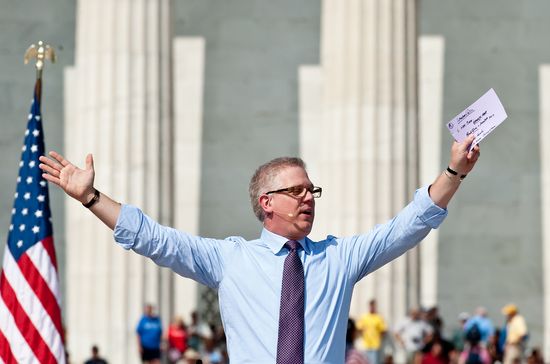
Peter at Right Wing Watch profiles the less-publicized part of Glenn Beck's revival weekend:
… America’s Divine Destiny, the Friday night warm-up to Beck’s Lincoln Memorial rally. The three-hour program at the Kennedy Center for the Arts combined gospel music, patriotic songs, and speeches about the need for spiritual renewal in America. It is impossible to overstate Beck’s assessment of the importance of his events. Toward the beginning of Divine Destiny, he stated, “this is the beginning of the end of darkness. We have been in darkness a long time.” Saturday’s rally, he said, would be a “defibrillator to the spiritual heart of America.” Near the end of the program, he emphatically declared, “We are 12 hours away from fundamentally transforming the United States of America. It has nothing to do with this city or politics, it has everything to do with God Almighty.”
Ultra-Christianist John Hagee gave the closing prayer. Peter was also there at 6 am:
[Betty] Ring said she arrived at 10 last night, too late for tickets, but spent the night outside anyway as she had no hotel room. She encouraged people to come back to the Kennedy Center tonight for an unofficial prayer rally outside while Divine Destiny was happening inside. Ring claimed that Beck had been told by Kennedy Center officials that he could not pray inside, and that in response they will pray all night.
(Photo by Nicholas Kamm/AFP/Getty Images)
by Chris Bodenner
Tim Heffernan winces at the dark rhetoric of Debra Burlingame, a September 11 activist – and now anti-Cordoba activist – who lost her brother in the Pentagon attack. (She and Liz Cheney co-founded Keep America Safe, perhaps the most powerful fear-mongering group out there.)
by Chris Bodenner
Efforts by liberal partisans to find displays of racism at the Beck rally come up short.
by Conor Friedersdorf
It's the final week before Andrew returns, and I'd like to begin it with another question for readers: What about your profession or field of expertise do most people not know or fail to understand or appreciate? Straightforward answers are fine, as are reflections on what the media gets wrong about your field, or what insights it gives you that others might find helpful as they try to understand the world. And yes, rants from service employees are also okay.
(Send to conor.friedersdorf@gmail.com with "About My Job" in the subject line.)
by Zoe Pollock
John Farrell celebrates the 60th anniversary of "Humani Generis", the papal encyclical (or pastoral letter) that established the Catholic Church's official relationship with Darwinian evolution, written by Pope Pius XII in 1950. While recognizing the Pope's foresight, Farrell also points out a slight problem in the church's position today:
While Pius was willing to concede that there was reason to believe the human body was the product of evolution, he was adamant that the special status of Adam as the father of the human race should not be a matter of question. "For the faithful," he wrote, "cannot embrace that opinion which maintains either that after Adam there existed on this earth true men who did not take their origin through natural generation from him as from the first parent of all or that Adam represents a certain number of first parents."
Pius declared that it was not apparent how such a theory of a founding population of humans, and not a single couple, could be reconciled with original sin. That Catholic doctrine regards the Fall as an historical rebellion against God; a sin actually committed by an individual and which is passed on through the generations from him to all men and women.
Subsequent research into genomics, however, has settled this question against Pius. It's not that scientists cannot trace human ancestry back far enough to an Adam and Eve; it's that in principle, the level of genetic variation present in the species today rules out a founding population with fewer than several thousand individuals.
by Zoe Pollock
Living backwards:
Aids PSA Topsy 90 human Mix-Simian H.264 2 from Human Music & Sound Design on Vimeo.
(Hat Tip: Videosift)
 The Dish