The Untamed Prince, Ctd

A reader writes:

As an Iraq invasion supporter, I suppose I too have been "radicalized." But I don't feel radical on principles; I don't mean to advocate for proletariat ownership of the means of production, or sub-10% taxation of the top 2% of wage earners, or anything. I am forever radicalized against trusting the government and the media about much of anything, particularly matters of national security.

As an oldest child, from an upper-middle-class family, I'd always been inclined to think that things were mostly being conducted on the up-and-up; that we as a people had learned the lessons of the Gulf of Tonkin, segregation, and Watergate. Now I know that those were eternal lessons of human frailty, not lessons of history learned by all.

Reading Marcus Aurelius and the Federalist Papers on governance and human nature would once have been described as "conservative"; no idea what to call this radicalization of tone and attitude in light of what that term means now.

For me, real conservatism and real Christianity have never been more vital. Or their absence so striking.

428 Districts

Nate Silver believes that the GOP is reprising Howard Dean's 50 state strategy:

According to research by Derek Willis of The New York Times, the Republicans will nominate candidates in 428 Congressional districts this year, leaving only seven races — all in overwhelmingly Democratic areas, like the South Side of Chicago — uncontested. This contrasts sharply with 2006, when Republicans left the Democrats unchallenged in 45 districts, or 2008, when they failed to nominate a candidate in 42 races.

The Democrats, for their part, are not doing badly: They will have a candidate  on the ballot in 412 districts –  all but 23 — which is better than their recent historical average. Still, this is a step down from 2008, when they left just 14 seats uncontested.

He gives Republicans about a 25 percent chance of taking over the Senate.

The Survivors

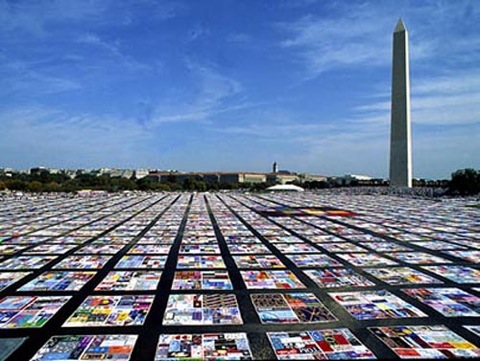
Aids_Quilt

A reader writes:

I know this feeling well. My small town in Pennsylvania hosts an annual AIDS Walk each autumn. A few years ago, I was involved as a volunteer, handing out tee shirts to participants. As part of the event, the organizers had arranged for a small portion of the AIDS Quilt to be displayed in the middle school gym for the day, a beautiful, azure-skied, October day. I had not been near the Quilt since the early ‘90s, when I served on the organizing committee for a display at Rutgers University in New Jersey. I had contributed a panel for a dear friend who died in 1992, a peak year for the AIDS epidemic that took so many from our lives. But other than that, I hadn’t thought much about the Quilt (or, to tell the truth, AIDS itself) for a few years. So when my tee shirt duties were done, I wandered into the gymnasium.

A fleeting feeling of apprehension did cross my mind but I thought, casually, “I can handle this. It’s been years now. I dealt with the pain, the loss. They’re dead. They can’t hurt me. The least I can do is see the panels, pay my respects, remember.” And so I strolled in to see the Quilt panels.

I lasted five minutes, if even that. All the pain, all the feelings of loss and bewilderment, came rushing back up at me, as if those deaths were yesterday, not a decade or more ago. “Like a knife through the heart” as the old cliché goes. The images, the words from the panels came swimming up around me, all the pain and loss and grief (“Oceans of grief” I used to describe it to my partner) overwhelmed me. I mourned everything again, their lives, their deaths, my losses, and all the pain and grief of the young man I used to be, the happy-go-lucky chap who changed forever in those black years. I was myself and I was him as well, all over again, mourning, keening, weeping.

I couldn’t take it. None of it was buried at all. It was all just below the surface. I still carried all my love and all my loss. “The past isn’t dead. It isn’t even past.” I understood that for the first time. And then I stumbled away. I could only take so much. And so much less than I expected I could handle. Hopefully, our grief strengthens us. In time it becomes part of us. But I’m not sure the pain ever goes away.

About five times as many young Americans died of AIDS as died in Vietnam, in roughly the same time period. In the gay community today, the silence about this, the avoidance of this, especially among the young who have no families to remind them of the terror, is staggering. But human.


The Untamed Prince, Ctd

Jane Mayer:

Much has been written about the denial of due process for the five men who claim to have been victims of the extraordinary-rendition program. But equally disturbing is the message that this verdict sends to individual American citizens, like the former Jeppesen employee, who felt a call to conscience that made him speak out, even at the risk to his own future employment, because he believed that secret kidnapping and torture were crimes in a country founded on the idea that all people, not just Americans, have inalienable rights, including protection from cruel and inhumane punishment. That his allegations could receive a public hearing in the press, but not a legitimate hearing in the American system of justice—even under an Administration headed by a former professor of constitutional law—is a daunting reflection of the clout wielded by the national-security bureaucracy in Washington, in the age of the Long War. 

Those with consciences must now know: it wasn't the Bush administration alone that treated you with contempt. It's now the Obama administration as well.

Yglesias Award Nominee

"I would hope that Pastor Terry Jones and his supporters will consider the ramifications of their planned book-burning event. It will feed the fire of caustic rhetoric and appear as nothing more than mean-spirited religious intolerance. Don’t feed that fire. If your ultimate point is to prove that the Christian teachings of mercy, justice, freedom, and equality provide the foundation on which our country stands, then your tactic to prove this point is totally counter-productive," – Sarah Palin.

She of course grotesquely conflates this vileness with the Corboda center, and has done nothing but add rhetorical gasoline to the religious fire, but credit where it's due. Fox News seems to have drawn the line here too.

“Now There Are Nine” Ctd

A reader writes:

Regarding "Now there are Nine," on Arabic Speakers in the FBI: I was recently cut from the FBI Special Agent hiring process at basically the last stage: the polygraph.

I been selected based on my resume, and had passed batteries of written exams, personal interviews, and the physical fitness test (this was a killer). I am not quite an Arabic speaker, but I was studying the language diligently using Rosetta Stone during the application process, and I would have been pretty solid by the time I got to Quantico (I am a former corporate lawyer — I figured that my financial-legal experience was my "in"). Reliance on the polygraph is one reason the FBI and other agencies cut good people. No less than the National Academy of Sciences produced a massive report on the polygraph, and concluded that it is unreliable and shouldn't be used for employment screening.

Here is the reason I'm sure I "failed" the polygraph: from 2005-2008, as an attorney, I represented, on a pro bono basis, detainees held at Guantanamo Bay by the United States.

It goes without saying that everything I and my team did in this representation was 100% on the up-and-up, and largely a matter of public record (we wrote many editorial pieces and lobbied Congress on GTMO issues). Nonetheless, this experience made me anxious on certain national security questions on the polygraph exam.

More importantly, my appeal of my polygraph results was rejected by the FBI, even though I had been completely up-front about my GTMO experience, and wrote a letter explaining in detail how this affected my test results. In fact, I had bragged about this legal experience in earlier stages of the selection process, figuring that it had relevance to the FBI's counter-terrorism mission. In the words of the National Academy of Sciences:

A belief that polygraph testing is highly accurate probably enhances its utility for such objectives as deterrence. However, overconfidence in the polygraph—a belief in its accuracy that goes beyond what is justified by the evidence—also presents a danger to national security objectives. Overconfidence in polygraph screening can create a false sense of security among policy makers, employees in sensitive positions, and the general public that may in turn lead to inappropriate relaxation of other methods of ensuring security, such as periodic security re-investigation and vigilance about potential security violations in facilities that use the polygraph for employee security screening. It can waste public resources by devoting to the polygraph funds and energy that would be better spent on alternative procedures. It can lead to unnecessary loss of competent or highly skilled individuals in security organizations because of suspicions cast on them by false positive polygraph exams or because of their fear of such prospects. And it can lead to credible claims that agencies that use polygraphs are infringing civil liberties for insufficient benefits to the national security.

I sometimes wonder whether the "security theater" that characterizes airport screening and the entire Transportation Security Administration is also found in other areas of national security.