Face Of The Day

Student_JeffMitchell_Getty Images

Students from St Andrews University indulge in a tradition of covering themselves with foam to honor the 'academic family' on November 22, 2010, in St Andrews, Scotland. Every November the 'raisin weekend' which is held in the university's St Salvator's Quadrangle, is celebrated and a gift of raisins (now foam) is traditionally given by first year students to their elders as a thank you for their guidance and in exchange they receive a receipt in Latin. By Jeff J Mitchell/Getty Images.

Mark Twain Wouldn’t Approve Of Iraq, Ctd

A reader writes:

I consider Twain's Connecticut Yankee in King Arthur's Court a scathing indictment of the Iraq War. I had been told it was a great book and happened to pick it up during the invasion. The novel was incredibly prophetic, both about the folly and hubris of trying to change a barbarous society, and in the corruption that happens to the person who injects himself into it. As you might assume, the book ends in grand tragedy.

A reader writes:

Your quote from Twain could use some present-day context.  More than a century after the US invasion, look at the Philippines today – one of the better success stories in Southeast Asia, with a significant portion of the credit owed to the US intervention there. 

The country's educational and health care system are true achievements, as is its democracy.  All of these institutions can trace their roots back to the US intervention in some significant ways (although the US did support a dictator in the country for a long time).  If anything, the biggest legacy failure in the nation is the corrupt Catholic Church, which is the result of course of the Spanish conquest. 

None of this is to say that the US invasion was justified, moral, or successful on pure cost-benefit terms.  And I certainly don't mean to take credit away from the Filipino people for what they have been able to do for their country.  But it's important to keep in mind that US colonialism there led to some important achievements that sets the Philippines apart from its neighbors.  I think if in 100 years Iraq turned out like the Philippines, and if the US invasion ends up playing a similar role as it has in the Philippines, the Iraqi invasion and its short-term failures will be viewed in much different terms than it is today.

Up To Huck?

Frum hopes Huckabee can best Palin:

[A]n early Huckabee pact with a candidate acceptable to Republican donors (if not Romney, then Tim Pawlenty or even Jeb Bush) would command enough clout to push Palin off the stage. If not, all bets are off. As I think about it, that’s one of the big problems with the candidacies of a Thune, a Daniels or a Barbour: They will need Huckabee as much or more than Romney. Yet Huckabee is also a re-elected governor, plus he won the second largest haul of delegates last time. Why should he defer to any of them? And who will make him?

More Pets Than Kids, Ctd

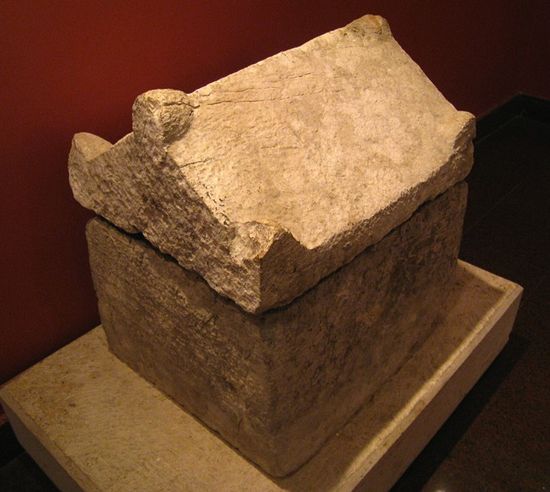
Stephanos_sarcophagus

A reader writes:

Pet pampering isn't anything new! Take a look at this photo that I took a few weeks ago. It's a sarcophagus from the ancient city of Termessos, in what is now Turkey. It was commissioned in the 3rd century AD by a rich and lonely woman called Rhodope for her beloved pet dog Stephanos. She had the following poem inscribed on the tomb:

(It was) Rhodope's happiness…
Those who play with it called lovely Stephanos
(This grave) keeps inside the one that death took suddenly
This is the grave of the dog Stephanos that went away and vanished
Rhodope cried for it and buried it like a human
I, (the) dog Stephanos, Rhodope caused my grave to be made.

Another writes:

I'm not really sure why I'm sending you this, other than the fact that you're a dog lover with a blog.  Our beautiful, gracious black lab, Emma, passed away this week, and Beloved-Emma-011 we're beyond heartbroken. 

She had been diagnosed with diabetes in May 2009, and she turned 14 on Nov. 11th of this year, so she was effectively a 98 year old diabetic.  Her passing can't be described as a shock, but it is crushing, nonetheless.

She had a long list of people that loved her, and that she loved in return.  We have had literally dozens of friends share their "Emma stories" with us over the past few days, and being able to recall the great memories of her long, wonderful life has provided tremendous solice.  What I found most helpful was putting those memories to paper (or computer screen), which resulted in my wife and I creating a long blog post.  A virtual wake, if you will. 

She was a wonderful companion that deserves to be remembered.  There is a massive hole in our house and our hearts.  We will miss her terribly.

“A Decision Happened”

George Packer reviews W.'s memoir:

The steady drip of … elisions and falsifications suggests a deeper necessity than the ordinary touch-ups of personal history. Bush has no tolerance for ambiguity; he can’t revere his father and, on occasion, want to defy him, or lose charge of his White House for a minute, or allow himself to wonder if Iraq might ultimately fail. The structure of “Decision Points,” with each chapter centered on a key issue—stem-cell research, interrogation and wiretapping, the invasion of Iraq, the fight against AIDS in Africa, the surge, the “freedom agenda,” the financial crisis—reveals the essential qualities of the Decider. There are hardly any decision points at all. The path to each decision is so short and irresistible, more like an electric pulse than like a weighing of options, that the reader is hard-pressed to explain what happened. Suddenly, it’s over, and there’s no looking back. The decision to go to war “was an accretion,” Richard Haass, the director of policy-planning at the State Department until the invasion of Iraq, told me. “A decision was not made—a decision happened, and you can’t say when or how.”

The Dark Side Of Foreign Aid

William Easterly and Laura Freschi use a new Human Rights Watch report to expose it:

Human Rights Watch contends that the government abuses aid funds for political purposes—in programs intended to help Ethiopia’s most poor and vulnerable. For example, more than fifty farmers in three different regions said that village leaders withheld government-provided seeds and fertilizer, and even micro-loans because they didn’t belong to the ruling party; some were asked to renounce their views and join the party to receive assistance. Investigating one program that gives food and cash in exchange for work on public projects, the report documents farmers who have never been paid for their work and entire families who have been barred from participating because they were thought to belong to the opposition. Still more chilling, local officials have been denying emergency food aid to women, children, and the elderly as punishment for refusing to join the party.

Palin’s Expectations Strategy For 2012

Telly Davidson contemplates the political implications of Palin's reality show (which I have dutifully DVRed but am having a hard time forcing myself to watch):

The show is an hour long weekly informercial for just how friendly, accessible, and common-sense intelligent Sarah Palin is (or seems to be when she’s in her natural habitat.)  Several liberal pundits rightly said that at least from an image/political POV, George W. Bush won his main debate with Al Gore back in 2000, because Bush over-performed from his low expectations (perhaps we “misunderestimated” him), while Gore, the climate-change genius who ‘invented’ the internet,  very noticeably under-performed from his.

Even someone as cuckoo for Cocoa Puffs as Sharron Angle was largely perceived to have “won” her debate with Harry Reid — because while Reid and the larger media narrative portrayed her as a glassy-eyed nutbar, she seemed like a reasonable, competent businesswoman in her actual one-one-one versus Senator Reid.  If that had been all we knew of her, she might well have won.  (With Angle’s beyond-Willie-Horton commercials and embarrassing digging-grave-deeper attempts at damage control with blacks and Latinos, she did herself in without any help.)

Why China Can And America Can’t …

… seem to build a network of fast trains:

Viewed from a purely technological perspective, America's high speed rail is an embarassment compared to China's:  shaky, slow, and not particularly sleek.  But viewed in another way, our slow rail network is the price for a lot of great things about America:  our limits on government power, our democratic political system, and the fact that we're already rich enough to have an enormous amount of existing infrastructure, in the form of houses, industrial plant, and roads, that would be very expensive to tear up in the name of building rail lines.  All in all, I think these things are more valuable than even a really cool train system.

Meanwhile, Megan struggles with her free market principles while observing China's economic miracles.