The RNC’s Affirmative Action

by Chris Bodenner

No, not Steele. Indiana GOP Committeeman James Bopp emails Ben Smith with a little-known fact:

Our rules require the co-chairman to be of a different sex than the chairman. If a woman is elected chairman, then it must be a man. Right now, 2 women are running for co-chair. Both are well-respected. They will be cut out if a woman is elected chairman. Thus, this puts pressure on the supporters of the two women candidates for co-chair to support a man for chairman, disadvantaging a woman for chairman, i.e. Ann [Wagner] and Maria [Cino].

To his credit, Bopp calls this gender requirement "unfair".  (The current co-chair is Jan Larimer, by the way.)

Pity Not Assange, Ctd

by Chris Bodenner

As the U.N. begins to investigate whether Bradley Manning has undergone torture, Greenwald relays more unsettling details of his confinement:

In addition to confirming the facts I reported, [Manning's military defense lawyer] Maj. Coombs added several disturbing new ones, including the paltry, isolated terms of Manning's one-hour-a-day so-called "exercise" time (he's "taken to an empty room and only allowed to walk," "normally just walks figure eights in the room," "if he indicates that he no long feels like walking, he is immediately returned to his cell"); the bizarre requirement that, despite not being on suicide watch, Manning respond to guards all day, every day, by saying "yes" every 5 minutes (even though guards cannot and "do not engage in conversation with" him); and various sleep-disruptive measures (he is barred from sleeping at any time from 5:00 am – 8:00 pm, and, during the night, "if the guards cannot see PFC Manning clearly, because he has a blanket over his head or is curled up towards the wall, they will wake him").

Greenwald also lists examples of how the US government routinely condemns solitary confinement … when carried out in other countries. David House recently had a rare visit with Manning at the Quantico brig and found that "the Pentagon’s public spin from last week sharply contradicts the reality of Bradley Manning’s detainment." Daphne Eviatar provides an example:

Manning is also said to be a threat to himself, given the serious trouble he's in. As a result, he's on "Prevention of Injury" watch, which accounts for the lack of sheets and pillows. But his lawyer thinks that's a ruse. And indeed, it's hard to imagine why prison officials would treat someone who they worry is mentally disturbed by isolating him to the point that, as medical experts have documented, is likely to make him crazy.

On Writing, Thinking, And Technology Ctd

by Conor Friedersdorf

Matthew Lee Anderson follows up on Clive Thompson's observation that the word processor allowed him to “write longer, more discursive drafts, letting my thoughts wander into ever-more-creative-or-weirder nooks."

The word processor didn’t open up those corridors of thought–it simply externalized the process of getting there.  In a world where multiple drafts was both cumbersome and time consuming, those wanting to work out every detail of their thinking could do so in conversation with others or themselves (which we might call “thinking”).  The backspace button has rendered that process less important, which has doubtlessly altered the way we approach the craft of writing.

Contrast that with how Thomas de Zengotita describes writing in Mediated, which is one of my favorite analyses of our contemporary life:   “The idea is that reading and writing, by their nature, turn the mind inward, cultivate habits of rational reflection, encourage the imagination, the inner life in general–thus giving birth to a self in the modern sense.” …My suggestion is that the backspace key works against that aspect of writing through the hasty externalization of ourselves in solitude.  The alternative to thinking alone is thinking out loud and where if we need to externalize thoughts before meandering down every corridor ourselves, we might turn to have a conversation with someone else.  Now it’s easier to throw down stream-of-consciousness thoughts and let the editing process take over.

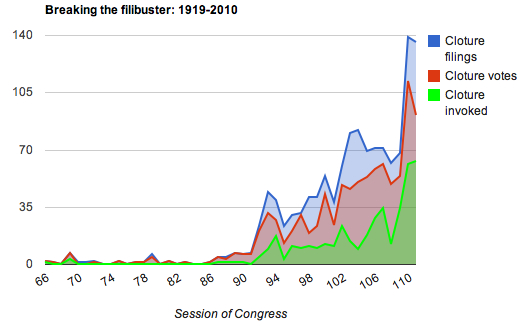
Chart Of The Day

Breakingthefilibuster

by Chris Bodenner

Ezra Klein comments:

First, the rise in filibusters is just shocking. And this doesn't even count all of them. It only counts those filibusters that the majority actually tried to do something about. Plenty more filibusters get threatened, but cloture doesn't get filed because the issue isn't important enough or the votes aren't present.

Second, note how many filibusters get broken.

It's not all, but it's a far cry from none (and it's more than you see in this graph, as filibusters that get withdrawn don't end through cloture). Some get broken by overwhelming majorities. But that doesn't mean the filibuster failed. A dedicated filibuster takes about a week to break even if you have the votes. That's a week of wasted time in the Senate. If your preference isn't merely to delay one vote but to threaten the majority with the prospect of getting less done overall, then launching a lot of fruitless filibusters makes perfect sense.

Ezra in a separate post addresses the question, "How, on the one hand, can I believe we've had the most productive congress in four decades, yet on the other, argue that the past two years show that we need major changes to reduce obstruction in the Senate?" Meanwhile, Greg Sargent reports that Reid is getting serious about the letter from Senate Democrats.

Towards A Sane Immigration Policy, Ctd

by Patrick Appel

A reader writes:

David Frum's point about more high-skilled immigration struck a cord with me.  As a Canadian who has been living and working in the US for more than a decade I can attest to how difficult it is to become a permanent resident, let alone a US citizen.  The US has high-skilled visa programs, and for high-skilled Canadians in particular it is fairly easy to get a T-1 or H1-B visa and live and work in the US indefinitely.  But there are restrictions and a lack of permanency and stability that come with these "temporary" visas.  For example, you could never be self-employed or start your own business, and if you change employers you might lose your visa status or have to leave the country and return under a newly issued visa.  A hassle at the least for Canadians, but can be incredibly disruptive and unsettling if your home country is India or Romania.  Then there's always the threat that if you ever leave the US you'll have trouble returning.

 Immigration and border security policies are constantly changing and an arbitrary decision by an INS agent can turn into a nightmare scenario.  Imagine at the end of a vacation not being allowed to return to your whole life, where you own a home, have a job you need to return to, significant other, a dog or cat,  a car left in airport long-term parking, etc. Your only recourse are frantic calls to an immigration lawyer, your boss, your family, hoping someone can help resolve the situation.  This sort of thing happens more often than you'd think.  I know this from personal experience, and the experiences of other Canadians working in the US.

The lack of permanency means Canadians in the US always have at least one foot out the door.  Many of my friends eventually return home because they never really put down roots.  And Canadians have it relatively easy compared to other nationalities.  As you can imagine, the difficulties and barriers are magnified when your home country is across an ocean.

It seems crazy that these high-skilled workers are not granted permanent residency the minute they arrive.  I think if that were the case, most would stay longer, or if they did leave they would be more likely to return at some point in the future.  There would be nothing but benefits for the US if these workers had permanency.

Another Canadian writes:

With Canadian unemployment rate of 7.6%, there is no suggestion of reducing the number of new permanent immigrants (equivalent to U.S. green card holders) from the usual rate of around 250,000 per year (2.5 million in U.S. population terms). All political parties are in favor of high rates of immigration, in part because new Canadians are politically active and have the resources to support political parties. Anti-immigrant newspaper or TV reports are almost non-existent. A recent NY Times article even described how one province was actively competing for skilled new immigrants

We are told that researchers from other countries (most recently a CBC radio report about Northern Ireland) come to Canada to figure out why the immigration system works. The media reports what doesn't work: Quebec's commission on "reasonable accommodation" which seemed to focus mainly on Muslim women wearing hijabs, foreign trained doctors driving cabs, Tamil refugees arriving on a boat from Asia, Sikh men carrying the kirpan, a ceremonial dagger, etc. I have no reason to believe that on a personal level, Canadians are any less racist than the average American – read the comments section online of the CBC, the Globe and Mail or any other newspaper – but there seems to be widespread acceptance that if we can't reproduce ourselves, then we need new Canadians to replace retiring workers (and to look after us in our dotage).

The question remains: why does it work? (My guess is it was more good luck than good planning; federal multiculturalism legislation may have provided a political framework in the 1970s but individual initiative and community support have probably had more important roles to play. It would be nice to hear from those foreign researchers…or maybe Mr. Frum can explain it to me.)

Let Taco Trucks Sell Beer

by Conor Friedersdorf

In my professional life, the freedom sapping policies that bother me most are consequential things like torture, excessive government surveillance, and the other civil liberties issues longtime readers have seen me cover. But in my personal life, it's restrictions related to the sale of alcohol that drive me nuts: Alabama's longtime prohibition on beer with the alcohol content of an average IPA; the baffling law in New York State that prevented my girlfriend and I from sharing a sample of whiskey when we visited a distellery; the fact that prior to a party I threw I couldn't buy alcohol at the Costco in Virginia; the notion that it is illegal for me to go down to a California beach on a Saturday at twilight and sip a cocktail at the water's edge as the sun sets.

These aren't the most urgent laws in the world to overturn, especially the ones that can easily be broken without great consequence. But they're so needless, nonsensical, and petty, and they offend my notion of the proper relationship between the state and its citizens. That brings me to an editorial in the Portland Oregonian. It's already been ridiculed by Kathryn Mangu Ward at Reason, but I can't help myself from seconding her. The subject are food carts in the city, some of which want to sell alcohol.

The OLCC has begun analyzing this request slowly, thoughtfully and carefully, as it should. The agency's first stop is the attorney general's office, to explore the legal ramifications of allowing food carts to serve alcohol. And let's acknowledge that, at present, neither the city nor the state has much experience in this realm. A wider, deeper exploration of what other states and cities do — and don't do — would be invaluable in guiding Oregon's policy direction. But our first response to the idea of food carts serving alcohol is overwhelmingly tilted in one direction: No, no, no.

There are two problems, as we see it, and not only do they seem insurmountable, but they also appear to be linked. First, food carts would have difficulty policing alcohol service to make sure it is legal and responsible. Second, if they found a way to solve that problem by fencing or roping off their alcohol service areas, other restaurants could gripe, quite legitimately, that the carts are undermining their businesses.

As Mangu-Ward points out, it's phenomenally absurd to assert that selling beer from a cart presents "insurmountable" challenges. Ponder that! Then there is this bizarre habit we have in America of roping off areas where people are drinking alchol. Many of you have likely experienced this pointless practice. "Oh, you want a beer at this concert? Come pack yourselves into this too small area." Because nothing makes alcohol use in society safe and healthy like packing all the drunks together.

And is it legitimate for brick and mortar restaurants to complain that carts are undermining their business? Bah. It's competition. To be fair, restaurants could legitimately complain if they faced huge burdens to sell alcohol, while food carts faced none. The solution: get rid of the absurdly costly regulations burdening the restaurants. The Oregnonian urges study of "what other states and cities do," and I encourage them to look across the Atlantic toward Europe. Any number of cities there show that citizens of liberal democracies can thrive and prosper even as carts legally sell alcohol outdoors!

Of course, Oregon remains under the mistaken impression that it is unwise to let consumers pump their own gas, despite it working out just fine almost everywhere else in the country, so the fact that its legislators can increase freedom without anything bad happening apparently isn't sufficient grounds for action.

The Return Of Depressing Christmas Songs

by Chris Bodenner

A reader writes:

Hey, how about some links to those dreadful Christmas songs you posted last year?  Or am I going nuts and it was another blog?

Twas us. Enjoy:

Charlie Brown – "Christmas Time Is Here"

Sarah McLachlan – "Wintersong"

John Eddie – "Another Lonely Christmas"

Judy Garland – "Have Yourself A Merry Little Christmas"

Judy Garland – "After the Holidays"

Laura Nyro – "Christmas In My Soul"

Robert Earl Keen – "Merry Christmas From The Family"

NewSong – "The Christmas Shoes"

Woody Guthrie – "1913 Massacre"

Harvey Danger – "Sometimes You Have To Work On Christmas"

Stan Rogers – "First Christmas"

Paul Kelly – "How To Make The Gravy"

John Prine – "Christmas In Prison"

Peter Warlock – "Bethlehem Down"

Bing Crosby – "I'll be Home for Christmas"

Pogues – "The Old Main Drag"

Aimee Mann – "Calling on Mary"

Jonathan Coulton – "Christmas Is Interesting"

Merle Haggard – "If We Make It Through December"

Joni Mitchell – "River"

Tom Waits – "Christmas Card From A Hooker in Minneapolis"

Roy Orbison – "Pretty Paper"

Nina Simone – "Little Girl Blue"

Stephen Colbert and Elvis Costello – Christmas duet

Kyle Broflovski – "A Jew On Christmas"

Dwight Yoakam – "Santa Can't Stay"

McConnell’s Long Game?

by Chris Bodenner

While most of the media are focused on the big wins of the White House and congressional Democrats in the lame duck session, Josh Green draws attention to GOP gains:

Last week, McConnell succeeded in blocking the omnibus spending bill to fund the government next year, forcing a compromise that will deny Democrats money budgeted to enact the new health care and financial reform laws. That spending bill will be revisited next spring, when Republicans will be more powerful and better able to shape it to their interests. The tax deal, too, even beyond the two-year extension of the Bush cuts, will yield future benefits. That extension will expire in the middle of the 2012 presidential campaign, which will allow Republicans to make the same threats about tax increases that have just proved so effective. Even the deficit-funded stimulus measures can be viewed as strengthening the Republicans' hand next year, when Congress has to raise the debt ceiling. Grassroots pressure to oppose this will be even greater in light of the larger revenue shortfall. In this sense, McConnell has operated in much the same way that Bill Belichick does during the NFL draft, forgoing immediate gratification for a bigger payoff down the road.

Pay the Best Teachers and Fire the Worst, Ctd

by Conor Friedersdorf

In so many ways, I am sympathetic to the American teacher. I tend to think that he or she is underpaid, expected to accomplish unrealistic progress in the classroom, forced to take unfair abuse from some parents, judged according to the flawed metric of test scores, and given insufficient administrative support.

But I just can't get past the issue of compensation and job security. Experience in other industries and many conversations with teachers in beats I've covered persuade me that pay primarily based on seniority and masters degrees doesn't attract the best canidates to the profession or motivate the folks there to excel as well as a different system would. And I know of no enterprise that wouldn't see the quality of its output drop if its administrators, however imperfect, lost the basic authority to fire unerperforming members of their staff without a protracted administrative battle. Some readers disagree, and others suggest I'm only partly right. (One reader below suggests evaluations are important, but should be done by teacher peers.)

As always, Dish feedback is a pleasure to read, even amid disagreement. Here are some folks pushing back against my viewpoint. A basic complaint:

What makes you think principals are capable of evaluating teacher performance?  Current teacher evaluation programs in public schools are a joke and have been for decades.  I’ll admit that job protections in teachers’ union contracts may be a root cause of this, because so little is at stake in evaluations that nobody has much incentive to take them seriously.  That said, public school principals as a group have little experience in effective teacher evaluation and many are
not prepared for the responsibility.

Note: this is not a secret in the educational community.  It’s why so many of the Race To The Top grants, not to mention enormous investments by the Gates Foundation and others, are directed toward evaluation methods.

A reader writes:

I retired last May after teaching 29 years.  A mistake people outside public education make is assuming that administrators know good teaching because they rose from the ranks.  They didn't become administrators because they were good teachers.  They went to school and got an administration certificate in order to make more money and/or get out of the classroom.  In hiring new teachers they are typically interestted in finding people who can coach (I'm talking high school here), who won't bother them with discipline problems, and won't cause too many angry parents to call and complain.  Its the teachers who know who's good in the classroom and who's a joke or
worse.

A few years ago the Denver public schools, with the help of the NEA affiliated teacher's union, came up with a teacher evaluation program that uses teachers as observers/mentors/evaluators rather than administrators. Its been a great success.  Teachers being evaluated by people who know how to teach, imagine that!  Think it'll ever catch on?

Says another:

There's a myth that somehow teachers are finished products at all times–they are either good or bad–rather than professionals who need to develop and improve in their field much like other professionals.  Here's a fact–Education programs in our universities are abysmal, with a few notable exceptions.  Teachers do not have the structured professional development that they need, especially in terms of the time and guidance to accomplish professional development. The Scholarship of Teaching and Learning (SoTL) is really taking off at the university level, and what I see in that scholarship is precisely what K – 12 teachers should regularly be involved with and participating in.  Sometimes the solution isn't firing bad teachers; the solution is training good teachers.  Ah, but then there's money that needs to be spent, and who wants to allocate tax dollars for those lazy, good-for-nothing teachers?

One solution or idea: you hear a lot about year-round schooling for students, but why not for the teachers?  Make the school year 9 months for students, but 12 months for teachers, with the summers being a time dedicated to structured professional development.  Sure, this is what a lot of dedicated teachers do in the summer months anyway, when they're not working other jobs, but it's time to make SoTL work, in some form, a regular part of a teacher's life and profession.  Professional development seems like a no brainer, but sadly, there is not much time for it under current working conditions, especially in our high schools.

And to hammer home the point:

I must warn you that you're only looking at one part of the equation. Arguably the biggest problem in schools — and one that's getting scant attention from policymakers or school reformers — is the abysmal standard of management in many school districts, or even within districts at specific schools.  There is a chronic national shortage of superintendents and principals, leading to a situation in which school districts hire each other's cast-offs at ever increasing salaries.  Management training in education is often little more than a pseudo-pedagogical credential for extracting pay increases under formulaic contracts based on college credit rather than performance.

Personality-based conflicts and vindictiveness and retribution abound in K-12 education administration today.  Talk to almost any teacher and you will constantly hear horror stories about administrators who are beyond even Scott Adams' ability to satire.  It's no wonder that even teachers who were good to start with will sometimes turn into unpleasant little trolls in this environment. Show me a good school or school district and I can almost guarantee that it's one where good principals and superintendents have been present in a stable arrangement for a long time.

This reader points out the complicity of principals in the current system:

I agree that bad teachers should be fired and it is often hard, but not impossible, to do this.  But the folks who are working toward that end have not taken your advice.  Policy folks seem to want ever more complex statistical tools, using test score data, to rate quality.  The LA Times story about value added analysis is the best example.  The issue of principals is thorny.  Yes, they should be given more ability to work with the staff of their school.  But even the strictest of teacher contracts allow for probationary periods for new teachers–those are the moments when principals can and should figure out which teachers need more training and which teachers may want to find another line of work.  If someone has been in a system for 10 years and obviously shouldn't be a teacher, there is probably a principal, not a union official, who can shoulder some of the blame.

And here's a powerful objection:

The best teachers are almost always rewarded for being so good, but not with salaries. They teach in the best schools to the best students. That's the main sorting mechanism for quality in public education. The best teachers don't compete with one another for better salaries. They compete to teach the most eager and capable minds, and for the social status that goes with teaching them: the students are grateful, and so are their parents.

This, of course, is why bad schools suck. Not only are the students "disadvantaged," but most of the best teachers leave. You can fire all the teachers in a lousy school, but if the students are impossible to motivate and resist teaching, if their parents don't give a damn whether their kids achieve or not (or credit the teacher when they do) it won't matter how much money you pay the teachers. Their students will be sitting in front of a burnout in no time.

I don't understand why so many economists don't get this. Do professional economists teach college because the money's so good? No. If you do find a teacher that is highly skilled and willing to throw his skills and talents away on year after year of students and parents who can't or won't appreciate his work, shoot him. He's no teacher. Can you imagine that any artist who was true to himself would do it?