The Purging Of Moderates And Liberals

Alan Abramowitz analyzes the incoming House:

[T]he new House of Representatives will be much more conservative and much more ideologically polarized than the old House. The location of the median member will shift from slightly left of center in the 111th Congress to well to the right of center in the 112th Congress due to the replacement of a large number of moderate Democrats with conservative or very conservative Republicans. In addition, the total number of moderates in the House, almost all of whom were Democrats, will shrink from 75 in the old House to 28 in the new House. As a result, the ideological distance between the median Democratic representative and the median Republican representative will increase dramatically.

Can You Imagine Palin On Meet The Press?

Weigel summarizes Palin's media strategy:

Since the launch of Going Rogue, Palin has had a two-pronged media strategy of policy statements via social media and conservative TV/radio, and soft-focus profiles via the "MSM." Palin has been one of Barbara Walters's annual "Most Fascinating People" every year since she was McCain's running mate. She's done Oprah, she's done the View, she has a reality show that you've probably heard of. What's missing in Palin's media strategy is what has been missing since she became a national figure — interviews or press conferences on policy, with political reporters. Going on Meet the Press might not reach as many people as going on Oprah, but surely some of the reason that Palin has a higher negative rating than Barack Obama or George W. Bush is that "indie" voters have yet to see her exit a comfort zone to talk policy.

Face Of The Day

AssangeTintedCarl CourtAFPGetty

Wikileaks founder Julian Assange is pictured through the heavily tinted windows of a police vehicle as he arrives at Westminster magistrates court in London, on December 14, 2010. Julian Assange blasted Visa, MasterCard and PayPal Tuesday for blocking donations to his website, in a defiant statement from behind bars ahead of a fresh court appearance in London. By Carl Court/AFP/Getty Images.

The Next Neocon Nation-Building Project?

A writer at Red State:

The United States of America will likely be forced to invade Mexico. It’s not a matter of if, it’s a matter of when.  The question then becomes: What to do with Mexico after we invade it and wipe out the drug cartels (as much as can be). Does the United States merely return Mexico to a nation state of corrupt politicians, failed economic policies, and lawlessness, or do we annex Mexico and turn it into the 51st state?

Ironically, it is American lawlessness, in the form of buying illegal narcotics, that has helped turn Mexico into a state destabilized by violent drug cartels. And merely ending drug prohibition, which would destroy the black market, would go a long way toward giving our southern neighbor space to improve its position.

Post-Nancy conservatives deserve most of the blame for the drug war as it exists today (not that Democrats have been much better). Sadly it seems likely that a lot of rank and file conservatives would sooner invade Mexico than admit defeat in the War on Drugs. Over to you, Rick Perry.

The Rebound Effect Or Why A Prius Won’t Save The Planet

Complicating Stephen Budiansky's thoughts on emissions and efficiency, here is Bjørn Lomborg:

Here's something to think about. Back in the early 1970s, the average American expended roughly 70 million British thermal units per year to heat, cool, and power his or her home. Since then, of course, we have made great strides in energy efficiency. As the Washington Post recently reported, dishwashers now use 45 percent less power than they did two decades ago, and refrigerators 51 percent less. So how much energy do Americans use in their homes today? On a per capita basis, the figure is roughly what it was 40 years ago: 70 million BTUs.

This surprising lack of change is the result of something economists call the "rebound effect." It's a phenomenon familiar to urban planners, who long ago discovered that building more roads doesn't ease traffic jams—it merely encourages more people to get in their cars and drive.

The underlying principle is a decidedly counterintuitive fact of life. You might think that learning to use something more efficiently will result in your using less of it, but the opposite is true: the more efficient we get at using something, the more of it we are likely to use. Efficiency doesn't reduce consumption; it increases it. 

Chart Of The Day II

Mobility

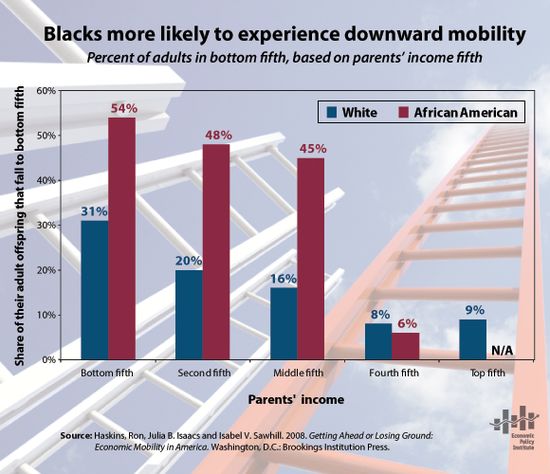
Kai Wright finds this arresting bar graph from the Economic Policy Institute on upward mobility, or lack-thereof. Adam Serwer adds:

As you can see from the chart, almost half of black children born into the middle fifth dropped to the lowest income group by adulthood. As Wright explains, "Economic mobility is not the same for everybody in America, and to the degree we can talk about a genuine black middle class, it’s not a terribly secure one." I'm sure someone will flippantly describe these results as indicative of pervasive black cultural pathology, but that kind of explanation strikes me more and more as a kind of social-science creationism, meant to blunt empirical inquiry into the problem rather than provide a real explanation.

Is Obamacare Really Unconstitutional? Ctd

Jeffrey Toobin thinks politics matter more than the substance of yesterday's ruling:

Personally, I found Hudson’s opinion unpersuasive. His invocations of Comstock were particularly misleading, in my view. But I found Hudson’s use of Comstock illustrative of a larger point. Judges, to a great extent, can do what they want. They can manipulate precedents to reach the conclusions they want to reach. In high-profile cases, the decisions are more about politics than law. If Hudson can cite Comstock for precisely the opposite of what that decision was clearly intended to do, all bets are off. The fate of health-care reform will rest not with the skill of the lawyers who will argue it—or in the words of the cases on which they will rely—but on the preferences of the nine Justices who will decide the case.