Andrew Belonsky considers the many small gay and lesbian bookstores across America that were forced to close this year:
Suddenly the dollars and cents of these businesses appears to be something else: a much larger discussion over whether it's best to have a "gay only" space safe from a sometimes hostile world? Or would it be better if gay become blasé, and we were fully integrated in the culture at large? Does self-segregation serve a purpose, or should the end goal be complete, seamless assimilation?
At their inception, gay bookstores weren't simply about wordsmiths. They were an organic outgrowth of a repressed culture, the manifestation of a collective need and want; they were part of a revolution. … The closures of OutLoud, Lambda Rising and the rest prove beyond a shadow of a doubt that LGBT people aren't fringe at all. We're mainstream precisely because we're struggling under the same recession as the rest of America.
Malkin Award: Running a strong second, with around 1,000 votes to his name, is South Carolina Lt. Gov. Andre Bauer. His remark about people who receive government aid:
“My grandmother was not a highly educated woman, but she told me as a small child to quit feeding stray animals. You know why? Because they breed. You’re facilitating the problem if you give an animal or a person ample food supply. They will reproduce, especially ones that don’t think too much further than that. And so what you’ve got to do is you’ve got to curtail that type of behavior. They don’t know any better."
Yglesias Award: In second place, and my vote for Yglesias Award of the year, is Jim Manzi's Mark Levin take down:
"There are many reasons to write a book. One view is that a book is just another consumer product, and if people want to buy jalapeno-and-oyster flavored ice cream, then companies will sell it to them. If the point of Liberty and Tyranny was to sell a lot of copies, it was obviously an excellent book. Further, despite what intellectuals will often claim, most people (including me) don’t really want their assumptions challenged most of the time (e.g., the most intense readers of automobile ads are people who have just bought the advertised car, because they want to validate their already-made decision). I get that people often want comfort food when they read. Fair enough. But if you’re someone who read this book in order to help you form an honest opinion about global warming, then you were suckered. Liberty and Tyranny does not present a reasoned overview of the global warming debate; it doesn’t even present a reasoned argument for a specific point of view, other than that of willful ignorance. This section of the book is an almost perfect example of epistemic closure."
This striking picture of a Palestinian girl at a beach by Getty's Uriel Sinai finished in second. The photo's caption:
An Israeli woman rubs sunscreen on a Palestinian girl from the West Bank village of Jahalin as they spend the day at the beach on August 2, 2010 in Bat Yam, Israel. A group of Israeli women organize a weekly visit for Palestinian children from all over the West Bank to the the Israeli seaside, for most of the children this is the first time they get to the beach.
Moore Award: With over a 1,000 votes, Keith Olbermann takes the silver for this gem:
"In short, in Scott Brown we have an irresponsible, homophobic, racist, reactionary, ex-nude model, teabagging supporter of violence against women and against politicians with whom he disagrees"
"The greatest threat to the United States today, the greatest threat to our liberty, the greatest threat to the Constitution of the United States, the greatest threat to our way of life; everything we believe in. The greatest threat to the country that our founding fathers put together is the man that's sitting in the White House today."
Shut Up And Sing: Justin Bieber's "Pray" narrowly beat New Kids On The Block, Sting, Madonna, and Michael Jackson for second place:
Von Hoffmann Award: Hugh Hewitt put up a good fight, but Andrew Sullivan –who will be back from vacation next week – was runner-up for the most wrong prediction of the year. The comment that earned him this honor:
"Even if Coakley wins – and my guess is she'll lose by a double digit margin – the [health care] bill is dead. The most Obama can hope for is a minimalist alternative that simply mandates that insurance companies accept people with pre-existing conditions and are barred from ejecting patients when they feel like it. That's all he can get now – and even that will be a stretch."
Mark Levin's interview with Sarah Palin couldn't best Bristol and the Situation but it still earned a respectable number of votes. I had the same reaction as this reader while listening to it:
I now understand, for the first time, why Sarah Palin is popular and why she is a real threat.
"Junk Mail" by T. R. Hummer first appeared in The Atlantic in April, 2003:
Opening his credit report, he found the story Of a woman he'd lied to twelve years before, and a book He'd lifted from a flea market, a signed first edition, And the time he'd watched, through a bathroom keyhole, his sister Touch herself: the Trinity of Credit Bureaus knew his every sin. He should have been outraged, he should have done— What? Called the FBI? Filed a lawsuit? Staged an exorcism?— Whatever you do to foil omniscience. But he kept on reading, And it went on forever, he couldn't put it down, it was fascinating.
The AP English teacher at my high school was a notorious dragon; for fun she also coached the debate team and regularly reduced the members to tears with her scathing critiques.
You had to take a test to be allowed into her AP level classes, write a paper, and if both were acceptable, she then interviewed you to see if she would accept you into her class. If the answer was yes, you then had to meet with the school counselor to make sure you could handle it. It was nerve-wracking, to say the least. So you can imagine our surprise when, on the first day of class, she instructed us to arrange our desks in a circle to facilitate discussion, she at a student's desk in the ring with the rest of us, and announced that we would spend the first semester on one book. Not the first week, the entire semester was to be completed devoted to one book, and she invidted us to guess which one. Smarty-pants that we were, the class guessed things like the Bible, the Complete Works of Shakespeare, the OED, etc.
Then she whips out Sherwood Anderson's "Winesburg, OH," a book most of us could have read in one night and delivered a five-page handwritten essay on the following day. To add insult to injury, it's a collection of short stories, many of which we had read for other English and comp classes. We were disappointed and grumbled, but soon ate our words, because this was a book that taught us to think.
Week by week we analyzed each character, line,and action. I don't know if you've ever read "Winesburg," but if you haven't you should. At it's heart, it's a story of human motivation, and how the little truths we cling to in life, like paper pills at the bottom of your pocket, can so easily become our things we wrap our lives around; sometimes for the better, sometimes for the worse. Anderson takes stock "small-town American" characters, like the retired doctor, spinster schoolteacher, the local hermit, shopkeeper, etc., and makes them real, taking us into their hearts. He shows us we are all the sum of our experiences, and how understanding the motivations of others will lead us to a better understanding and acceptance of the people around us. I have taken this to heart in my own life – I may not like all the people in my world, but understanding how they got the way they are goes a long way towards tolerance. I think more about why someone is bitter, or mean, or just plain weird, rather than dismissing them outright. In my work, I deal with a lot of crazy people - the mentally ill, alcoholics, drug addict, habitual liars, criminals, people with chronic pain; most of whom are uneducated or undereducated, and so used to being devalued that anger and defensiveness are second nature. Winesburg taught me to look beneath the surface and seek common ground – as one character puts it, "I want someone to love and I want someone to love me." Isn't that what we all want, in the end.
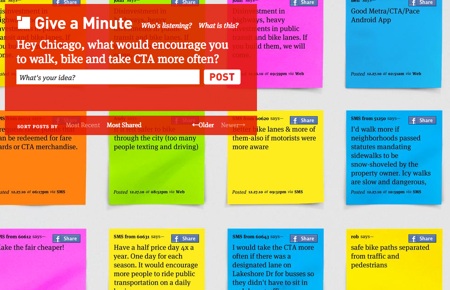
Alex Davies examines Chicago's attempt to improve its public transit system by crowdsourcing:
Over the last few weeks, Chicagoans have been asked a simple question: "What would encourage you to walk, bike and take CTA (Chicago Transit Authority) more often?" Ads posing the question in buses, subways and public spaces invite the city's residents to respond with their ideas, via text message. This mass call and response is part of Give a Minute, a campaign created by advocacy group CEOs for Cities and media design firm Local Projects, which looks to take public dialogue out of town meetings and into the streets.
I wanted to be deep. I thought I could search my brain, find something obtuse but well recognized. I wanted to be impressive. I wanted my comment posted, and for people to exclaim "ooh, good one." I read a lot. I know my music and my movies.
But when I think about what really guides my life, it isn't my politics, it isn't my worldliness, it isn't my education. It is the knowledge that life is kind of shitty, and then we'll all die. How long have I known this? Forever, it seems. At least before Camus or Tolstoy or Marquez reminded me as an adult. When I was a child, my mom would take me to The Hug Chair when life disappointed me and read The Velveteen Rabbit. I recognize now that it is not the most uplifting book. But it was a gift to acknowledge life's cruelties, and to learn that the only thing that would get us through it all is blind love.
In a fine longread, Paul Collins profiles the sad case of one of the first child celebrities, author and prodigy Barbara Follett, who went missing at age 26:
Extraordinary young talents are all the more dependent on the most ordinary sustenance. But instead of a home and a college education, what Barbara Follett got was author copies and yellowing newspaper clippings. This girl—who should have been America’s next great literary woman—was abandoned by the two men she trusted, and her fame forgotten by a public that she never trusted in the first place. Her writings, out of print for many decades, only exist today in six archival boxes at Columbia University’s library. Taken together, they are the saddest reading in all of American literature.
Odd Atlantic archives connection: Follet's father who abandoned her to marry another woman "wrote a peculiar anonymous essay for The Atlantic—“To a Daughter, One Year Lost,” in May 1941—which expressed muted guilt and amazement: 'Could Helen Hayes be lost for ten days without a trace? Could Thomas Mann? Could Churchill? And now it is getting on toward forty times ten days…' "
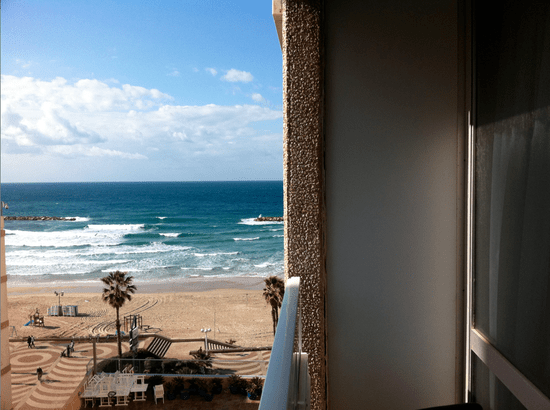
You have until noon on Tuesday to guess it. City and/or state first, then country. Please put the location in the subject heading, along with any description within the email. If no one guesses the exact location, proximity counts. Be sure to email entries to VFYWcontest@theatlantic.com. Winner gets a free The View From Your Window book, courtesy of Blurb. Have at it.
Alan Jacobs insists opting out of social networks is still a viable option for some:
We tell ourselves, by way of self-justification, that we need Twitter, need our RSS feeds, need Facebook. But no, we don't. We just like them very much. And as far as I’m concerned that’s good enough. It’s just necessary always to remember that we’re making choices and could, if we wished, make different ones about how we’re informed and what we’re informed about.
In this light it’s good to be reminded of a passage from John Ruskin’s Modern Painters that I recently quoted on my tumblelog:
To watch the corn grow, and the blossoms set; to draw hard breath over ploughshare or spade; to read, to think, to love, to hope, to pray — these are the things that make men happy; they have always had the power of doing these, they never will have the power to do more. The world’s prosperity or adversity depends upon our knowing and teaching these few things: but upon iron, or glass, or electricity, or steam, in no wise.


 The Dish