by Chris Bodenner
Amira Al Hussaini is gathering reactions to Yemen from Arabs on Twitter.
by Chris Bodenner
Luke Allnet explains why the popular hashtag is pretty much useless at this point, at least for protesters:
As much as the #jan25 Twitter hashtag enables protesters to coordinate, it also gives the police an easier way to monitor protesters as the conversation is focused in one place. Also, it's not clear how anyone could organize anything on popular hashtags like #jan25 with all the retweets, messages of solidarity, and sheer volume of tweets. If activists really wanted to organize through hashtags, they'd probably use ones not popularized by Western media. …
As in Tunisia, it seems where social media are truly transformative is in getting the story out (no small thing) to the wider world and acting as a surrogate for a state-controlled media either ignoring the story or only touting the government line.
by Chris Bodenner
Tens of thousands of people in Yemen have taken to the streets in the country's capital, calling for an end to the government of Ali Abdullah Saleh, the president. Inspired by recent events in Tunisia and Egypt, opposition members and youth activists are rallying at four different locations in Sanaa on Thursday, chanting for Saleh, who has been in power for 32 years, to step down.
by Chris Bodenner
One of our Egyptian readers closely following the coverage sends us a variety of great links:
People are trying to access Twitter (which was blocked Tuesday and Twitter confirmed that via their feed) and Facebook through proxies and all kinds of tricks. A video of how to reach blocked sites is making the rounds. Tunisians are helping by providing proxy lists.
Egyptian (government controlled) TV and Media have totally ignored the events even though the picture that you included yesterday here is in Tahrir Square which is less than 2 miles away from the state television building.
A headline in Al-Ahram (the state's most prominent newspaper) is about the riots, clashes and huge protests in Lebanon!!!! Translation: "Protests and Wide Unrest in Lebanon". Some info here from Al-Masry Al-Youm (Egyptian Today), an independent newspaper.
There's big dismay among protests about AlJazeera coverage of the events, but late Tuesday night when the government started cracking down on the protests gathered in Tahrir Square using tear gas (50 tear gas bombs reported to be fired), AlJazeera aired video of the shots being fired and the clashes with the protesters. Here's a video.
Some pictures are here, here, and a whole gallery here. Carlos Latuff (a Brazilian cartoonist of Lebanese descent) made some nice cartoons in support of the protests.
by Patrick Appel
Radley Balko complains about a New York bill that "ban the use of mobile phones, iPods or other electronic devices while crossing streets — runners and other exercisers included." Adam Serwer seconds him:
[B]anning cellphone use in cars also doesn't actually reduce automobile crashes, so there's no reason to believe that banning jogging with an audio device would reduce a negligent number of pedestrian fatalities. Listening to music while running seven miles makes doing so substantially more bearable, so I doubt a ban would even be effective. But if you want people to excercise more, banning the one thing that mitigates the pain of doing so strikes me as a particularly dumb idea, because if the ban actually worked it would probably reduce the amount that people exercise.
by Chris Bodenner
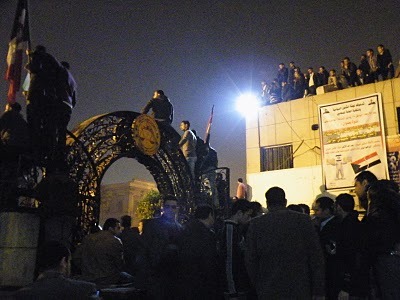
Scott Lucas takes stock of the past two days:
For those trying to follow events in Egypt, Wednesday was a chaotic experience. Unlike the close of Tuesday, when there was a single, dramatic episode to concentrate the signs of Government and opposition — the gathering in Tahrir (Liberation) Square in Cairo — yesterday forced the observer to try and gather information on a series of running battles.
Difficulties were compounded by the restrictions on communications by Egyptian authorities, who blocked Twitter and may have interfered with Facebook as well as disrupting cell phones in an effort to snap links between protesters. And of course the Government put security forces — thousands of them — on the streets of the cities.
Yet, for all the uncertainty and confusion of the day, what emerged last night was that the Government had not broken the back of the January 25 movement.
While demonstrators in Cairo could not offer the image of a mass rally, as they had 24 hours earlier, the smaller gatherings — from the Press and Lawyers' Syndicates to the Corniche to Ramses Street — demonstrated that the Ministry of Interior's threat to arrest anyone who assembled publicly had not been entirely effective.
The authorities were able to stamp out demonstrations in other cities before they could take hold. But in Suez, the situation appears to have been all-out conflict. By afternoon, the report was that 350 had been injured since the start of protests. While only three people had been killed — a remarkably low figure, given the reports of the intensity of the battle — by last night there were armoured vehicles on the streets.
This morning has started quietly in comparison. An observer reports "not a single policeman" is in Tahrir Square in Cairo. News from Suez is sparse. Yet this is probably an expected lull. For demonstrators are already pointing to Friday, the day of prayer, as the time for a mass display of resistance.
(Photo caption: "1000 Protesters at the Lawyers Syndicate in Cairo". More here.)
by Chris Bodenner
A reader writes:
The implication of Millman's quoted comments is abhorrent – that the "purely practical" violence and brutality of slavery is secondary to the "hugely negative" ideological impact of the 3/5 compromise. I wonder if he imagines slaves sitting in their lounge chairs reading the Constitution by firelight, their excited and expectant faces dropping with their self-esteem once they realize the document codifies them as but 60% of a person. They'd probably be too depressed to work in the fields the next day!
Another elaborates:
Your reader is right, and Noah Millman is wrong.
Counting slaves as three-fifths for census purposes was better than counting them as whole for precisely the reason the reader lays out: it diminished the power of slave holders by reducing the number House seats and Electoral Votes apportioned to states with large slave populations. Millman admits that the compromise was positive in "practical" terms, but insists that it was a negative ideologically. At first, this makes sense. He points out that (white) women and children did count as whole people for census purposes, even though they, like slaves, could not vote. (He appears to forget about unpropertied white men and free blacks, who also could not vote, but were counted in the census, which I'll dismiss as a minor oversight on his part.)
Millman complains that the compromise "[e]stablished in America’s founding document that slaves were not analogous to women and children – that they were something less than full (nonvoting) members of the community." It is true that slaves were not full members of the community – because they were slaves, whose status was determined by the states, not because of the way they were counted in the federal census.
I'm not buying the argument that counting them as full persons in the census while leaving them in bondage would have "[i]mplied that slaves were, indeed, analogous to women and children – fully human, but dependent on others because of their condition." It would have done no such thing. It would not have made them "full members of the community." It would not have made them full, or even partial, citizens of the Republic. It would, however, have further aggrandized their masters' political power.
And, contrary to what Millman might think, there was no "official ideology of the slave power." There was only an ever-shifing set of rationalizations. Some claimed slave holders were benevolent caretakers. Others claimed that the white race had God-given right to lord over other races. John C. Calhoun justified slavery by defending its role in preserving the pastoral, semi-feudal life of Antebellum South, which he saw as superior to the industrial life of the North. The truth is that there could not have been an "ideological" victory against slavery while still leaving it intact.
So the better choice was aim for the "practical" victory of the three-fifths compromise, however repugnant it may seem.
Another adds:
Sure, counting slaves as three-fifths of a person (rather than one) in the Census diminished the political power of the South in the early days of the United States. But it also meant they had to pay fewer taxes! This is because, prior to the 16th Amendment (which allowed income taxes), all taxes had to be levied "in Proportion to the Census or Enumeration herein before directed to be taken." (See Article 1, Section 9, Clause 4)
So there were two opposing forces: counting slaves fully meant the South would have more political power, but it also meant that they would also have to contribute more in taxes. The South resented the latter, and many thought that slaves shouldn't be counted for tax purposes (but of course they also thought that slaves should be counted for representation purposes!)
More supplemental history from Facts On File:
Delegates in Philadelphia did not conjure the three-fifths fraction out of thin air; rather, the three-fifths compromise had a history that predated the convention by a full four years. The federal number originated in 1783 with a proposed amendment, under the Confederation Congress, to transition the apportionment of taxes away from land values and to population. During that debate, Northern states campaigned hard to use population as the basis of taxation and to count slaves as people. The Northerners' position made sense for them because, at the time, a slight majority of all Americans (including slaves) lived in the South. By contrast, Southern states argued for the continuation of taxation based on land values. The problem with that proposal was that state governments assessed the values of their own land and notoriously undervalued their property in an attempt to escape the full brunt of taxation.

by Patrick Appel
Flowing Data explains how to read it:
The brighter the red, the more profanities used in the area, and the more black, the less swearing. Words looked for were (pardon my language): fuck, shit, bitch, hell, damn, and ass, and variants such as damnit.
How it was made:
Isolines are based upon an interpolated surface generated from approximately 1.5 million geocoded public posts on Twitter between March 9th and April 12th, 2010. These data represent only a sample of all posts made during that period. Isolines are based upon the average number of profanities found in the 500 nearest data points, in order to compensate for low population areas.
Larger version here.
Today on the Dish, Patrick rounded up the SOTU reax, including the three words most NPR listeners heard, while Nate Silver put Obama's power in perspective. Conor illuminated the real state of the union and obliterated the perfunctory SOTU editorials, while Douthat bemoaned the lack of specifics on the deficit. Alex Balk comforted us about the state of our stomachs, and Kevin Featherly ogled Bachmann's pupils.
Chris tracked events on the ground in Egypt, including the status of Facebook/ Twitter, and the day's craziest pictures and video. Blake Hounshell critiqued the WaPo for critiquing Obama's response, and Marc Lynch remained humble but optimistic, along with Steven Cook. Stephen Walt stood by his earlier assessment about Tunisia's domino effect, and Conor prickled at the blatant profit-scheme of the military-industrial complex. The US lost more troops to suicide than combat, but gaming helped them cope. Jennifer Rubin refused to apologize for calling Steve Clemons an Israel-basher, and Conor wondered if ending hotel porn would increase escort calls. Belgium pranked its phone company, and terrorists were punished.
Conor fought back against Hugh Hewitt's insistence that the right is a victim, but he wasn't any easier on Olbermann's bazooka style rhetoric. Frum blamed Fox News for the lack of 2012 candidates, Conor begged Bill Kristol to break a story about the GOP's inner sanctum, rather than just complaining about it, and he dared Ailes to hire Glenn Greenwald. Conor reiterated the Dish's policy on airing dissents, and the Internet still wanted the President to answer questions about our drug policy. We heard the flipside to animal testing, Noah Millman rebutted a Dish reader on the three-fifths compromise. Readers also weighed in on evolutionary psychology and rape, Obamacare, and Conor luxuriated in Huckabee's "folksy Old Testament wrath."
Walter Murch tested the science of 3D and found our evolution lacking, but Dish readers proved him wrong. E.G. found the shame of states bigger than just a joke, studying declined, and Apple (and Girl Talk) changed how we listened to albums. The DEA sold rubber duckies, America shuddered at eating soy, and weed went the way of Walmart.
Headline for the day here, VFYW here, MHB here, and FOTD here.
–Z.P.
by Conor Friedersdorf
Last week, my non-fiction newsletter took up "The Gun," an excerpt from CJ Chivers' book length history of the AK-47. The selection concerns the way that the American military responded to the weapon during Vietnam: intent on getting an assault rifle of its own into the hands of troops, it settled on the M16.
Had the early M16 been reliable, this might have been a straightforward and simple development, a story as old as war. One side gets a new weapon, the other side matches it in kind… The early M16 and its ammunition formed a combination not ready for war. They were a flawed pair emerging from a flawed development history. Prone to malfunction, they were forced into troops' hands through a clash of wills and egos in Robert McNamara's Pentagon.
Instead of a thoughtful progression from prototype to general-issue arm, the M16's journey was marked by salesmanship, sham science, cover-ups, chicanery, incompetence, and no small amount of dishonesty by a manufacturer and senior military officers. Its introduction to war was briefly heralded as a triumph of private industry and perceptive management. It swiftly became a monument to the hazards of hubris and the perils of rushing, a study in military management gone awry.
I found this piece timely due to the recent anniversary of President Eisenhower's warning about the military industrial complex. If you read the whole story – and I recommend doing so – you'll see that domestic politics and institutional flaws in the military were so influential that nothing was done even as American troops were sent into actual battle in wartime with weapons that didn't work.
A more egregious failure is hard to imagine – and it still wasn't sufficient for the matter to be immediately corrected. So ponder how much more difficult it must be to stop nonsensical military spending that isn't literally malfunctioning on the front lines. This bit of history suggests to me that we can never underestimate the mercenary impulse of humankind, that we cannot count on common sense or patriotism or a functioning moral code to ensure functional procurements, and that constant skepticism and vigilance are required, however uncomfortable it may be to acknowledge that some American defense contractors are perfectly willing to put lives at risk to safeguard their profits.
 The Dish