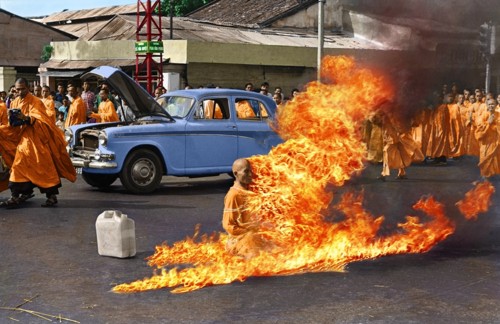
With Mohammed Bouazizi's self-immolation bound for the history books, The Daily What features another famous suicide in a new light:
Redditor mygrapefruit spent what I can only imagine was a considerable amount of time colorizing Malcolm Browne’s iconic photo of Vietnamese Mahayana Buddhist monk Thích Quảng Đức protesting the persecution of Buddhists by the American-backed government of Ngô Đình Diệm through the act of self-immolation (better known to many as the Rage Against the Machine debut album cover).
Sen. Mark Udall wants Republicans and Democrats sit together during the SOTU. Dan Amira differs:
Unity is great, sure, but apart from the entertainment value, there is an important practical reason to maintain the State of the Union's partisan seating arrangement. A neat separation of the parties allows the American people to see, in real time, their positions on the president's agenda and the issues of the day. It's actually very informative and helpful to be able to easily assess which proposals the Republicans and Democrats support, respectively, through the decision to applaud. It also allows us to identify the few party-bucking independent thinkers who, every so often, stand up to clap while the rest of their colleagues remain seated.
Conservative radio talk show host Mark Levin has put out a stunning challenge to those left-wing media personalities accusing conservative talk radio stars and Sarah Palin of encouraging murder. First, he offered $100,000 to Chris Matthews to find any example where Sarah Palin or Levin himself had "promoted the murder of anybody."
Here's an exchange Mark Levin had with a liberal caller to his radio show in May 2009:
Mark Levin: Answer me this, are you a married woman? Yes or no?
CALLER: Yes.
Levin: Well I don’t know why your husband doesn’t put a gun to his temple. Get the hell out of here.
Hmm. Suppose he gets off on a technicality – he was merely suggesting that someone kill himself. So unfair that anyone would accuse him of extreme rhetoric!
"Even giving a response that she had time to polish and rehearse, [Palin] was not so much unpresidential as anti-presidential. The party's congressional leaders did far better, by the way. Their responses, I thought, were mostly dignified and appropriate. Many Republicans, of course, already wanted to see Palin's political career go no further. I think her video was so bad it will persuade even some admirers to reconsider," – Clive Crook.
Her next decision – to face the public through the propaganda mouthpiece Sean Hannity – is of the same creepy nature. Hey, governor: hold a press conference. And why have you never done so? Is it, in your view, beyond your skill-set? But it's a critical part of the skill-set of any president.
[W]e are not always aware of what a glum, uninspiring thing compromise can be. It frustrates. Compromise was how things tended to go under those Vardaman sorts, when few thought of our government as especially gifted at getting serious things done. Or, the reason most of us have trouble naming the Presidents between Andrew Jackson and Abraham Lincoln is that they were mostly compromise candidates chosen to mind the store as inoffensively as possible, not leaders or innovators.
I would so love a politician these days who could just “mind the store”. Last time I checked, most stores had to balance their budget or go out of business.
President Ben Ali addressed his people last night:
[He] backed down in the face of deadly riots in his country and vowed Thursday not to run for re-election in 2014. Ben Ali has been in office for 23 years…. In addition to vowing to not change the constitution to allow him to run again, Ben Ali promised press freedom and ordered his security forces to stop shooting at protesters.
Tunisian blogger Youssef Gaigi says the speech was "definitely a major shift in Tunisia’s history":
Ben Ali talked for the third time in the past month to the people. Something unprecedented, we barely knew this guy. Ben Ali talked in the Tunisian dialect instead of Arabic for the first time ever.
He spoke directly to the police forces and ordered them not to shoot, unless in cases of self-defense. On the same line he said a commission will investigate in the murders that occurred. … He stated that the right of setting an organization, a political party, or a media will be totally opened. He said all censorship online or on traditional media will be stopped.
And there seems to be progress in that direction already:
Within hours after the speech, reports were already pouring in confirming the unblocking of some previously censored websites. … [T]he Twittosphere received the confirmation of the liberation of blogger, activist, and Global Voices contributor Slim Amamou, whose first tweet as a free man read: “I am Free.”
Pew has a new report on the future of automotive transportation. Cristine Russell helpfully summarizes:
The Pew authors conclude that by 2035 a new midsize car with a conventional drivetrain might get about 50 mpg on-road and those with hybrid-electric drivetrains roughly 75 mpg on-road (assuming new standards or market pressures continue to accelerate vehicle design and fuel efficiency improvements). Of course it takes longer to replace the older cars on the road. Even so, they say that the light vehicle fleet could perhaps attain an on-road fuel economy in the 35 to 40 mpg range by 2035 and 45 to 60 mpg by 2050 (much higher than the 21 mpg of today's on-road fleet or more conservative government projections of about 30 mpg for 2035).
I'm from Oregon, and have recently gone on several police ride-a-longs in the Salem and Portland areas. I spoke with officers at length about exactly this issue. While they were quick to point out the declines in local meth production, they were equally quick to point out (although not always in direct connection with the new ban) an increase in the presence of Mexican Cartels in the area. Essentially what happened is that, by curtailing local production, the government consolidated the meth market in Oregon, and made it a lucrative enough business that it was worth the cartels' time and money to get into.
So now we don't have biker gangs; we have Mexican cartels.
Another writes:
In 2006, I worked for the subcommittee in the House of Representatives that was the principal oversight body of the federal drug war. We were the ones responsible for the Combat Meth Act (inserted in the renewal of the Patriot Act), which federalized the restrictions on pseudoephedrine sales.
The thinking was that there seemed to be a real chance of truly ending meth production and consumption – a rare, total victory in the war. The precursor chemicals needed to make meth were produced only in Germany, India and China, and if those exports could be reliably controlled, restrictions on pseudoephedrine sales here could mean the end of the meth problem entirely. Apparently, the precursor chemicals are still finding their way to Mexico and the U.S.
Undoubtedly, the new law led to a noticeable decline of local "mom-n-pop" meth labs – dangerous productions sites that produced five pounds of toxic waste for every pound of meth. As usual, emotion was a big part of the arguments for it, with stories and pictures of redneck mobile homes or motel rooms polluted with chemicals, and men in biohazard suits carrying out children and hosing them down.
But, as with everything done in the drug war, we were just squeezing the balloon. That same year, we were in Mexico City and met extensively with government officials regarding the meth problem. At that time, they firmly denied that any meth was being produced there, much less exported to the U.S. Today, of course, all must admit that meth has now become a significant product of the Mexican cartels, and thus a driver of the horrible violence south of the border. Not only that, the "crystal meth" they send north is much more potent than what was normally produced locally.
In the end, we squeezed domestic production, and thereby created a tremendous opportunity for the cartels that they are ruthlessly exploiting.
Opposition to the drug war does not indicate a cavalier attitude to the destructive power of addictive substances (like, you know, alcohol). It is simply an honest recognition that there are limits to what big government can achieve, as well a recognition that the costs of prohibition far outweigh its alleged benefits.
People want drugs. Our moral outrage at the wreckage they cause is not a sufficient reason to criminalize their use. Alcohol prohibition taught us that. We should legalize (or at least, decriminalize, as Portugal has done with great success) and regulate production, and pour into rehab all the money we save by no longer caging casual users.
Lynch prodsThe Weekly Standard and the WaPo to write about the protests:
Tunisia is topic number one with Arab publics today, even if it isn't yet in Washington, and Arab audiences keenly notice their silence. If U.S. advocates of Arab democracy don't step up to draw attention to Tunisia's protests, it will only reinforce the skeptical view that their advocacy of Arab democracy is mainly about putting pressure on Hosni Mubarak or scoring points against the Obama administration. And that will weaken any future advocacy.

 The Dish