A Plea For Humility

Youngprotester

by Patrick Appel

Gregory Djerejian delivers one:

We have seen the usual suspects gripe and moan that ‘we should have supported Person X more’, or ‘Who Lost Egypt?’, or still, ‘See, Bush was Right!’, and so on. This is mostly clap-trap from journalistic, think-tank and other like-situated congeries busily settling old grudges and trotting out tired stereotyped narratives that, worth noting, tend to grossly overstate the impact the U.S. can or cannot really have amidst fast-moving historical currents.

The bottom line is events underway in Egypt are epochal and manifestly of gigantic implication, bigger than any one Administration, or whether we prodded Mubarak the right amount on say the Ayman Nour issue a few years back (as Nour himself noted from jail during the entire Condoleezza Rice ‘will she, won’t she' saga: “I pay the price when [Rice] speaks [of me], and I pay the price when she doesn't”), and regardless, certainly bigger than increasingly discredited mastheads ascribing blame for perceived missteps, by say, a heartlessly overly 'realist' Obama.

The bottom line is that history is in the making, and it is being made by Egyptians, in the main, and more quickly than we likely realize now. Put simply, we have less power to influence events than some of us might hope, and more should reckon with this reality, as well somewhat related, the edict: 'first, do no harm'. 

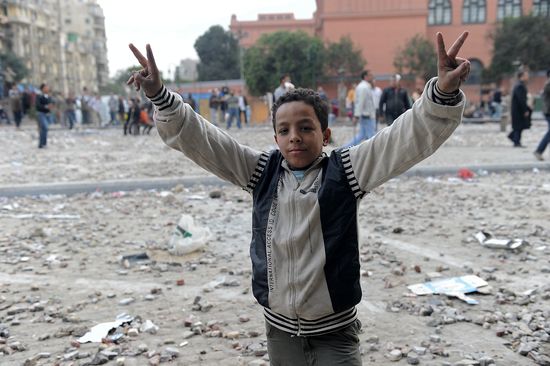
(Photo: A young Egyptian anti-government demonstrator flashes victory signs as a stone battle rages between fellow demonstrators and pro-regime opponents at Cairo's Tahrir Square on February 3, 2011 on the 10th day of protests calling for the ouster of embattled President Hosni Mubarak. By Miguel Medina/AFP/Getty Images)
Would You Want To Know When You’ll Die?

by Conor Friedersdorf

This Reason teaser gets at a fascinating question:

In 1998, a panel of eminent bioethicists convened at Stanford University said that most women should not take the new test for the BRCA-1 and BRCA-2 breast cancer genes. As Boston University bioethicist George Annas explained, "Since there is no way to prevent this disease, what good is knowing you will probably get it in the future?"

This may be a common view among bioethicists, notes Science Correspondent Ronald Bailey, but it is still wrong. As genetic tests become more readily available, researchers can identify people who are at higher risk of falling ill earlier, and enroll them in studies to uncover how the disease progresses. And the people who take the tests can use the information to help plan their futures. There's plenty of good in that.

I tend to agree with Bailey – lots of people would decide they don't want these tests, which is their right, but it ought to be a patient choice. On a related subject, it seems to me that these kinds of innovations are going to lay bear the long term untenability of using traditional insurance to cover health care.

Egypt Isn’t Iran

by Patrick Appel

Thoreau's view of Egypt's democracy movement:

Like many Serious People, Richard Cohen is convinced that the Egyptian protests will lead to the rise of an illiberal regime that doesn’t respect minority rights.  Now, yes, I am aware of what happened in Iran in 1979, and I am aware that Egypt has a history of illiberal regimes (e.g. the one that Serious People have supported for decades).  However, just a few weeks ago Egyptian Muslims were in the streets protesting against violent fundamentalists and acting as human shields around Christian churches.  So if I absolutely had to wager money on the outcome of these protests, I’d wager that the Muslims who acted as human shields for Christian churches are not about to turn around and put in place a radical theocracy.  I’d be less than shocked if they elected something a bit more conservative than Turkey’s Justice and Development Party, but would that really be so bad?

Gladwell Sticking To It, Ctd

by Patrick Appel

Pascal-Emmanuel Gobry exposes Malcolm Gladwell's faulty logic. Ackerman interviews Ahmad Gharbeia, a "computer security specialist" in Tahrir square:

“The role of the Internet was critical at the beginning,” Gharbeia says. “On the 25th, the movements of the protesting groups were arranged in real time through Twitter. Everyone knew were everyone else was walking and we could advise on the locations of blockades and skirmishes with police. It was real time navigation through the city, and that’s why it was shut down.”

Quote For The Day

by Conor Friedersdorf

"Justice Holmes said a long time ago that the best test of the truth is its ability to get accepted in the marketplace of ideas. Glenn Beck has gotten very far in the marketplace of ideas. If he's so wrong, where is the speech on the other side showing him to be wrong?" – Ann Althouse in conversation with an incredulous Bob Wright.

Once The Cameras Stop Rolling

ThursdayProtests

by Patrick Appel

Michael Wahid Hanna fears for the future of Egypt:

The actions of the Egyptian government should not inspire confidence. If the regime is willing to employ such violence in front of rolling cameras and worldwide attention, the international community should contemplate what the regime will be capable of doing once that attention has faded.

With the current regime committing to solely cosmetic changes, those in the Ministry of Interior who have been the primary repressive apparatus for the state will still be in place and will continue to backed by an emergency law granting them essentially unfettered discretion to continue their activities with a much broader list of regime opponents from which to draw.

The state does have constituents in addition to security forces and paid thugs — people who are worried about their positions in a post-Mubarak Egypt, or who legitimately fear an unstable transition. Mubarak is manipulating their fears, and there is some risk that he will succeed at driving divisions among different classes of disenfranchised Egyptians.

(Photo: Egyptian anti-government demonstrators gather at Cairo's Tahrir square on February 3, 2011 during clashes with pro-government opponents on the 10th day of protests calling for the ouster of embattled President Hosni Mubarak. ABy Marco Longari/AFP/Getty Images)

A Momentary Iranian

by Patrick Appel

Graeme Wood has an insightful new dispatch on being detained for having an Iranian stamp in his passport. He muses that Egypt's new vice president, Omar Suleiman,"probably knew the consequences of his word choice" when "he said this afternoon that 'foreign agents' might have instigated the demonstration against his boss Hosni Mubarak":

The men ultimately delivered me to a government building on the Nile, where a man in a police uniform spoke English and confirmed that I was either a native English speaker with an accent appropriate to his nationality, or an Iranian with an unusually effective ESL teacher. He guessed the former and let me go, but not before telling me by way of apology that there are "foreign people in the crowds who want to create danger and kill Egyptians." He said roadblocks and crowds along the corniche were advised to hunt down "Iranians, Hizbullah, Qataris, Hamas, and" — because why not? — "Israelis."

I suppose this list of suspects has some logic to it. Iran hates Egypt enough to have named a main Tehran thoroughfare after Khaled El Islambouli, the Egyptian artillery officer who gunned down Mubarak's predecessor Anwar Sadat (and injured Mubarak in the process). Qatar's Al Jazeera is indeed pro-demonstration. And Egypt is no friend of Hamas. 

In any case, the net is wide, and purposefully so. Foreigners are under attack, not just journalists. A stroll down the corniche has never been so frightening.