New Yorker Fact-Checks Poems

Which still seems surprising, but so does The Atlantic. This anecdote is one for the books:

[Elizabeth] Bishop, we learn in the new volume of correspondence between the poet and The New Yorker, yielded to most editorial requests, and this time was no different. "It's good to have a standard," said Alice Quinn, formerly the poetry editor at The New Yorker and the caretaker of the Bishop legacy. "Accuracy was one of the three qualities Bishop strove for: accuracy, mystery and spontaneity."

It was copy editors, though, who made their mark on Bishop's most famous poem, changing a colon to a semi-colon in Bishop's "One Art" ("The art of losing isn't hard to master;"), a subtle change that relaxes the statement rather than making it a declaration.

 And then there are just screw-ups. At TNR in the old days, we actually published a poem whose final sentence read "This is dummy copy". This boilerplate was a way of fitting words on a page before the final publication and obviously should have been removed before we went to press. It slipped through the copy-editing cracks. The truly tragic thing is that the only reader complaint we got was from the poet himself, who humbly asked why his poem had been so altered.

Yes, we re-ran it the following week, as it should have appeared in the first place.

The Day Of Rage Continues

EA rounds up protest video from Bahrain, Libya and beyond. Below are protesters in Libya destroying Muammar Qaddafi's Green Book, which outlines his political views, in Tobruk:

HRW's update:

The Libyan security forces killed at least 24 protesters and wounded many others in a crackdown on peaceful demonstrations across the country, Human Rights Watch said today. … Hundreds of peaceful protesters took to the streets on February 17, 2011, in Baida, Benghazy, Zenten, Derna, and Ajdabiya. According to multiple witnesses, Libyan security forces shot and killed the demonstrators in efforts to disperse the protests.

Nick Kristof's view of Bahrain:

As a reporter, you sometimes become numbed to sadness. But it is just plain heartbreaking to be in modern, moderate Bahrain today and watch as a critical American ally uses tanks, troops, guns and clubs to crush a peaceful democracy movement and then lie about it.

This kind of brutal repression is normally confined to remote and backward nations, but this is Bahrain. An international banking center. The home of an important American naval base, the Fifth Fleet. A wealthy and well-educated nation with a large middle class and cosmopolitan values.

Mackey:

Hadeel Al-Shalchi, a correspondent for the Associated Press in Bahrain, is also filing updates from her phone to Twitter on the new attack on protesters on Friday. About 30 minutes ago, she wrote that shots were fired at protesters trying to enter the Pearl Roundabout they had been cleared from in a deadly raid one day earlier.

She reported that the country's army was "firing live ammo from anti-aircraft guns from APC's at protesters" who were "carrying flowers." 

Al Jazeera reports from Bahrain:

I met up with Rajab and other protesters and activists in Bani Jamrah.  By the time I arrived, the group which included women and children, had finished marching and was milling about in front of neatly lined houses. Some held flags, others tried to walk to the roundabout that lie ahead, myself included, but none were actively demonstrating. This, however, did not stop the police from firing tear gas rounds at us. The first couple of times I choked a bit and my eyes burned, and I was given onions and rags dipped in vinegar to lessen the effects of the tear gas. As we attempted to walk towards the roundabout a second time, the police shot rubber bullets in our direction without warning. The cylindrical objects came flying at us from medium range about 15 at a time.

Meanwhile Scott Lucas describes Egypt today:

In contrast, Friday Prayers in Tahrir Square in Cairo has brought out hundreds of thousands of people in the "Day of Victory and Continuation". In the center of the square memorials were set up for the close to 400 people killed during the uprising against President Mubarak as demonstrators chanted, "The people demand the trial of the regime."

The Friday Prayer was led by prominent Muslim scholar Yusuf al-Qaradawi, his first public sermon since he was banned from leading weekly prayerst 30 years ago.

The Guardian provides a summary of events across the Middle East:

• Bahrain: After the funerals of protesters killed in recent violence, demonstrators were expected to head back to Manama's Pearl roundabout. Tens of thousands turned out for the funeral of Mahmood abu Taki (see 10.30am). The protesters' demands seem to be getting more radical, with calls for the monarchy to be removed (see 11.33am).

• Egypt: An estimated 1 million people have gathered in Tahrir Square in an event celebrating the fall of Hosni Mubarak and putting pressure on the army to include demonstrators in the country's transition to democracy (see 12.21pm). Yusuf al-Qaradawi, a controversial cleric, gave a strikingly non-sectarian speech.

• Libya: Reports claim up to 50 people have been killed in anti-government protests in the east of the country – but it is very hard to verify information from Libya. Reports claim al-Bayda has been taken over by anti-government protesters. But there was little sign of anti-Gaddafi feeling in Tripoli, where the Libyan leader paraded among crowds of supporters (see 12.17pm).

• Yemen: Crowds are demonstrating against Ali Abdullah Saleh, the president, in the capital, Sana'a, and elsewhere. The biggest demonstration – tens of thousands of people – was in Taiz, where reports said eight people had been wounded by a hand grenade (see 12.12pm).

• Jordan: Eight people have been injured in Amman in clashes between pro- and anti-government demonstrators (see 12.28pm).

• Iran: There were calls for the execution of opposition leaders (see 12.03pm).
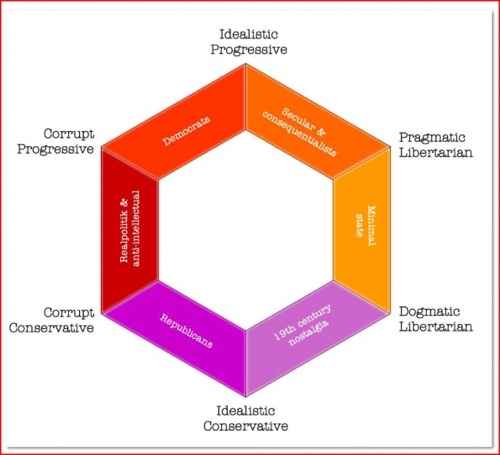
 

The Political Spectrum Reimagined

Taxonomy

Isn't that a novel way to see the political spectrum? It's Scott Sumter's idea. And Will Wilkinson gives it a qualified endorsement:

I find Mr Sumner's typology quite congenial probably because I have Mr Sumner's politics, more or less, and his way of carving up the ideological space places us where we see ourselves: as "pragmatic libertarians" leaning a bit more toward "progressive idealism" than "dogmatic libertarianism". That said, there is something troubling about the lack of parallelism in Mr Sumner's scheme. While conservatism and progressivism both have "idealistic" and "corrupt" variants, libertarianism is only "dogmatic" and "pragmatic". I think the ideological influence but electoral insignificance of libertarianism goes some way toward justifying its different treatment. But I wouldn't want to leave out the possibility of conservatism and progressivism that is pragmatic in the sense of pursuing conservative and progressive values through practical, empirically-tested means, and not in the "corrupt" sense of catering to the electoral interests of a partisan faction.

An Invisible Uprising

Najla Abdurrahman worries that no one is paying attention to Libya:

Libyans are painfully aware of the fact that their country does not attract nearly the same level of interest as Egypt or Iran, except perhaps when it comes to the eccentricities of their notoriously flamboyant dictator. This, despite the fact that the Qaddafi regime has been in power significantly longer than nearly any other autocratic system, during which time it has proved itself among the world's most brutal and incompetent.

Thus, from the moment a group of Libyans inside Libya — taking a cue from their Tunisian and Egyptian neighbors — announced plans for their own day of protest on Feb. 17, Libyan activists outside the country have been working tirelessly to get the word out, circulate audio and video, and pressure media outlets to report on Libya. If the Libyan protesters are ignored, the fear is that Qaddafi — a man who appears to care little what the rest of the world thinks of him — will be able to seal the country off from foreign observers, and ruthlessly crush any uprising before it even has a chance to begin. Eyewitness reports to this effect are already trickling in from Libya, and the death toll appears to be slowly mounting. Regrettably, international attention has thus far been minimal. 

Cool Ad Watch

And creepy all the same:

A few readers submitted the Youtube. One writes:

I thought you might like this, given your fandom for zombies. Yes, it's a trailer (with no actual gameplay) for a gory video game about survival on a resort island during a zombie outbreak. But for all that, it's classier than one might expect and makes a nice short film in its own right.

Oh yeah, and fair warning: CG blood everywhere.

One reader actually recommended it as a Mental Health Break. Oy.

The History Of Hello

NPR recounts it:

The Oxford English Dictionary says the first published use of "hello" goes back only to 1827. And it wasn't mainly a greeting back then. Ammon says people in the 1830's said hello to attract attention ("Hello, what do you think you're doing?"), or to express surprise ("Hello, what have we here?"). Hello didn't become "hi" until the telephone arrived.

Attending Harvard, In China

Evan Osnos marvels:

I was reminded of [China's deeply felt yearning for knowledge] as I scrolled through the extraordinary offerings on the “Public Class” section of Netease, a popular Chinese Web site. The “Public Class” program lists videos of American college classes, which have been subtitled into Chinese, so that any Chinese speaker can watch them for free. Are you a coal miner in Shanxi interested in Michael Sandel’s hugely popular “Justice” class at Harvard? Click here. Does your job at a real-estate developer in Shenzhen leave you curious about political philosophy? Perhaps a twenty-four-session semester with Steven B. Smith of Yale would satisfy you.

Egypt’s Future

Nathan Brown outlines possibilities: 

The danger of indefinite military rule in Egypt is small. While pundits have often proclaimed the military to be the real political power in Egypt since 1952, in fact the political role for the military has been restricted for a generation. And there is no sign that the junta wants to change that for long. It is order, not power that they seem to seek.

When the generals suspended the constitution, most opposition elements saw that as a positive step because it made possible far-reaching change, and I think that was a correct political judgment. (The suspension led to odd headlines in international press referring to Egypt as now being under martial law. But Egypt has been under martial law with only brief interruptions since 1939. It was not the generals who placed Egypt under martial law; that step was taken by King Faruq.)

For The Love Of Bieber

BieberGetty

Nina Shen Rastogi studies fandom's darkside:

[L]ots of fans [of Justin Bieber] reacted [to his Grammy loss] in ways that seem less sweet than scary. Spalding's Wikipedia page was attacked that night, with one irate Bieber fan commanding the woman to "GO DIE IN A HOLE." Twitter lit up with vicious chatter in the same vein. … At the same time, you could argue that Bieber devotees are just acting out a key part of what it means to be a fan of something (if in a slightly deranged version).

After all, fandom isn't just about celebration; it's also, ultimately, about competition—whether it's "my football team can crush your football team," or "I can name more obscure Bob Dylan B-sides than you can," or "I love Justin Bieber more than you do, and I'm going to PROVE IT." Plenty of us managed to outgrow our pre-adolescent passions and become relatively sane, normal adults.

(Photo: Justin Bieber fans show their support at Circular Quay on April 26, 2010 in Sydney, Australia. By Graham Denholm/Getty Images)

A Strategy Deficit

Jacob Stokes lambastes defense budget hawks:

Following, the release of the fiscal year 2012 budget Monday, the “Defending Defense” trio of The Heritage Foundation, the American Enterprise Institute and the Foreign Policy Initiative released a statement. The first line was “strategy should always guide the defense budget, not vice versa.”

True enough. But looking at the group’s proposals, there’s no strategy involved. Strategy involves identifying threats, establishing what’s needed to combat those threats and then budgeting to ensure those capabilities. The Defending Defense group makes no such efforts. Instead, they use as their yardstick defense spending as a percentage of GDP. GDP tends to continually rise – which is, for them, exactly the point. If the defense budget is pegged to GDP, it keeps rising.