Calling A War A War

Dennis Ross labeled the conflict in Libya "a limited humanitarian intervention, not war." Ackerman rolls his eyes:

It’s true that not every application of military force is a war. Reasonable people can disagree, but when Saddam Hussein’s removal of weapons inspectors in 1998 prompted four days of U.S. and British bombs and missile strikes, that didn’t quite rise to the level of a whole new war. By contrast, the concerted, open-ended multinational application of naval and air power to enforce a United Nations Security Council resolution authorizing “all necessary measures” to forcibly change the political behavior of a head of state — that’s something that Carl von Clausewitz would recognize in an instant. Call it smart, call it stupid, but please don’t call it anything besides war.

Why Focus On Copying?

Google Books is facing new trouble in the courts, which prompts Julian Sanchez to ponder the purpose of copyright:

Instead of ginning up exceptions to a general prohibition on copying just to permit publicly valuable use of content, maybe we should just admit that “copying” no longer makes sense as a primary locus of intellectual property regulation. Fair use analysis typically employs a four factor test, but the upshot is usually to see how a particular type of copying would affect the market for the original work—which makes sense, given that the purpose of copyright is to give creators a financial incentive to produce and distribute new works.

If that’s fundamentally what we care about, though, a default property-like right of control over copying, which now has to be riddled with exceptions to allow almost any ordinary use of content, looks like an increasingly circuitous Rube Goldberg mechanism for achieving that goal. I’m not sure what the alternative would be—or even whether rejiggering the basic categories would alter the the underlying analysis much. But—just off the top of my head—you could imagine a system where the core offense was not “copyright infringement” but some kind of tort of unfair competition with an original work. 

Chart Of The Day

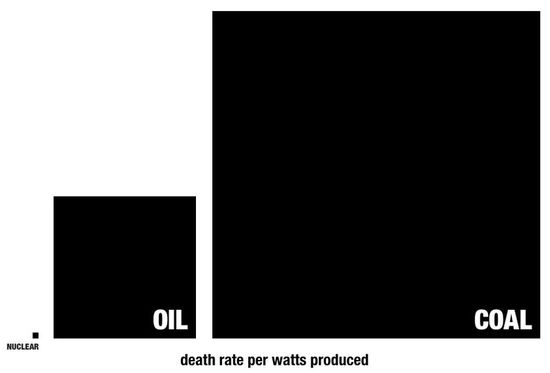
DeathRateEnergy

Seth Godin puts nuclear power's danger in perspective. He notes that for "every person killed by nuclear power generation, 4,000 die due to coal, adjusted for the same amount of power produced":

Vivid is not the same as true. It's far easier to amplify sudden and horrible outcomes than it is to talk about the slow, grinding reality of day to day strife. That's just human nature. Not included in this chart are deaths due to global political instability involving oil fields, deaths from coastal flooding and deaths due to environmental impacts yet unmeasured, all of which skew it even more if you think about it.

This chart unsettles a lot of people, because there must be something wrong with it. Further proof of how easy it is to fear the unknown and accept what we've got.

Leave Him

Caitlin Truman endorses relationship euthanasia:

Every marriage, union, commitment ceremony, or whatever begins with some silent hope. To whisper “I love you”, is to make invisible wishes: please work, please survive, please don’t go away. If it doesn’t work anymore, it never will again. This is very sad, but failed attempts to resurrect the dead will result in deep and excruciating pain. Anything special that ever existed will be invisible beneath a stupid, shitty mess. I have learned the hard way that best course of action is to turn, walk away, and allow your relationship to die and rest in peace. I know that I struggle with this process. Nobody will respond: Where did you go? I can see you but I cannot feel you.

Ideally, the death of what you had together is understood and mourned for. It’s best to sit alone and remember the love that you had once shared, because it does deserve some final homage. Beware of denial, because it is not cute. Absolutely do not try and get back together. Post-death relationship will be forced to exist in zombie half-life until finally there is nothing left except sick bitterness and a worm-eaten corpse.

The Case For The War, Ctd

Despite Zakaria's support for intervention in Libya, Joe Klein remains a pessimist:

[T]here is a segregation of talking heads–they tend to be either foreign or domestic. Those who specialize in foreign or military affairs tend to know little or nothing about what's happening within our borders. Those who specialize in domestic politics tend not to understand that vital impact on our national security that a country like Pakistan, for example, plays. Those who've argued for Libya intervention have been, for the most part, those who do not focus on the waning economic power of the United States, the need to rethink our long-term deficits, the need to invest in our future. They tend to think more about the Middle East than the Middle West. That leads to skewed priorities.

How Big Is The Rebel Force?

110801863

The NYT reports that "the army that rebel military leaders bragged about consists of only about 1,000 trained men." Michael Cohen is discouraged:

What this suggests to me is that unlike the situation in Afghanistan in which the US was able to work hand-in-hand with a proxy army to dislodge the Taliban from power, there simply isn’t a rebel force on the ground in Libya that has the military chops to unseat Gaddafi. 

(Photo: Libyan rebels prepare for battle against government forces on March 24, 2011, a few kilometers from the key city of Ajdabiya as UN Secretary-General called today on both sides to cease fire, as the Security Council prepares to hold a new meeting on the crisis. By Aris Messinis/AFP/Getty Images)

“When Somebody Hurts, Government Has Got To Move”

Julian Sanchez explains what Barack Obama and George W. Bush really have in common:

What I find striking is the background assumption that whether the United States military has a role to play here is taken to be a simple function of how much we care about other people's suffering. One obvious answer is that caring or not caring simply doesn't come into it: That the function of the U.S. military is to protect the vital interests of the United States, and that it is for this specific purpose that billions of tax dollars are extracted from American citizens, and for which young men and women have volunteered to risk their lives. It is not a general-purpose pool of resources to be drawn on for promoting desirable outcomes around the world.

A parallel argument is quite familiar on the domestic front, however.

Pick any morally unattractive outcome or situation, and you will find someone ready to argue that if the federal government plausibly could do something to remedy it, then anyone who denies the federal government should act must simply be indifferent to the problem.

My sense is that many more people tend to find this sort of argument convincing in domestic affairs precisely because we seem to have effectively abandoned the conception of the federal government as an entity with clear and defined powers and purposes. We debate whether a particular program will be effective or worth the cost, but over the course of the 20th century, the notion that such debates should be limited to enumerated government functions largely fell out of fashion. Most people—or at least most public intellectuals and policy advocates—now seem to think of Congress as a kind of all-purpose problem solving committee.

And I can't help but suspect that the two are linked. Duties and obligations may be specific, but morality is universal: Other things equal, the suffering of a person in Lebanon counts just as much as that of a person in Lebanon, Pennsylvania. Once we abandon the idea of a limited government with defined powers—justified by reference to a narrow set of functions specified in advance—and instead see it as imbued with a general mandate to do good, it's much harder for a moral cosmopolitan to resist making the scope of that mandate global, at least in principle.

Bringing A Tank To A Cockfight

Via Radley Balko, the latest absurdity from Joe Arpaio, sheriff of Maricopa County, Arizona:

West Valley residents in the neighborhood are crying foul after armored vehicles, including a tank, rolled into their neighborhood to make the bust. Neighbor Debra Ross was so worried she called 911 and went outside where a nearby home had its windows blown out, was crawling with dozens of SWAT members in full gear, armored vehicles and a bomb robot.

“When the tank came in and pushed the wall over and you see what’s in there, and all it is, is a bunch of chickens,” Ross said. In a massive show of force on Monday, the Maricopa County Sheriff’s Office executed a search warrant and arrested the homeowner, Jesus Llovera, on charges of suspected cockfighting. Llovera was alone in the house at the time of the arrest, and he was unarmed.“I think taxpayers should be shocked,” said Robert Campus, Llovera’s attorney. Campus said he believes the operation costs tens of thousands of dollars.