The Better End Of The Deal?

Timothy B Lee thinks the moralism surrounding paywalls obscures the basic point:

In economic terms, what’s happening is that I’m giving you something—a copy of this post—whose marginal cost to me is basically zero. You’re giving me something—your time—that is far more scarce and valuable. Since I’m getting the better end of the deal, I need to work hard to make sure you’re getting enough value out of the deal to entice you back in the future.

So I find it pretty rich when a site thinks it’s doing me a favor by letting me read its content. To be sure, the New York Times is a great website. But there is far more free, good content on the web than I could possibly find time to read. My RSS reader is full of smart bloggers I wish I had time to read. So the Times should be grateful for the time I devote to their website rather than one of the many alternatives.

In related punditry, Felix Salmon explains how the payfence might make economic sense. I hope it works myself. I see no reason why a site like the NYT shouldn't in effect ask for support from its most loyal readers, while giving itself away to others largely for free. And a payfence is a little less humiliating than a pledge drive.
The Case For The War, Ctd

A reader writes:

Saw your meep meep.  In the context of the swirling and rapid change in the region, consider this.

If the Libya intervention works as intended, this is it. "It" being the end of the neocon-Bush doctrine. This is the moment the Al Qaeda "narrative" is first dealt its death blow. This is the moment America turns the page on 10 years of insanity. This is the moment of "change" we all voted for, with dividends for years and decades to come.

I think that's why Obama took the considerable risk, knowing the blowback would be breathlessly apocalyptic, knowing he had little time, and knowing the opportunity would not present itself again.

Meepity meep fucking meep.

Libya In Light Of WWII

Elvin Lim considers the history of "our collective cognitive illusion that all wars should be like World War II":

Democracies are rarely in consensus about the conduct of war, which is why we should start them with abundant caution. One reason why we have had a long and less than impressive list of foreign misadventures since the middle of the last century and at least since Vietnam is that we have tried too long, and without any success, to prove to ourselves that World War II was the war to guide all future wars. As it turns out, that war was the exception, not the rule.

And K-Lo Wept, Ctd

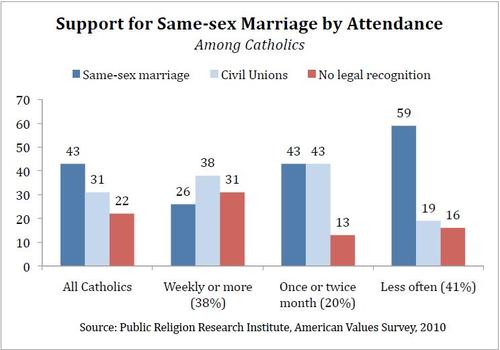
PRRI Catholic Support for Same-sex Marriage by Attendance-thumb-500x350-423

It's worth pointing out, for the record, that even if you measure those American Catholics who attend church weekly, the numbers are pretty decisive: 64 percent favor either civil marriage or civil unions for gay couples. Only 31 percent take the Vatican line. K-Lo thinks the shift from 74 percent overall approval and 64 percent approval among the weekly mass-goers is "dramatic." I'd say: not so much. The Vatican has lost this argument in the developed world.

(Chart via Bold Faith Type)

The Case For The War

Fareed focuses on the international dynamics and sees how shrewd and innovative it was to follow the French lead. Money quote:

The U.S. cannot always do the cooking and tell its allies to do the dishes.

Juan Cole counts the humanitarian gains:

Pundits who want this whole thing to be over with in 7 days are being frankly silly. Those who worry about it going on forever are being unrealistic. Those who forget or cannot see the humanitarian achievements already accomplished are being willfully blind.

Has Obama meep-meeped me again? Here's hoping.

Knowing Oneself

Lsd

A defense of the personal use of LSD:

This drug, above all, confronts you with yourself. The flickering flowers can turn into scenes of horror and desperation, the coloured-streaked sky into a theatre of unwelcome memories and shame.

For myself I used to face terrible scenes of torture, rape and other kinds of human cruelty. I do not know why, but I found myself imagining them again and again both in meditation and with drugs. Perhaps like most people, I began by fighting them and trying to push them away, but LSD will not let you push anything away. You have to face it. And this is, I think, what makes it the ultimate psychedelic. There is no hiding with LSD. You have to face whatever comes up or be overwhelmed by it…

Our question asked "did anyone learn anything about reality from LSD?", "… was it a glimpse – however inadequate – of something real and standing beyond our everyday lives?". I would say that in one sense selves are not "reality", but are invented stories about non-existent inner beings; that what we learn through LSD is precisely about our everyday lives, not something beyond them. But then I would say the same of spirituality. It is not something to be found beyond our everyday lives at all. It is right here and now, and that is precisely what LSD reveals.

A notion of salvation that has absolutely nothing to do with the future?

“It’s Like, You Know, Tom Cruise”

Lileks meets a young man who has never heard of an iPad. He reflects:

I could only wonder. Car crash? Coma? Memory loss? If so: Does he go around every day asking people about their iPads and iPhones? Point B: It’s a sign of the times that the most reasonable explanation for a 30-something American male to be ignorant of the iPad is some sort of mental handicap or brain injury. 

Maybe he's just sane.

(Hat tip: Pejman)

“Falling Between Two Stools”

Rory Stewart sticks it to both sides:

If you oppose intervention, you call it ‘another Vietnam’. If you support intervention on national security grounds, you call the opponents appeasers and invoke Munich. And you could still do a ‘replace all’ and instead of Libya insert Zimbabwe, Darfur or for that matter Abyssinia, the Hejaz or ‘the Kingdom of Caubul and its dependencies’. Here more than ever what seems to matter is not detailed knowledge of the country concerned but a basic attitude of mind: a high optimism, a reactionary pessimism and very rarely anything in between.

Was Bush Torture Really About Interrogation?

Newly released notes from one of the architects of the Bush-Cheney torture program have shown that the scale and ambition of the torture camps at Gitmo and elsewhere might have been greater than we once imagined. A key figure was Dr Bruce Jessen, who reverse-engineered program to resist exploitation and torture into programs to enforce exploitation and torture. A former colleague of Jessen, retired Air Force Capt. Michael Kearns, a "master" SERE instructor and decorated veteran who has previously held high-ranking positions within the Air Force Headquarters Staff and Department of Defense, provided the Jessen notes. Money quote:

"The Jessen notes clearly state the totality of what was being reverse-engineered – not just 'enhanced interrogation techniques,' but an entire program of exploitation of prisoners using torture as a central pillar," Kearns said. "What I think is important to note, as an ex-SERE Resistance to Interrogation instructor, is the focus of Jessen's instruction. It is exploitation, not specifically interrogation.

And this is not a picayune issue, because if one were to 'reverse-engineer' a course on resistance to exploitation then what one would get is a plan to exploit prisoners, not interrogate them. The CIA/DoD torture program appears to have the same goals as the terrorist organizations or enemy governments for which SV-91 and other SERE courses were created to defend against: the full exploitation of the prisoner in his intelligence, propaganda, or other needs held by the detaining power, such as the recruitment of informers and double agents. Those aspects of the US detainee program have not generally been discussed as part of the torture story in the American press."

The goal was, in other words, to brainwash these prisoners into becoming double agents, by breaking them down psychologically and reconstructing them. This looks like torture as a form of warfare, not torture as a last-ditch attempt to gain critical information in a ticking time bomb case.

The full report – and out-takes from Jessen's notes are here.