With empiricism!
Month: March 2011
And K-Lo Wept, Ctd
The British Example
Some unsettling news for the Coalition government:
"The government's ongoing commitment to large-scale deficit reduction is very important to the AAA rating and stable outlook," Moody's said the day after George Osborne downgraded growth forecasts in his 2011 Budget.
"Although the weaker economic growth prospects in 2011 and 2012 do not directly cast doubt on the UK's sovereign rating level, we believe that slower growth combined with weaker-than-expected fiscal consolidation could cause the UK's debt metrics to deteriorate to a point that would be inconsistent with a AAA rating," Moody's said in a statement. Moody's downgraded its own forecast for British growth this year to 1.6pc from 2pc, below the 1.7pc forecast by the government's independent Office for Budget Responsibility in Wednesday's Budget.
The winter weather is not all to blame. The austerity measures already in place – and due to intensify over the next year – have clearly dented short-term growth. And that in turn has made deficits larger than they would otherwise have been. There are two cycles possible here: spending cuts that restore confidence in a country's fiscal health, leading to more growth and lower deficits; or spending cuts that depress growth which increases debt that forces new cuts. Britain does not have the luxury of a reserve currency to sustain the kind of long-term debt the US manages. But the data so far are not encouraging about the wisdom of short-term slashes in spending.
The US has an alternative, of course. No drastic cuts in government discretionary spending now, but substantive long-term entitlement reform and defense cuts that would revive business confidence and build on still-fragile growth. But that, alas, seems the least likely outcome of the next two years.
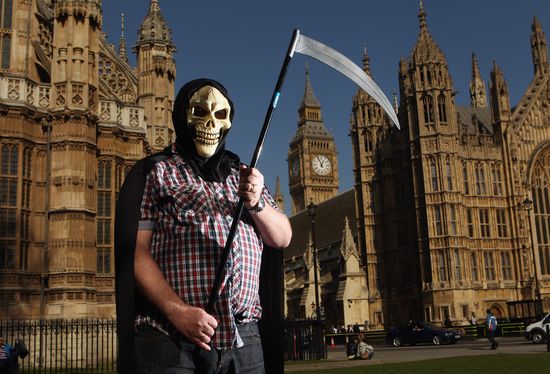
(Photo: A protester from the Public and Commercial Services Union demonstrates outside Parliament as Chancellor of the Exchequer George Osborne delivers his budget on March 23, 2011 in London, England. By Oli Scarff/Getty Images.)
Must We Remove Qaddafi?
Andy Bacevich, who calls the war against Libya "needless," nevertheless argues that removing Qaddafi "should be the centerpiece of U. S. strategy":
Remove him from the scene and the threat posed to innocent Libyans, whose well-being provides the nominal rationale for intervention, will subside, if not disappear altogether. … There are two ways for Qaddafi to "go." The first is voluntarily, by offering him inducements — the promise of a comfortable exile in Venezuela perhaps. Then there is the other way, a departure that is involuntary, violent, and therefore permanent.
Sod’s Law
An Irishman's take on Fukushima and the black swan:
With extremely rare events, there is an obvious limit to the power of rational calculation. Being extremely rare, they don’t happen often enough for us to be able to work out the patterns of their occurrence. Yet when it comes to systems designed by mathematically literate people themselves, this wisdom goes out the window. Highly unlikely events are treated as if they are, in effect, impossible…
This way of thinking is peculiar to economic and scientific elites, who are prey to utopian delusions.
The rest of humanity tends, from the bitter experience of countless generations, to believe in Sod’s law: “If anything can go wrong, it will.” We may add the extensions of Murphy’s law: “If there is a possibility of several things going wrong, the one that goes wrong will be the one that can cause most damage. If you perceive that there are four possible ways in which something can go wrong, and circumvent these, then a fifth way, unprepared for, will promptly develop.”
Now I understand the deep genetic causes of my occasional dips into hyper-pessimism. It's the Irish in me!
And, yes, I know we cannot live by this maxim, in a highly developed advanced industrial society. But that just keeps suggesting to me that a highly developed advanced industrial society is itself prone to a black swan. In the grand narrative of human existence, it's a recent hubristic blip.
We may be the exception that ultimately proves the rule. It sure feels like it lately, doesn't it?
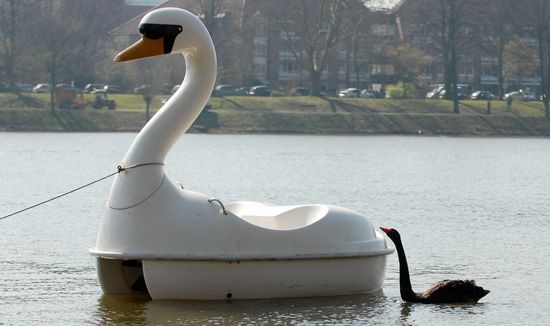
(Photo: Black swan Petra swims behind a swan shaped pedal boat 28 March 2007 on the Aasee lake in Muenster, northwestern Germany. Petra fell in love with the pedal boat already in spring 2006, never left its side and even spent the winter time with the boat at Muenster's zoo. Both were brought now back to the Aasee, where the romance began. By Michael Gottschalk/Getty.)
Palin’s Negatives: State By State
PPP compiles them:
Palin is not a serious general election candidate for President- but she would have a serious chance at the GOP nomination if she ran and that's why we keep polling her.
Assad Cracks?
Some hopeful developments out of Syria:
Katherine Marsh (a pseudonym) in Damascus has just told us that Syria has announced major concessions ahead of planned protests tomorrow. The government says it will look at removing emergency laws, prepare new laws for political parties, media and respond to "legitimate demands".
AP has a bit more on those government concessions in Syria:
Presidential adviser Buthaina Shaaban says the government is drafting a law that would allow political parties besides the ruling Baath party. She tells reporters that President Bashar Assad's government will begin studying a possible ending to the emergency laws in place since 1963 and putting in place mechanisms for fighting corruption. She also promised higher salaries for public servants.
The pledges appear unlikely to satisfy protesters in the city of Daraa after a violent crackdown that killed what many say are dozens of demonstrators.
Under-Estimating T-Paw?
A reader writes:
You said of Pawlenty, "And one that I simply cannot imagine winning really enthusiastic support from the base or beating Barack Obama." I don't know if the two halves of this disjunction were supposed to be connected, but they're not. You're making the same mistake the McCain campaign inexplicably made in 2008 – thinking the Republican base matters. It doesn't.
Unless they can get the Amish back out like they did in 2004, there isn't some great untapped reserve of Republican base voters to appeal to. The same Republicans who always vote will vote, more or less. The beauty for someone like Pawlenty (or McCain, had he realized it) is that the far right is now relatively electorally inert. Short of a photo emerging of Pawlenty peeing on a crucifix, most people on the far right have been backed into a corner where they have no choice but to vote against Obama, who will have no problem turning out the base on his own.
The real game is in the center – people with moderately conservative values but who couldn't care less about gay people being in committed relationships so long as someone gets them some damn jobs and stops taking their money for liberal bullshit. (The real trick to winning is to somehow convince people that you can do both those things at once, even though they seem to suggest almost exactly opposite courses of action – yay Reagan!). Basically, I'm talking about prototypical Mid-Westerners. Alabama ain't going blue anytime soon, but if Palin were nominated, Ohio sure would. I don't see how someone like Pawlenty or Daniels can get nominated, but one of them doing so is the ONLY realistic chance (other than a particularly nasty second economic dip) the Republicans have of beating Obama.
Another writes:
Today you said that you can't imagine Pawlenty either winning the Republican nomination or defeating Barack Obama. I have to demur on both counts. After taking a look at Pawlenty's new campaign ad, I am fairly certain that the punditocracy is dramatically underestimating the unassuming governor from Minnesota.
First, it's important to note just who created the ad for Pawlenty, and who will be doing a lot of media work for him. It's Lucas Baiano, a former Hillary '08 supporter and media guy. Pawlenty is in a perfect position to become a hub for the Clinton Independents, who want a president to focus like a laser beam on the middle class, and who think that Obama is too elitist, out of touch, etc. Pawlenty can do this with his Sam's Club image in a way that Romney couldn't, for class reasons, and in a way that Palin couldn't, for ideological reasons (i.e., she's a product of the base, while Pawlenty seems more malleable).
Second, take a look at the imagery in the ad. It's all Northern cities, Rust Belt metropolises that have fallen victim to globalization, and to the dearth of manufacturing jobs and other low-skill jobs that used to give blue collar whites a halfway decent life. Pawlenty is not going to bring those jobs back. But he's not going to tell anyone that. In fact, if you were a non-ideological swing voter and you saw that ad, and you didn't really understand the difference between "right" and "left," you might come away believing that Pawlenty's plan was to bring the manufacturing jobs back home. It's sort of like Clinton in 1992. He didn't really have a discernible plan to fix your pain, but boy, could he feel your pain. Americans will choose the guy who can feel their pain over the guy who can fix it every time.
Third, Pawlenty chooses his words in order to evoke the populist sentiment that exists beneath the surface in America in hard times, but not enough to turn himself into a Sarah Palin. His is a softer populism. From the ad: we're going to take our government back. Back from whom? Pawlenty doesn't say. The listener is left to fill in the blank with his or her favoite baddie (big corporations, unions, the French, etc). And then the powerful ending: together we'll restore America. Pawlenty plans to contrast his optimism with the supposed managed decline being wrought by Obama. It's pitch perfect for swing voters, particularly downscale whites who live in states like Ohio and Pennsylvania. That could be where this election is won. Obama could win every granola Colorado voter and still lose because of Pennsylvania. That's why I'm saying that Pawlenty, a Republican who understands blue collar whites, shouldn't be underestimated.
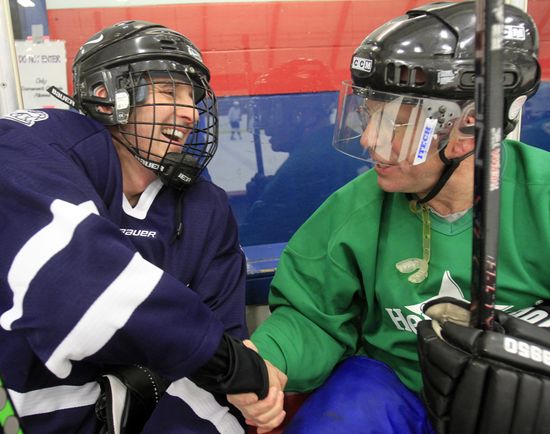
(Photo: Former Minnesota governor Tim Pawlenty, left, shakes hands with Mike Farrelly during a pick-up hockey game on Friday, March 11, 2011 in Concord, N.H. The Republican is spending a couple days in the nation's earliest presidential primary state. By Jim Cole/AP)
Why Wasn’t The UN Resolution Vetoed?
Larison has a theory:
When all of the major powers opposed to intervention abstained on the resolution, supporters of the war were encouraged by this, but those abstentions were really votes of no-confidence. Germany was as adamantly against the Libyan war as it was against the Iraq war, but this time the permanent member opponents were willing to let Western governments plunge ahead without a lengthy, protracted debate and the threat of veto in the Security Council. After all, why should they jeopardize their relations with Western governments by opposing the Westerners’ folly?
Brazil and Turkey have already experienced the unpleasant political consequences of trying to do the right thing by Western governments by opposing misguided Iran sanctions, and others probably learned from that episode that there is nothing to be gained by getting in between Western governments and their targets. Germany probably doesn’t want to repeat its Iraq war experience by damaging the relationship with the U.S. to save Obama from making a mistake.
What About Fred?
Pareene is giddy about Fred Karger, who just became the first openly-gay Republican to run for president (and has been plaguing my email in-tray for months):
Karger had to make it extra-official so that it would be more difficult for the party to keep him out of debates. While coastal elites at the RNC have been friendly to Karger, the true Republicans… at the RNC… have also already blocked him from participating in one debate, and they are likely to continue banning him from all future debates, at least until he stops being gay (which will be even more difficult now that the gay-curing "app" has been banned from all the iPhones).
As [Mother Jones' Stephanie] Mencimer explains, the person the RNC has overseeing the debates, lawyer James Bopp, is no fan of Karger:
Bopp represents many anti-gay marriage organizations that have been battling in court to protect their donors and supporters from state disclosure laws. Many of those lawsuits have been inspired by Karger himself, who was instrumental in organizing boycotts of the major donors to California's Prop. 8, which banned gay marriage in the state. Bopp has argued in court that the Prop. 8 donors were harassed and subjected to potential violence because of their outing and is fighting to eliminate many of the laws that made Karger's boycott possible. Bopp has actually subpoenaed Karger in one of those cases in California, and has been defending the group Protect Marriage from a state ethics complaint Karger filed against the group in Maine.
Awkward.
 The Dish