As If Iraq Never Happened

I criticized supporters of the Iraq War who are now offering knee-jerk support of strikes against Libya. Chait objects:

This argument over who has the right to comment about the war, or the endless philosophical discursions into the relative merits of anti-malarial nets — an issue that hardly anybody ever brought up until it was discovered as a foil against intervention in Libya — is a bizarre distraction. Look, the substantive arguments against intervening in Libya are pretty compelling. They could well be vindicated. I come down on the side if intervention but I certainly see the merits of the case against. I don't understand why war critics are obsessed with making their case in ad hominem terms, and it's all the more bizarre when the ad hominem arguments are made by people who would themselves be disqualified them. 

But Chait misses my point entirely. I am not arguing that supporters of the Iraq war should now be disqualified from further commentary. As Jon points out, that would also exclude me. All I ask is that they wrestle with their own past misjudgments and explain why they support another military intervention in Muslim countries after the ongoing fiascoes of Iraq and Afghanistan. This isn't ad hominem as such. It's just asking for some accountability from public intellectuals – some reckoning with their previous misjudgements in the face of this new adventure in intervention. But they feel no need to account for their past. In fact, they never mention it. To debate a new war in the Middle East without any reference to Iraq and Afghanistan, even as those two wars continue, is amnesiac to the point of delusion.

But if Chait wants an ad hominem, try this on for size:

Blogging is a notoriously time-consuming vocation. Surely there is a kitchen for the homeless where [Ezra] Klein lives. If he were to tear himself away from his laptop, he would not solve the hunger problem, but it would help.
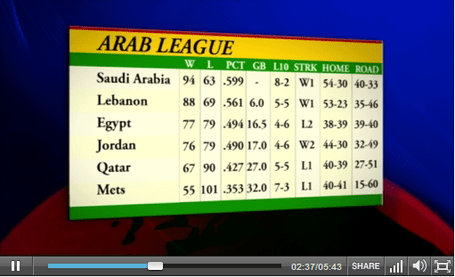

“Rats Jumping Off A Sinking Ship”

Arab_league

Irfan Husain describes how the Arab League's hedging could backfire: 

In all probability, the Arab League's more conservative members thought that by throwing Qadhafi to the wolves, they could move the spotlight away from their own repression of their rebellious youth. However, it would seem that finally, retribution is catching up with them. Yemen is on the brink, with many government supporters deserting, much like rats jumping off a sinking ship. Bahrain continues to face violent unrest, despite Saudi Arabia`s crude intervention. Syria and Morocco are being shaken by demonstrations. Egypt and Tunisia seem to be moving towards achieving functioning democracies.

(Image from The Daily Show via The Bryman)

As Bill Keller Gnashes His Teeth …

The HuffPo signs up a crime reporter. Dish fave, Radley Balko, is moving come May:

As you may know, AOL bought Huffington Post several months ago, and they’re hiring a ton of great people to build out a serious journalism program. I’ll be working with some really talented folks, like (former Agitator guest blogger) Ryan Grim, and Peter Goodman and Tim O’Brien, who came over from the New York Times. I’ll be covering the same beat I do now, only with a much bigger platform, and with the resources to delve into bigger, more in-depth projects.

So what does all this mean for the blog? Come May, The Agitator will be hosted over at Huffington Post. I’ll continue to blog here daily, and I’ve been assured that there will be no content restrictions or editorial control over what I post. The blog will likely look a little different (I imagine there will be more ads), and the comments section will probably be a bit more crowded, but otherwise, things here will stay the same. So I hope you’ll all keep reading.

[Update: I somehow spelt "gnash" "nash" in my original headline. Brain-fart. Or perhaps because I rarely if ever see the word in print. Nonetheless, apologies.]

The Oligarchy Entrenches Itself

Ezra Klein explores inequality's roots in a review of Winner-Take-All Politics, by Jacob S. Hacker and Paul Pierson:

[T]he book’s greatest strength is its easy command of political science data, which sets it apart from most of the other studies of inequality that have been released. Perhaps the most shocking study the authors cite comes from Martin Gilens, a political scientist at Princeton University. Gilens has been collecting the results of nearly 2,000 survey questions reaching back to the 1980s, looking for evidence that when opinions change, so too does policy. And he found it—but only for the rich.

“Most policy changes with majority support didn’t become law,” Hacker and Pierson write. The exception was “when they were supported by those at the top. When the opinions of the poor diverged from those of the well-off, the opinions of the poor ceased to have any apparent influence: If 90 percent of poor Americans supported a policy change, it was no more likely to happen than if 10 percent did. By contrast, when more of the well-off supported a change, it was substantially more likely to happen.”

In part, this is because politicians began to need money more than they had before, as the costs of campaigns started skyrocketing. The predictable outcome? Both parties have been relying more on wealthy donors and less on labor unions.

Who Will Take Over?

Ackerman isn't sure:

In Brussels, NATO managed to agree on enforcing the arms embargo against Gadhafi, but it hasn’t come to a consensus on taking over the broader mission from either [Adm. Samuel Locklear] or [Gen. Carter Ham] or the U.S. overall — something the Pentagon has said from the start of the war that it expects within “days.” That’s led France to seek work-arounds allowing a French-led coalition to press the attack. Reportedly, it wants a “political steering committee outside NATO” to run the war, which would have the benefit of adding the Arab League under its banner, an organization wary of working under NATO.

That would be my preference, for what it's worth, as I explained here. The more distance the US can put between itself and this clusterfuck the better. Kori Schake sees no clear resolution:

[T]here is still no agreement to whom command will be passed. British Prime Minister Cameron insists it must be NATO; Sarkozy insists not. The French defense spokesman now suggests all participating military forces should have the honor of serving under French national command. Turkish Defense Minister expressed mystification, saying "It does not seem quite possible for us to understand France's being so much at the forefront in this action." Italian Foreign Minister Frattini threatens Italy will not allow use of its bases unless it becomes a NATO operation.

“A Reasonable Gamble To Take”

That’s Bill Kristol’s new take on the farce that was the Palin candidacy. He says just enough to give himself wiggle room if she is indeed the nominee. Meanwhile, there’s an absolutely priceless piece of Palin analysis by Janet Malcolm over at the New York Review. She assesses the surreal “Sarah Palin’s Alaska” reality show. There were times reading this at a Starbucks that I disturbed those around me with laughter. It begins thus:

The nine-part docu-series Sarah Palin’s Alaska, shown late last year on the cable channel TLC, has the atmosphere of a cold war propaganda film. It shows the Palin family during the summer of 2010, making happy trips to one pristine Alaskan wilderness area after another—fishing, hunting, kayaking, dogsledding, rock climbing—and taking repeated little swipes at the left. During a visit with her dad to a store in Anchorage named Chimo Guns, where she is buying a rifle for a camping trip in bear country, Palin remarks:

Out and about in Alaska’s wilds it’s more common than not to see somebody having some kind of weapon on their person, in fact it’s probably as commonplace as if you’re walking down in New York City and you see somebody with a Blackberry on their hip.

New York, of course, is code for all the things that Palin-style populism is against. I don’t have to tell my fellow Commies what these things are.

But the real jewel is Malcolm’s account of the great Gosselin-Palin mashup in the pivotal episode. Malcolm then ends with a sharp observation of how the series did at times indeed seem real: Palin’s obvious emotions regarding her last child. If you assume that everything that Palin has told us about Trig is true (which is, actually, logically impossible since she has given contradictory accounts), then Malcolm’s peroration works. If you don’t, it works as well – but in a different and just as wrenching kind of way.

The Known Unknowns: Iraq And Libya

LIBYAREBELPatrickBaz:Getty

Among the many many things we do not know about Libya is the answer to a critical question. Did the events of the last month add up to the people of Libya peacefully trying to secure democracy only to be gunned down by a tyrant? Or was the rebellion more tribal, only briefly non-violent, and driven by the kind of opposition all tyrants provoke over time? Is this Egypt, in other words? Or Iraq? One can see elements of both, but I should simply confess: I don't know the core explanation. Tom Friedman notes:

It is no accident that the Mideast democracy rebellions began in three of the real countries — Iran, Egypt and Tunisia — where the populations are modern, with big homogenous majorities that put nation before sect or tribe and have enough mutual trust to come together like a family: “everyone against dad.” But as these revolutions have spread to the more tribal/sectarian societies, it becomes difficult to discern where the quest for democracy stops and the desire that “my tribe take over from your tribe” begins.

I have to say that, given the tribal, post-totalitarian chaos of Libya right now, I suspect the latter is the most powerful force. If that's true, we have done all anyone can reasonably ask: prevent one massacre in one city. But what if Qaddafi wants to conduct another cleansing in, say, Misurata? That's why the self-righteous pieties of the interventionists strike me as riddled with the kind of ignorant certainty that prevailed before 2003. Money quote:

The problem, after all, is political: a popular democratic revolt was savagely attacked by a tyrant and his mercenaries and some of his army… The Libyan people are in the midst of an armed revolt against a dictator who is in the midst of an armed campaign to crush them … The president may not wish to be embroiled in an internecine Libyan conflict, but there he is. He should console himself that it is not a civil war, but it is a war nonetheless.

In the article in which this sentence appeared, you can find references to Nazi Germany, Rwanda, Bosnia, Egypt, Kuwait, but nothing but two quick asides about Iraq and Afghanistan – and neither aside grapples in any serious way with the obvious lessons. One is that tyrants can have allies within their own countries, especially countries riven with sectarian or tribal divides. We may find it impossible to believe that anyone could support Qaddafi in Libya, but the truth may be a little different. The US could not cope with the insurgency in Iraq because it had persuaded itself that there could be no insurgency against the removal of such an obviously crazy, despicable mass murderer as Saddam.

But there was an insurgency. It appeared very quickly. And our attempt simply to transpose onto a country we did not understand our own cultural biases, our own democratic impulses, and our own internal debate about intervention … turned into a disaster whose costs have far outweighed the benefits.

I understand and respect the humanitarian motives of the interventionists. What I cannot understand, after the last decade, is their certainty.

(Photo: A Libyan rebel sits on the back of a pick up truck as rebel forces massed a second day on several kilometres from the key city of Ajdabiya to try to attack government forces that have encircled the town on March 22, 2011. By Patrick Baz/AFP/Getty.)