The Tea Party Goes To War

Weigel identifies one reason tea-partiers overwhelmingly support attacking Libya:

There are individual Tea Party leaders, like Williams or Rand Paul, who wince at a military intervention undertaken like this. The Tea Party is libertarian in plenty of ways. But if it has one defining characteristic, it's that it's nationalist. If there's a way to remove Qaddafi decades after he aided the Lockerbie bombers, then that's more important than a debate over the deep thoughts of the founders. 

If the Tea Party can support military action where there isn't even a smidgen of national interest involved, they are neocons in libertarian clothing. Just as one suspects they are Christianists in fiscal clothing. They are the hard right of the GOP.

“Winning” In Libya

110587223

Matt Steinglass believes that the administration's vague goals are purposeful:

The United States may not be willing to commit the military force that would be needed to guarantee driving Muammar Qaddafi from power. In that case, the way to guarantee production of "victory" in Libya is to define the war aims as something like "striking a blow" against Mr Qaddafi.

On the other hand, an open-ended commitment to preventing tyranny and regime atrocity seems almost guaranteed to fail to produce victory. On the third hand, it seems a bit perverse to judge the performance of our political leaders based on how well we think they're manipulating us. It's our job to try to focus as little as possible on how opinion shapers try to produce "victories" in the public mind, and instead to look at what's actually happening in Libya. It might, however, be useful to look at what the Libyan public defines as their expectations of "victory", and whether what America and Europe are doing right now makes any sense in their eyes. 

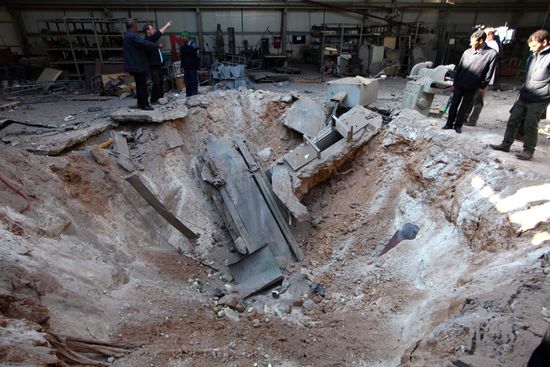
(Photo: People look at a crater in the destroyed Boussetta Libyan navy base on March 22, 2011, the day after it was bombarded some 10 kilometres (six miles) east of Tripoli center. By Mahmud Turkia/AFP/Getty Images)

The GDP Explosion

David Leonhardt interviews Charles Kenny, author of Getting Better. Kenny discusses Parson Malthus, who argued incorrectly that "each country’s output was pretty much limited by the amount of land available":

In Malthus’s time, output worldwide was indeed pretty much static — for most of history, global G.D.P. had expanded by much less than half a percent a year. But since then, output has exploded — everywhere. Between 1960 and 2000, only one country worldwide -– the Democratic Republic of the Congo — saw G.D.P. growth slower than 0.5 percent per year, and only 11 countries saw output grow at less than 2 percent a year.

The Last Chapter

David Greenberg observes that almost every book "aspiring to analyze a social or political problem" ends with "an obligatory prescription that is utopian, banal, unhelpful or out of tune with the rest of the book." Kevin Drum explains why final chapters often disappoint:

[A]ny social or political problem that’s hard enough to be interesting is also hard enough to have no obvious solutions. In fact, most of them are hard enough not to have any short-term solutions at all, obvious or not.

Joyner nods:

[A]n author spends the entirety of a book or article ensconced in his comfort zone and is then forced to put on a prognosticator or policy guru hat to wrap up the work in a neat bow, which he’s likely unqualified to do.

Mexico’s “Torturer-In-Chief”

NoMoreBloodGetty

Julian Leyzaola Pereza is a Mexican police chief known for taking on drug cartels. He recently became police chief of Ciudad Juárez, a city said to be among world's the most dangerous. William Finnegan reviews Leyzaola's record:

He was most proud, he told me, of his anti-corruption campaign. Unfortunately, there was extensive evidence that that campaign proceeded largely by torture, and not by investigation. Amnesty International found twenty-five police officers who have claimed credibly that they were seized and tortured by soldiers on Leyzaola’s orders. The Baja California state human-rights commission released a report detailing Leyzaola’s personal participation in torture and recommending that he be suspended. He was not.

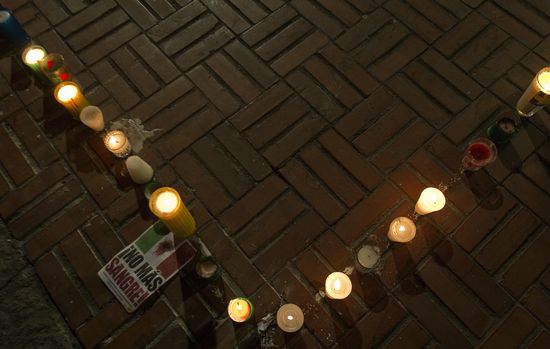
(Photo: Candles lit by university students stand beside a sign reading 'No mas Sangre' (No more blood) during a protest against violence at the Universidad Autonoma de Mexico in Mexico City on February 17, 2011. The battles between drug lords have claimed more than 30,000 lives across the country over the past three years, according to official figures. By Alfredo Estrella/AFP/Getty Images)

A Better Reactor

Alexis reads up on advances in nuclear power:

With the Fukushima plant's problems putting safety back at the forefront of Americans' minds, these new reactors could be the only real way forward for nuclear power, if the globe's citizens decide they want that future. Many engineers think they're safer. For example, they incorporate "passive" safety features instead of the active pumping systems that failed at Fukushima.

As importantly, some new reactor designs are made to be smaller than the one-gigawatt behemoths we built for decades. That could assuage some critics' contention that nuclear power exacerbates the centralization of an energy system that's already too centralized. Because they're smaller and may be safer, the plants may cost less too. That's important considering that a new standard reactor may cost up to $10 billion, which is more than the market value of all but a handful of the largest utilities. 

In Defense Of Tasteless Jokes, Ctd

In response to our post on gallows humor within the medical field, a reader points to "an annual round-up of the usage of medical slang by British physician Dr. Adam Fox of St Mary's Hospital, London." Examples:

6PFP – 6-pack and a fishing pole, as in "this patient doesn't need chemo, he needs 6PFP." – Usually referring to an end-stage patient who should go die somewhere else.
ART – Assuming Room Temperature (dying)
Ash cash – UK peculiarity of house officers obtaining payment for signing cremation form

Another adds:

As the son and brother of doctors, I regularly experienced the sometimes cringe-worthy humor that they employed to get themselves through the day. My dad is a surgeon who served in Vietnam from '69-'70 and was the go-to guy at his hospital for particularly gruesome procedures. When my brother was a resident fresh out of med school, he would tell me about ER patients who were beyond help and would not survive. He and his colleagues had an acronym for such patients: AMF YOYO, which stands for "Adios motherfucker, you're on your own."

Another:

The best example I've seen of black humor in emergency medicine is the Student Doctor Network forum's thread Things I Learn from My Patients, in which med students, trauma surgeons, emergency medicine doctors and nurses, firefighter-EMTs (like me), paramedics, and others tell stories about the patients they have who are often both horrendous and hilarious.  It's an enormous thread and stretches back years, but I've read it beginning to end several times because the stories are so funny and it's such a good relief valve.

Keeping Up With The Joneses (But Not The Bloombergs)

Room For Debate tackles income inequality. Tyler Cowen suggests that the growing income gap isn't hugely probematic because "in terms of happiness [the gap] is relatively low by broader historical standards." He also claims that "a lot of envy is local":

People worry about how they are doing compared to their neighbors, their friends, their relatives, their co-workers, and the people they went to high school with. They don’t compare themselves to Michael Bloomberg, unless of course they are also billionaires. When the guy down the hall gets a bigger raise, perhaps by courting the boss, that’s what really bothers us. In other words, envy and resentment are not going away and they also do not stem fundamentally from the contrast between ordinary lives and the lives of the very wealthy.

The Missing NYT Reporters, Ctd

AP110321033760

Now safely out of Qaddafi's grasp, they tell their harrowing story:

Tyler’s hands were bound by a strip of a scarf. A soldier took off Lynsey’s gray Nike shoes, then bound her with the shoelaces. “God, I just don’t want to be raped,” she whispered to Steve.

“You’re the translator!” a slight soldier screamed at Anthony. “You’re the spy!”

A few seconds passed, and another soldier approached, demanding that we lie on our stomachs. … At that moment, though, none of us thought we were going to live. Steve tried to keep eye contact until they pulled the trigger. The rest of us felt the powerlessness of resignation. You feel empty when you know that it’s almost over.

“Shoot them,” a tall soldier said calmly in Arabic.

A colleague next to him shook his head. “You can’t,” he insisted. “They’re Americans.”

They bound our hands and legs instead — with wire, fabric or cable. Lynsey was carried to a Toyota pickup, where she was punched in the face. Steve and Tyler were hit, and Anthony was headbutted.

Even that Tuesday, a pattern had begun to emerge. The beating was always fiercest in the first few minutes, an aggressiveness that Colonel Qaddafi’s bizarre and twisted four decades of rule inculcated in a society that feels disfigured. It didn’t matter that we were bound, or that Lynsey was a woman.

Thirteen journalists are still missing or detained in Libya.

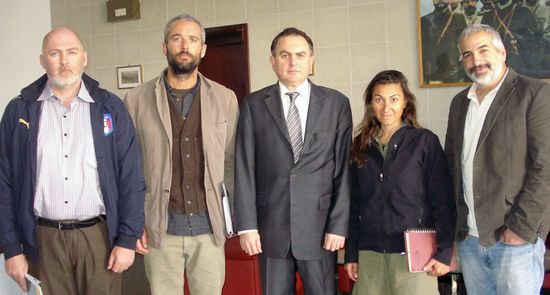
(Photo: In this March 21, 2011 photo released by the Turkish Ministry of Foreign Affairs, from left to right, New York Times journalists Stephen Farrell, Tyler Hicks, Ambassdor Levent Sahinkaya, Lynsey Addario and Anthony Shadid pose at the Turkish Embassy in Tripoli, Libya. By the Turkish Ministry of Foreign Affairs/AP)