A Practical Metal

Niall Ferguson watches the copper market. He observes that, since December 2009, copper is up 181 percent:

[T]he key to the copper story is soaring Asian demand. Asians want modern houses with Western-style wiring and plumbing. They want cars. They want electronic gadgetry. So they want copper. In 2005 China accounted for 22 percent of global copper consumption. In 2009 the figure was 39 percent. Try as they may, the copper miners can’t keep pace. And the supply of copper in the world isn’t limitless. Indeed, if the rest of the world were to consume at just half the American per capita rate (1,386 pounds a year), we’d exhaust all known copper reserves within just 38 years.

Malkin Award Nominee

"We need you to come in and lock shields, and strengthen up the men who are going to the fight for you. To let these other women know on the other side — these planned Parenthood women, the Code Pink women, and all of these women that have been neutering American men and bringing us to the point of this incredible weakness — to let them know that we are not going to have our men become subservient. That’s what we need you to do. Because if you don’t, then the debt will continue to grow," – Congressman Allen West (R-FL), addressing the members of Women Impacting Nation (WIN).

The Daily Wrap

Today on the Dish, Andrew defended his right to ask empirical questions on Trig and wasn't buying Weigel's argument that conspiracy theories have been flogged to death. Andrew weighed the damage done in Gitmo and bemoaned Israel's rightwing victory in shutting Obama down on the peace process, and David Shulman sifted through the remains of Goldstone's partial retraction. Syria descended into chaos, Rio fought back against favela violence, and the war in Libya wasn't winning Obama any Republican cred.

Andrew rallied against pressuring lawyers of any kind, even DOMA defenders, and Texas acted crazier than Iran about transgendered marriages. Gas taxes can't achieve what we want them to, but Ryan Avent still defended them. Andrew gushed over Tom Coburn's fiscal realism and dismissed Haley Barbour as not being presidential material, and readers picked apart the mass insanity on the Democratic side. The GOP bucked Karl Rove, and E.D. Kain approved of Gary Johnson for his unwillingness to drop bombs. We unsucked the office, and analyzed whether healthcare patients can act like consumers. Aaron Carroll and Austin Frakt put emergency care in context, readers debated vaccines, and Mormonism can't cure poverty.

Our grapefruits evolved from atomic gardening, bananas have their own carbon footprint, and Heather Mac Donald dissed grafitti. Angry Birds shifted advertisers from TV to mobile devices, Michael Eisen outed Amazon's automatic pricing scheme, and Alexis feared the iPhone's tracking system. Women worried more openly, a "wrong" marriage is partially hindsight, and Elizabeth Abbott argued polygamy is wrong. James Gleick chronicled the biology of the meme, and Andrew swore off the Kate & Will wedding pizza.

Tweet of the day here, horrible analogies here, cool ad watch here, FOTD here, VFYW here, and MHB here.

–Z.P.

Correction Of The Day

Barack-Obama_0_jpg_600x1000_q85

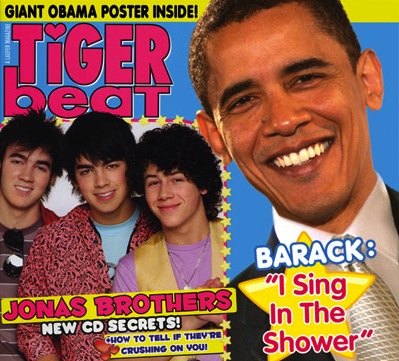
"A series of pictures last Sunday of covers of the magazine Tiger Beat, with an article about how the original teen-girl tabloid has remained virtually unchanged since its inception in 1965, erroneously included a parody cover, produced by the satiric newspaper The Onion, that featured a picture of President Obama," – The New York Times.

(Hat tip: Max Read)

Another Palin Book

Levi signs a deal. There are many more coming out, including Joe McGinniss’ and Frank Bailey’s. None will be able to avoid the pregnancy question, even as the MSM has ducked it. Which means we may still get closure. And by the fall, we’ll know if she’s running again. I suspect she is. (By the way, I did get to talk to Johnston off the record at one point. I look forward to the book and hope he tells it exactly like it was.) My preference for simply releasing medical records was also the view of Frank Bailey, one of her closest confidantes. He was, in his own words, “stunned” when he heard the news of the pregnancy, called it the “bombshell of bombshells” and, in another instance part of an “absurd-sounding storyline”. Another close confidante pushed back against the notion that Palin had advanced in one of her emails that she was “as big as a house.”

Kris broke my brief introspection when she addressed Sarah‘s big as a house comment: And big as a house … I just saw you and you most certainly are not. I couldn’t tell a darn thing.

So one of her closest aides “couldn’t tell a darn thing” at seven months. Bailey says simply: “She didn’t look pregnant,” but says he could discern a baby bump under the scarves. But when her story was openly queried, Bailey had the obvious response:

When discussing the possibility of feeding information to Sheila Toomey who wrote the ADN‘s political gossip column The Ear, Sarah suggested that Sharon Leighow feel out Shelia on it discreetly, play it by ear and clear it up if she’s suspecting anything. Then, for the second time, Sarah suggested, Heck – offer to let her see my new stretch marks to prove which Palin is truly pregnant!

While the serendipitous suggestion of viewing stretch marks was clearly not a serious proposal, it was nonetheless strange for both the disturbing imagery and a deflection from a more simple solution.

Bailey’s analysis is that Palin gave birth to Trig but was simply too paranoid and thin-skinned to put out a medical record. That is worth knowing, no?
Patients, Consumers, Voters, Ctd

Out_Of_Pocket

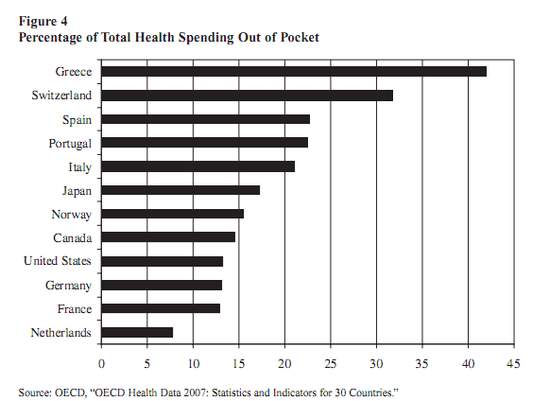
On Friday, the Dish pointed to problems with consumer-based healthcare. Karl Smith notes that people aren't very good at making healthcare decisions. Yglesias repurposes Smith's argument:

[T]here’s very little reason to think that when human beings act like health care consumers they behave like rational health-maximizing agents. People do not appear to be interested in pursuing cost-effective improvements in health outcomes, so there’s little reason to think that giving individuals more autonomous choices would result in that end. The most cost-effective systems out there appear to be highly statist systems that become stingy due to tax-aversion and then ration the provision of care.

Megan McArdle, who provides the above chart, holds a different view:

[W]hile consumers may be stupid, rules are often stupid too.  Evidence-based medicine is certainly a good idea, but we are nowhere near being able to generate solid rules that a) cover all major possibilities and b) provide the highest chance of survival for the money.  People are incredibly complicated.  This makes outcomes hard to measure–and solid guidelines hard to develop. 

Tyler Cowen collects more commentary. Aaron Carroll repeats that American out-of-pocket costs are not especially low.

The Return Of The Paulites

Weigel confirms that Ron Paul will announce his presidential exploratory committee tomorrow. Allahpundit looks ahead:

[T]his will be a last hurrah for dad and then Rand, with six years’ experience, will tackle the Rubios and Christies in 2016 when, assuming Obama wins reelection, the field will be wide open on both sides.

An Unpopular War

PPP finds that the Libyan war isn't a vote-getter:

Obama's not picking up any Republicans on Libya- just 4% say his actions there make them more likely to vote for him. He's losing more Democrats on the issue- 14% say it makes them less inclined to support him again. And it's also hurting him with independents, who split 13% more likely to vote for him because of Libya to 29% less likely.

What A Gas Tax Can Do

Ryan Avent counters Jim Manzi:

If demand for carbon or oil is relatively elastic, then a tax on carbon or oil is a great way to reduce dependence on carbon or oil. If demand for carbon or oil is relatively inelastic, then a tax on carbon or oil is a great way to generate revenue. After all, a tax on those negative externalities will reduce their output a little bit, and given the choice between reducing carbon a little bit and reducing income a little bit, wouldn't we prefer to reduce carbon?

Even if you think humanity should do absolutely nothing to stop global warming or reduce oil dependency, governments will want to spend money to handle the inevitable costs of warming or oil-dependence, and it would be far better to fund that spending with as efficient a tax system as possible. And there's no question that a system more dependent on taxes on negative externalities is more efficient than one more dependent on taxes on income.