Today on the Dish, Andrew meditated on the reason that is at the heart of his faith. Andrew remembered those lost to AIDS on this Good Friday, weighed the religious appeal of writing a living will, and reconciled being a fiscal conservative with HIV. Andrew picked apart the morality of Obama's choices in Libya, McCain strutted around, and Larison watched history repeat itself. Campaign coverage of Palin ebbed, but Andrew stuck to his guns on why Trig helped Palin and why transparency matters. Andrew rejected Justin Elliott's "definitive" debunker on the Trig question, and a teenager faked a pregnancy.
Trump's hair blanketed America, and forced all the other post-modern Republicans to act crazy. Thoreau inquired after all the anti-Birthers, Michelle Goldberg defended the left, and Ben Smith reminded us more than half of Democrats used to believe Bush was complicit in 9/11. Megan and Kevin Drum went another round on tax hike fixes for the deficit, and until tax code changes, most people pursue pure self-interest. Annie Lowrey imagined a debt ceiling catastrophe, Ezra looked at the long-term, and Bradford Plumer investigated who killed cap and trade. We examined whether vaccine deniers belong to the left or right, Freddie Deboer reassured us liberal indoctrination doesn't fly on college campuses, Conor urged cops to surveil themselves, we digested a violent turn in Syria, readers misdialed porn numbers, and science regenerated a hand.
Email of the day here, cool ad watch here, VFYW here, MHB here, and FOTD here.

Thursday on the Dish, Andrew laid out a modest proposal to lower healthcare costs, we gawked at what we pay versus the rest of the world, while real Americans would rather cut defense than Medicare. Josh Marshall, Andrew and Politifact parsed whether Ryan's plan would end Medicare, Catherine Rampell cautioned us to examine what's covered by our current healthcare plans (hint: not much). Obama didn't tax himself too highly, readers came to his defense, and Avent had faith that DC will tackle the debt. The GOP's Birther problem ballooned, Andrew felt more alienated than ever from the GOP, while drawing closer to understanding Obama.
Palin plummeted in Alaska, and Andrew reiterated his respect for Trig, while still demanding some real answers. Romney cowered before Trump, we ran the numbers on Trump as an independent, and we held out hope for a libertarian candidate like Gary Johnson to end the drug war. Americans wanted limited government (in war), and Egyptians wanted an Islamic state like Americans believe in Birtherism.
Andrew reeled from the loss of two missed war journalists, Sebastian Junger honored them, and remembered how the AIDS epidemic changed real attitudes about homosexuality in America. Dahlia Lithwick faced off with Ramesh Ponnuru on the war on Roe v Wade, and David Link quelled our fears about DOMA's defense. China dominated the beer market, E.D. Kain longed for alternatives to college, and the drug war, not the drugs, caused violence on the streets. The Dish waded into the Deaf Culture wars, and readers laughed at a possible Poseur alert who loves their mobile device. Cooked eggs helped make us fat, Andrew can't multitask when Judge Judy's on, and Lady Gaga almost rejected Weird Al.
Dissents of the day here, cool ad watch here, correction of the day here, chart of the day here, quotes for the day here and here, VFYW here, MHB here, FOTD here, and a poem for Holy Thursday here.

Savannah, Georgia, 9.45 am.
Wednesday on the Dish, Andrew used Louis CK to illuminate the right response to Kobe's slur, prized WikiLeaks but not the Pulitzer, and called Obama on revising "I am my brother's keeper." Steve Kornacki splashed cold water on cocksure Democrats, Ryan's plan actually bested Obama's, Andrew Romano reminded us raising taxes is on the table, and Frum begged the GOP to tackle it. Palinites complained that the media was ignoring her, the Trig story reached denouement, Geoffrey Dunn hoped to disprove the Trig birther conspiracies, and HuffPo rejected his article as a conspiracy theory of its own. Michael Scherer mocked the Palin / Trump policy disagreements and Andrew's eyes bulged when critics called Trump unserious.
Readers assessed how to solve Mexico's drug war, Jeremy Cherfas defended the poppy trade, and we checked in on ending marijuana Prohibition in America. Mission creep came to Libya and Joel Wing followed up on blood for oil. Gabby Giffords received better medical treatment than many soldiers, tea partiers in New Hampshire didn't mind gay marriage, and phone porn tricked customers. Josh Green psychoanalyzed Glenn Beck's brain in a wordcloud, readers defended uploading to the Internet's shared brain during conversations, and Josh Green savored silence. We peeked into the medicine cabinet of Dish readers, Kay Steiger considered the dearth of women with disabilities on film, and Americans loved their Medicare. Ben Adler explored the roots of gentrification, short readers were offered steroids, and the web debated whether to pity the white male. Rich people didn't realize they're rich, a royal wedding just isn't what it used to be, penguins giggled, trees came pollen, and Andrew weighed in on Gaga's Judas.
Chart of the day here, quote for the day here, MHB here, VFYW here, and the yesterday's VFYW contest psychoanalysis here.
Tuesday on the Dish, we kept an eye on the growing debt bubble, ideas for how much to raise taxes, and a possible turning point in Syria. We debated Trump's seriousness, Obama performed at Clinton's level, and Huckabee threw us for a loop on taxes. The Tea Party over taxes may be on the wane, and Obama's fate may be tied to gas prices. Mark Kleiman solved Mexico's drug war, Adam L. Silverman watched our withdrawal from Iraq, and BP definitely had its eye on Iraq's oil fields. The AP hounded the State Department on human rights for Wikileaks, Andrew questioned the lack of out gay arch conservatives, and reminded us this country won't be drug-free until it's people-free.
Readers assessed Harvard's value, and you can read the Harvard Magazine profile of Andrew here. We explored deafness as an ethnicity, Dave Weigel considered capitalism in all its messiness, short men gave us their dating horror stories, and a warning, don't check your device around Dish readers. Shakespeare played with our brains, Stephen Fry wanted more joy in language, babies pay attention to "uhs," and Andrew quenched his Palin thirst with some inspired fantasy blogging. Alexis dug up an amazing account of San Francisco's earthquake 150 years ago, Alex Massie celebrated name-calling in British tabloids, and Nige documented the world's adventures in bad filler. Glenn Greenwald mastered the age gap, gay marriage matters immensely for immigrants, Kate Sheppard stayed angry a year after the BP oil spill, and Linda Holmes reconciled the fact that we'll miss almost all the great art there is to experience.
Hathos alert here, endorsement of the day here, chart of the day here, quotes for the day here, here, here, and here, FOTD here, MHB here, VFYW here, and contest winner #46 here.
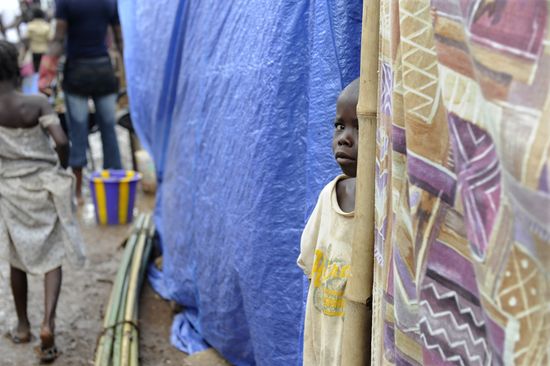
By Philippe Desmazes/AFP/Getty Images.
Monday on the Dish, Andrew mulled the problems in both Ryan and Obama's plans, parsed Obama's poll numbers, and considered what's at stake in 2012. Andrew considered liberals vs progressives, remembered He Who Shall Not Be Named by GOP candidates, and we kept tabs on the S&P with a full web reax here. Andrew raged against our inablity to stop looking at our devices while with friends, and seconded readers on Palin's bizarre birth. Roger Ailes remained creepy, and Palin's ghostwriter hit it big with otherworldly toddler stories.
Andrew countered Max Boot on withdrawing from Iraq, Andrew Exum defended cluster bombs, and the Libyan war hurts the West. Brandon Garrett illuminated why the innocent confess to crimes they didn't commit, and John L. Allen Jr. questioned the fast-tracking of Pope John Paul II's sainthood. The Giving Tree still made readers cry, readers talked smack about Greyhound's service, and Andrew didn't believe in perfection, or dieting, for God. We checked in on the Mancession, 60 Minutes exposed the story we tell ourselves about the Middle East, and Andrew wiled away time on Google Maps. Scott Adams wrestled with the real world as school's hardest subject, readers defended history, and Charles Fishman argued water shouldn't be free. Creativity flows in blue rooms, Conor and Andrew appreciated the noise in coffee shops, and Christian movies suffered the same problems gay cinema used to. Readers debated dating short men, Street Carnage gaped at a new drug that's uppers for your uppers, and Obama declared a no-fly zone for Angry Birds.
Typo of the day here, hidden lives of Barbie and Ken here, map of the day here, Sully bait here, dissent of the day here, quote for the day here, VFYW here, MHB here, and FOTD here.
–Z.P.
 doctrines of Mormonism are manifestly untrue – perhaps because they are more easily exposed because they are so recently concocted. And that's why, to my mind, it is insufficient or condescending to argue that the literal truth claims of fundamentalist religion are irrelevant, as long as they reliably lead to happiness of morality. On this, I side with the new atheists who do literalist believers a service by taking them at their word.
 empirical grounds. Ditto the Resurrection. Was it a literal, take my shroud off and walk out experience? Or was it something more mysterious? Again the Bible tells us all sorts of contradictory things: Jesus is tangibly physically resurrected; he is strangely altered; those close to him can see him after his death and yet not recognize him at all on the road to Emmaus. These cannot all be literally true and yet they all point to a mystery at the core of our faith: He is risen.
 The Dish