Washington Will Act, Eventually?

Ryan Avent is betting that DC will address the debt before all hell breaks loose:

Some writers worry that views of American creditworthiness may turn on a dime, such that there will be no time to act between the moment when yields begin rising and the moment they hit unsustainable levels. That's not impossible, but it does seem highly unlikely. American yields didn't soar overnight in the early 1990s, and Greek yields crept up for months before spiking last April.

The existence of a broad array of parties interested in an orderly American budget fix makes it likely that parties would intervene to slow rising American yields if they did spike rapidly, in order to buy Congress time to take action. But I find it hard to imagine things progressing that far. Whenever Treasury yields climb the least bit, even if its only from epically low levels to abnormally low levels, pundits and politicians begin squawking and demanding immediate budget steps. And indeed, these squawking pundits have been quite effective; it's striking how much attention is being paid to deficit issues rather than, say, unemployment. If the 10-year returned to its 2007 level, all hell would break loose in Washington, even though the yield in 2007 was really unusually low.

Beer Money

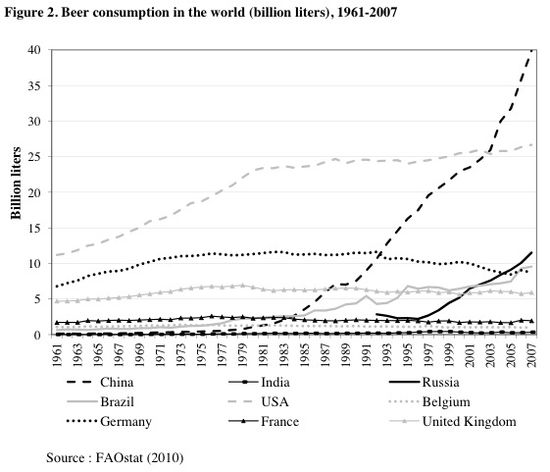
Beerconsmption

A new paper (pdf) by Liesbeth Colen and Johan Swinnen study global alcohol consumption. From the abstract:

Recently, China has overtaken the US as the largest beer economy. A quantitative empirical analysis shows that the relationship between income and beer consumption has an inverse U-shape. Beer consumption initially increases with rising incomes, but at higher levels of income beer consumption falls. Increased openness to trade and globalization has contributed to a convergence in alcohol consumption patterns across countries. In countries that were originally “beer drinking nations”, the share of beer in total alcohol consumption reduced while this is not the case in countries which traditionally drank mostly wine or spirits. Climatic conditions, religion, and relative prices also influence beer consumption.

Felix Salmon looks closer to home:

I would imagine that this relationship could also be found within the U.S. — that states increase their beer consumption as they grow to an income of about $22,000 per capita, and thereafter see their beer consumption drop as their wine consumption increases.

Taxing Themselves

Gregg Easterbrook notices that "Obama said last year that itemized deductions for the wealthy should be phased out — then on his own tax return, claimed a huge itemized deduction":

Wealthy people who say the rich should pay higher taxes — Bill Gates and Warren Buffett have joined Obama in declaring this — are free to tax themselves. If you believe the top rate should rise to 39.6 percent (Obama) or 50 percent (Buffett), then calculate the difference and send a check for that amount to the Treasury. Of course no one individual doing this, even a billionaire, would have much impact on the deficit. But if rich people who say they believe in higher taxes were willing to practice what they preach, this would prove their sincerity, making legislation on the point more likely.

Easy To Digest

Doctor Science notes that "cooked eggs are almost twice as digestible as raw eggs" and that a cooked egg therefore "has effectively more human-available calories than a raw egg":

[O]nce our ancestors started cooking food, they could get more calories and nutrition out of a given item. If they started with a chimpanzee-like gut, mouth, and chewing habits, they would have taken in *many* more calories than their bodies were evolved to handle. … I've been wondering if the so-called "obesity epidemic" reflects (in part) something similar: if our food has become, in some fundamental but unnoticed way, more digestible. This might be a clue to why increases in BMI and obesity have been going on for a century.

Deafness As An Ethnicity, Ctd

A reader writes:

Oh my goodness. You really waded into a hot-button topic with this one, Andrew. I have a master's degree in Deaf Education, and I'm Deaf myself. Your second reader is really, really off about ASL. So off that I'm sending this quickly while I have a minute rather than sitting down and writing the thorough, citation-filled screed that I want to write. OK, short version:

Cognitively speaking, every child must learn a language. It doesn't matter what language that is, but it must be a true language. ASL is a true language. (Signed English, for example, is not. Cued speech also is not; it's a way to attempt to make spoken English more visible.) Deaf children with DEAF PARENTS – or who are otherwise exposed to ASL from birth – do very well with language. They are able to learn English as a second language because all of the necessary language pathways have been established via early and natural exposure to ASL.

However, 90% of deaf children (small-d = hearing issue, big-D = culture) are born to hearing parents. These days, with infant screening, many hearing issues are caught right away. Historically, parents often didn't figure out that a child was deaf until he or she failed to start talking. So from zero to two or so, that child often had no access to language. Then (assuming that the hearing parent wanted to learn ASL, which frequently is not the case) the hearing parent would have to learn ASL, and then become FLUENT in ASL, which is a difficult language to learn. This meant that even in the best-case scenario, a deaf child with hearing parents would not be getting access to language at home for many years. And this means general cognitive delays, that apply to any language (including English).

Again, cued speech is not a language; it's a means to access spoken English. It can be useful for some. But ASL is a much more widely used and accessible means of communicating. Deaf people almost never speak to each other using cued speech. I am deaf but have a hearing daughter and a hearing husband. I am very active in the Deaf community, and also very active in the hearing community. I am bilingual and bicultural.

I'll leave it there now but the main thing I want to address is the idea that there is anything wrong with ASL. There really, really isn't.

Another writes:

There is nothing wrong with any of the communication approaches.  What seems wrong, however, is the intensity of the ‘vs’ debate.  The d/Deaf and hard of hearing (d/D/HH) group is one of the most diverse groups you will see in special education.  I say special education, because in theory, all children diagnosed with a degree of hearing loss receive special education services to some extent, regardless of their or their parents’ perspective on disability.  A singular approach to communication and teaching with children who are d/D/HH is impossible.  We (families, educators, and communities) need to view the child as an individual, with individual communication and learning styles, not within the political context of the hearing and d/Deaf communities.  The point is access to language, not the "right" way to access language.

Another:

Some years back I was friends with a family that had a deaf college-aged daughter. She was completely deaf from birth and was raised on cued speech. She grew up in France (her parents were American missionaries) but then later returned to the States and attended Wellesley College. Because of cued speech, she learned to speak both English and French and could also understand what hearing people were saying by reading their lips (another skill she was able to pick up because of cued speech). Her speech was slightly slurred but completely understandable, and as long as she was within sight of your mouth she was able to speak to you and understand what you were saying back, just like a hearing person. Sometimes I'd even forget she was deaf.

During college she studied Russian and became good enough to spend a few months overseas teaching an ESL class to Russian students, which is difficult enough for any non-native Russian speaker, let alone someone who's deaf. I understand she struggled a bit, but the fact that she even took on the challenge shows the confidence in her own language skills that cued speech was able to instill.

Her mother became very good at cued speech. While they were in France, she taught classes for other parents of deaf children. The mother would sometimes cue the movies they watched on video or TV because it was sometimes difficult for her daughter to read the actors' lips (this was before DVDs and subtitles). She told me that once when two characters were speaking, one in English and the other in French, she used her left hand to cue the English speaker and her right hand to cue the French speaker. I was continually amazed at what this family was able to do with cued speech and how far along they were able to bring their daughter in her education because of it.

Another:

Here's a video released by California Department of Education with the collaboration of CSUN's Deaf Studies to promote ASL literacy.

Another:

This is a great article on Deaf Culture – it's from 1994 and therefore somewhat dated, but almost all of the basics are covered. Incidentally, this article (which made a huge impression on me, as someone who was just entering Deaf culture) is part of why I'm now a fan of yours.  I read the article, lost track of Andrew Solomon, then much later saw your name and thought you were him.  I really liked you for writing such a great article! :-)  By the time I figured out that you were different people, I had become a fan of the actual Andrew Sullivan.

Another:

This whole discussion reminds me of an old Onion article, "Deaf Man's Deaf Friends Way Too Into Deaf Culture."
The Daily Wrap

Today on the Dish, Andrew used Louis CK to illuminate the right response to Kobe's slur, prized WikiLeaks but not the Pulitzer, and called Obama on revising "I am my brother's keeper." Steve Kornacki splashed cold water on cocksure Democrats, Ryan's plan actually bested Obama's, Andrew Romano reminded us raising taxes is on the table, and Frum begged the GOP to tackle it. Palinites complained that the media was ignoring her, the Trig story reached denouement, Geoffrey Dunn hoped to disprove the Trig birther conspiracies, and HuffPo rejected his article as a conspiracy theory of its own. Michael Scherer mocked the Palin / Trump policy disagreements and Andrew's eyes bulged when critics called Trump unserious.

Readers assessed how to solve Mexico's drug war, Jeremy Cherfas defended the poppy trade, and we checked in on ending marijuana Prohibition in America. Mission creep came to Libya and Joel Wing followed up on blood for oil. Gabby Giffords received better medical treatment than many soldiers, tea partiers in New Hampshire didn't mind gay marriage, and phone porn tricked customers. Josh Green psychoanalyzed Glenn Beck's brain in a wordcloud, readers defended uploading to the Internet's shared brain during conversations, and Josh Green savored silence. We peeked into the medicine cabinet of Dish readers, Kay Steiger considered the dearth of women with disabilities on film, and Americans loved their Medicare. Ben Adler explored the roots of gentrification, short readers were offered steroids, and the web debated whether to pity the white male. Rich people didn't realize they're rich, a royal wedding just isn't what it used to be, penguins giggled, trees came pollen, and Andrew weighed in on Gaga's Judas.

Chart of the day here, quote for the day here, MHB here, VFYW here, and the yesterday's VFYW contest psychoanalysis here.

–Z.P.


Meet The Republican Rump

Dave Weigel prepares for the 2012 campaign:

Remember those interviews with racist Democratic voters in West Virginia back in 2008? Remember the interviews outside McCain-Palin rallies — that nice gentleman with the toy monkey who called it "little Hussein"? Yeah. Things are not better now. And there aren't any Democratic primary rallies at which conservatives can record competing videos.

No More Happily Ever Afters

Bagehot observes that "only a third [of the British public] are certain to watch [the royal wedding] on television" and there will be far fewer street parties "than when Prince William’s parents wed in 1981":

What is going on? Most simply, experience has taught the British that to cheer a royal wedding today is to risk feeling a chump tomorrow. After decades of royal divorces and marital wars conducted by tabloid leak or tell-all book, sighing over a new princely union requires a Zsa Zsa Gabor-like leap of faith.