How Important Is Parenting?

Bryan Caplan thinks twin studies prove that parenting matters less than genes. Jane Waldfogel counters:

I think we need to be careful with the evidence from adoption and twin studies. Such studies rely on the assumption that twins adopted into different homes experience different environments, but in fact twins who are reared apart are often raised in quite similar homes. Another confounding factor is that the influence of genes seems to be stronger in more advantaged settings than it is in more disadvantaged settings. Think of corn planted in fertile, well-watered soil; the main thing that will matter in that context is genetic variation in seeds. Because adopted children more often grow up in advantaged homes, studies of adopted children will therefore tend to overstate the influence of genetics.

Tax Brackets 101, Ctd

Some remaining revisions to this thread:

Your reader wrote, "Earning more than $106k a year won't entitle you to any more in social security benefits, so one should not be taxed on income in excess of that…" This perpetuates a basic and harmful misunderstanding of Social Security and how it is paid for.

Social Security is not a self-funded retirement plan. My payroll deductions do not pay for my future benefits, they pay for the benefits of current retirees. While my benefits will not increase over a certain amount even if I were to pay additional payroll taxes, that should not be relevant, since I am not paying for my own benefits. If the issue is revenue – how to pay for benefits – and I think it is, then there is no rational reason not to tax income over $106K to create additional income for social security. I don't really need that "bonus" I get every September as a reward for being highly paid in the first place.

Another:

I take issue with what your reader wrote:

Dividends are paid by corporations who are already subject to 35% federal tax rates on the income they earn. So while Bill Gates personally may pay 15% on the cash Microsoft pays him as dividends, Microsoft has already paid 35% of federal income tax on its earnings in that year, whether or not it chooses to pay the dividend. And that dividend the company pays out is not deductible against its tax bill.

In light of the reporting of the NYT, I don't see how we can expect any major US corporation to be paying the nominal 35% tax rate – that is just smoke and mirrors.  In fact, Microsoft pays 25% according to Forbes, and frankly I was surprised that it is that high.

Another:

As I'm sure others will also point out, Bill Gates is not taxed at a 15% rate on the dividends paid to him by Microsoft.  Dividends are taxed as regular income, not capital gains. Long term capital gains, which qualify for the 15% tax rate, result when Bill sells his Microsoft stock after holding it for more than a year; Microsoft pays no corporate income tax on those gains because they don't own the stock, and don't profit when Bill sells it. 

Update: A CPA writes:

Bill Gates' Microsoft dividends absolutely ARE taxed at 15% at the federal level. One of the Bush tax breaks was to lump qualifying dividends (those paid out of a subsection C corporation's earnings) together with long-term capital gains when calculating capital gains that are taxed at the maximum rate of 15% for those in the 25% percent bracket and higher. Even better, if you are in the 15% bracket or lower, qualifying dividends and long-term capital gains are taxed at ZERO percent federally.

I've had to explain to a senior citizen client of mine sitting on a million dollars of utility stock paying $45,000 of dividends a year that they owe no federal income tax whatsoever, even with having to pick up 85% of their Social Security payments in adjusted gross income. That's pretty fucked up.

The Daily Wrap

Today on the Dish, rifts in the GOP leadership deepened, Andrew called them on their panic, and wasn't buying their dishonest memories of Bush as budget master. Andrew defended Obama's plan, Ezra sized up the cuts, and prisons robbed us blind. Henry Blodgett dared to question Palin's pregnancy, Andrew hoped we were reaching critical mass, and we remembered Palin's crush on Ivana. We measured how many could ride on Obama's tiny coattails, Mark Blumenthal rooted for the underdogs in Iowa, and Romney wasn't throwing in the cards yet.

Dani Rodrik defended dining with dictators, kids these days didn't know better about torture, a reader criticized the study's methods, and we eavesdropped on North Korea's cellphone conversations. We got an update on Libya's genocide threat, NATO was still debating whether to arm rebels, and Ackerman checked in on our exit from Iraq. PM Carpenter bashed the Beltway's rules, and Andrew drummed up pity for the unpaid HuffPo bloggers.

The Civil War lived on, Andrew ripped apart the culture war's stigmas against gay kids, and abortion remained personal. Readers kept tabs on our tax brackets, a startup could fund college kids to drop out, and cheap bus travel wooed customers. Books made a beeline for perfumes, Andrew didn't hop on the Foodie bandwagon, but we can blame that on jellied eels. Southpark weighed in on The Giving Tree, readers identified with the empty trees, Andrew judged American Idol, and the three elements of Dishness converged.

Deep thought of the day here, VFYW here, headline of the day here, quote for the day here, poseur alert here, MHB here, and FOTD here.

–Z.P.
Quote For The Day II

"I tell it like it is. [Y]ou'll hear a political reporter go on and say [Hillary Clinton's loss in 2008] had nothing to do with race. But how come she had such a tiny piece of the vote? And you know, it's a very sad thing. I have a great relationship with the blacks. I've always had a great relationship with the blacks. But unfortunately, it seems that, you know, the numbers you cite are very, very frightening numbers," – Donald Trump on president Obama's sky-high support among African-Americans.

It's gonna be a fun primary season, isn't it?

Dishness, Explained

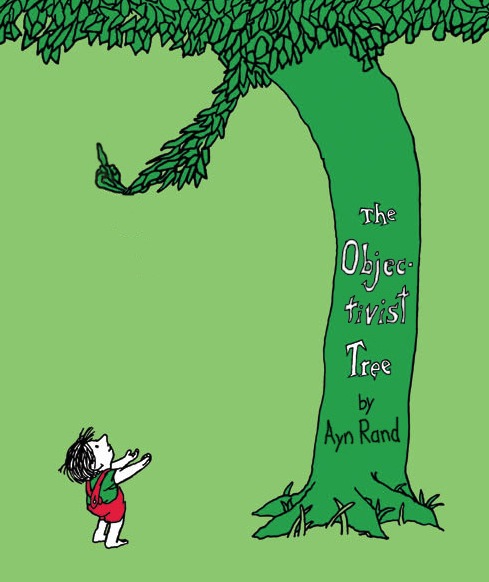
Objectivist-tree

A reader writes:

As a long-time reader, one of the things I love about the Dish is the way parallel discussions grow from posts, so that multiple political or cultural themes come and go.  These discussions sometimes run for weeks, which runs counter to the perception that the web is all short attention span dreck. Sometimes, these themes interweave.  

Perhaps I was late to see this, but the discussion of the childish, self-centered Objectivist philosophy overlaps superbly with the Giving Tree debate.  Would Rand have cried reading the book for the first time?  I doubt it.  She would have said that the boy was noble to take all he could (though she may have been puzzled by the fact that he did not make a fortune off the apples, house and boat).

Another reader is on the same page:

I find it fascinating how the three most popular discussion threads this week – "Growing Up Objectivist" (on the influence of Rand's writings on the youth), "The Best Children's Books" (on the controversial lessons of The Giving Tree and how it relates to parenting), and "Married Without Children" (on the trade-offs of being an uncle/aunt versus having kids of your own) – have overlapped in so many subtle ways.  

I suppose the theme that binds them all could be, "To what extent should you live for yourself and how much should you live for others?" An age-old question.

Image by joshik72. Previous acts of Dishness here, here and here.

Exiting Iraq

Spencer Ackerman checks in on the withdrawal. The remaining troops are scheduled to pull out by year's end:

Defense Secretary Robert Gates visited Iraq last week and loudly warned that its fractious political leadership was running out of time to request the U.S. to stay. If that construction seems odd — and reminiscent of a jilted lover — it’s out of diplomatic necessity and bureaucratic reality.  The U.S. and Iraq signed an accord in 2008 mandating a full military withdrawal. To halt that withdrawal requires a cumbersome renegotiation, and the host nation has to initiate it. Clock’s ticking.

Ackerman concludes that "the obstacles to a prolonged U.S. presence in Iraq are the leaders of both countries — one of whom wants to get out in order to stay in power, and the other can’t ask his counterpart to stay for fear of losing power."

It’s So Personal: A Video Version

A reader writes:

Here is the story of Danielle Deaver. As she explains in the video, Danielle's water broke at 22 weeks.  Doctors informed her that her fetus had virtually no chance to survive. With abortion banned after 20 weeks by Nebraska law, she was unable to stop a pregnancy that ended with her giving birth to a child who lived for 15 minutes.  The law – the Unborn Child Pain Awareness Act – is based on the disputed idea that a fetus can feel pain beginning at 20 weeks; ironically, the Deavers’ sought an abortion because of concern that the infant would suffer while it died, trying to breathe.

A collection of stories by Dish readers here.

Is Romney Done For?

Ed Kilgore believes "the Invisible Primary of elite opinion" has already voted against Romney:

Romney is going to be operating without a net once the campaign is under way. With the entire political world impatiently waiting for his inevitable demise so that the "real" campaign can get under way, every mistake the man makes is going to get exaggerated in the hope that he will see the light and stop taking up space.

Jonathan Bernstein isn't so sure:

Is all this speculation about Romney's weakness simply outsiders thinking through the logical case against him, perhaps prodded a bit by spin from rival candidates and general ambivalence from serious GOP players? Or is it — as was almost certainly the case with Palin-bashing — part of a serious effort by anti-Romney Republicans to veto him?

Can The Ryan Plan Pass The House?

Steven Taylor has doubts:

I am wondering if a majority of House Republicans are going to be willing to go on record for a plan that will end Medicare as we know it.  Yes, there are many in the Republican base, especially the Tea Party faction, that are currently quite passionate about the plan.  However, with the 2012 elections around the corner, how willing are individual members of the House to go home and campaign for reelection after having voted to utterly transform Medicare?  Worse, since even if the given member believed in the Ryan Plan they know that it will never pass the Senate (let alone survive the veto pen if it did).  As such:  why go home and risk the wrath of constituents over Medicare when the whole thing is a legislative dead end?