Chicken Shit In The Tax Code, Ctd

A reader writes:

I understand this seems ridiculous, but the current alternative to this would be to have the poultry farmers continue to use the earth as a toilet. Until there is a serious effort to put monetary value on the benefits of NOT using the earth as a toilet, incentives to keep people from doing this are necessary.

Another writes:

I worked on Energy and Energy Tax policy for a Senate Finance Committee member when Senator Roth was Chairman of the Committee.  You and Len Burman only scratched the surface of this (which, for the record, I thought was a decent use of the Tax Code to clean up some serious environmental problems on the Delmarva, the Potomac Highlands, and other chicken raising areas).  What Burman didn't seem to appreciate is that Senator Roth didn't push this for the poor downtrodden farmers ("growers" is the term of art); he did it for the giant poultry companies – Tysons, Perdue, etc.

The growers exist in a commercial situation that is reminiscent of the old "company store" system from pre-UMWA coal mining.  They have to pay for the baby chickens (peeps), the feed, the veterinary services, and other expenses forced on them by Big Poultry, and are only paid for the peeps they raise to the point where the companies take back from them – there is no payment for a bird that dies on the day the big poultry companies take possession of the mature birds, or any bird that died before that. 

Often, growers barely break even, even if they are lucky enough or good enough at what they do to have a high yield. And the way the credit terms work, once you're in the business as a grower you have to build bigger and bigger chicken houses and take more and more birds – at your expense – to stay in the poultry companies' good graces, but they can cut you off at any time for no reason.  Before the chickenshit credit, state and federal regulators went after the growers for the massive damage the poultry waste was causing, while poultry companies said, essentially, "hey, those aren't our birds and farms." 

After the Roth credit was enacted, and growers thought they might have some incentive to ease the financial burden as well as the environmental degradation, all of a sudden the chicken waste (both manure and dead birds) had a value.  What was once their problem to deal with as growers, now became the property of the big poultry companies.  The growers didn't benefit much, if at all.

Where The Money Is, Ctd

Where_money_is

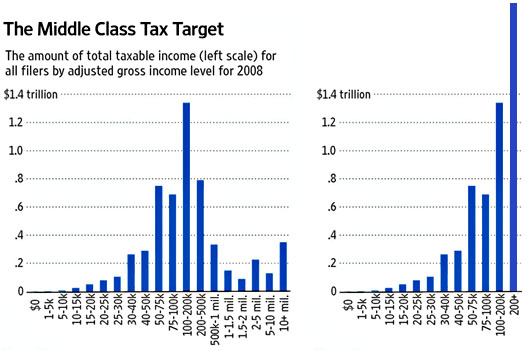
Chait finds this chart from the WSJ highly misleading:

Democrats have been arguing that their tax increases should solely effect income over $250,00 a year. The Journal makes that pot of income appear small by diving it up into seven different lines. See, the $100,000-$200,000 line is tall, and all the other lines to the right of it are short. That tall line must be where the money is!

But if you add up all the lines of income over $200,000, you get around $2 trillion. (I may be off, because I'm eyeballing it, but I'm not off by much.) That obviously far exceeds the nearly $1.4 trillion accruing to the $100-200,000 set.

Kevin Drum's redrawn chart, to the right of the original chart, is above.

Housing: Near The Bottom?

Stan Humphries takes stock of the first quarter of 2011:

The cumulative decline in home values since the market peak is now 29.5 percent. … Nearly three-quarters (74.5 percent) of homes in the United States lost value from Q1 2010 to Q1 2011. … A record (37.7 percent) number of homes sold in March were sold for a loss.

Mark Zandi thinks the worst is behind us. Annie Lowrey compares the housing bubble with accusations of a higher education bubble:

A house is an investment vehicle much more like silver or stock shares than it is like a degree. It can be readily bought and sold. Americans had a housing bubble not just because they bought more homes, but because they speculated on homes, snatching them up, fixing them up, and pushing them back onto the overheated market. The asset-price bubble burst when people started defaulting and stopped buying.

No such market for college degrees exists: You cannot trade your University of Phoenix B.A. for a Yale degree when you start making the big money. In the words of Kevin Carey of the think tank Education Sector, "College degrees have value. … But they have no inherent worth. They are secondhand testimony of something valuable—the knowledge and skills associated with a unique person."

The Tragicomedy Of Sarah Palin, Ctd

One more round with Josh. I did indeed read his piece which contained nothing new, except an intriguing angle that Palin lost an opportunity to turn her massive tax-and-redistribute plan for the oil companies in Alaska into a national program. In his response, Josh argues she could have proposed a similar plan for Wall Street. But does Josh really believe that a big new tax for Big Finance would have worked as a campaign theme for the Republicans in 2008? Wall Street at the time was reeling, and McCain famously backed TARP. My view is that this is grasping at straws, not so much counter-intuitive as counter-factual.

Josh takes one policy legacy and ignores the reams of evidence that she abused her office on personal vendettas, could not rid herself of congenital lying, played culture war politics from the first moment she entered politics, and left her state in the lurch halfway through her first term. Palin is what she always was. Part of what she is and was is contemptuous of sage advice and bored by policy. She had no superpowers but great performance skills and empowering resentment. It just so happened that those abilities met a rare moment in Alaskan politics and the tax was passed. But the notion that she could then don a new persona and help the country is simply at odds with who she is.

Steve Schmidt swiftly discovered to his horror what Josh has still not absorbed. Palin is Palin. Her character and attitudes have barely changed since high school. She is increasingly despised in Alaska because Alaskans know this, and live in her wake. Josh managed to go all that way to assert the opposite. Apart from making John McCain feel marginally better, I see no point to this alternate universe fantasy.

Romney’s Healthcare Speech

Ezra Klein says it "featured as thoroughgoing a defense of the individual mandate as I’ve heard in months." Avik Roy is scathing:

The final straw, for me, was when Romney said that “there’s not a lot that I want to borrow from France and Switzerland.” I’m with him on France, but Switzerland (despite its own individual-mandate issues) has the most market-oriented health-care system in the developed world. I would love to borrow Switzerland’s exceptionally low levels of state-health spending, which they manage to achieve while providing universal coverage and high-quality care. Their tax rates aren’t shabby either.

The Taliban Joins Twitter

Screen shot 2011-05-12 at 1.29.25 PM

Jon Boone follows their activity:

Their Twitter feed, @alemarahweb, pumps out several messages each day, keeping 224 followers up to date with often highly exaggerated reports of strikes against the "infidel forces" and the "Karzai puppet regime". Most messages by the increasingly media-savvy movement are in Pashtu, with links to news stories on the elaborate and multilingual website of the Islamic Emirate of Afghanistan, as the Taliban's shadow government likes to style itself.

Boone notes an obvious irony:

When the Taliban ruled Afghanistan, they eschewed most modern technology, including television and music players.