Don’t Judge A Restaurant By Its Prices

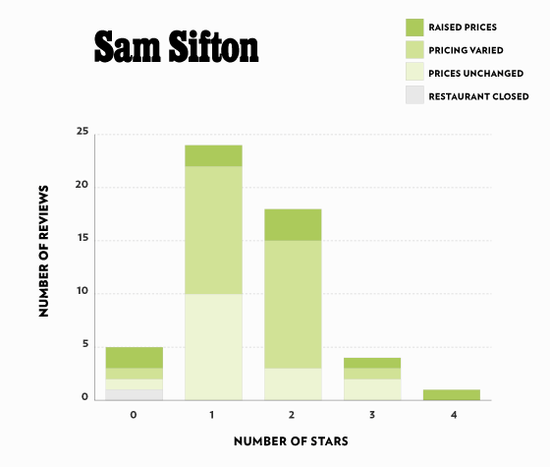
Siftongraph

Felix Salmon quells the crowds by showing that there's very little correlation between good reviews and price hikes:

From a consumer perspective, the lesson here is that price is no particular guide to food quality, as measured by reviewers' stars or anything else, nor do rave reviews mean that a restaurant will soon be hiking its prices. Some great restaurants are very expensive, but many mediocre ones are, too. … Restaurateurs, especially at new establishments, undoubtedly lose sleep about how many stars they're going to get from [reviwers Sam] Sifton and [Adam] Platt. But reviews rarely make as much of a difference as we might suspect — at least when it comes to the check.

Conserva-Reality II

Et tu, Ed Morrissey? The latest Paul Revere kerfuffle is proving to be a fascinating insight into how far the media right is prepared to distort reality to protect their icon. Here's Andrew Malcolm's spin:

The well-known fable is Revere's late-night ride to warn fellow revolutionaries that….

…the British were coming. Less known, obviously, is the rest of the evening's events in which Revere was captured by said redcoats and did indeed defiantly warn them of the awakened militia awaiting their arrival ahead and of the American Revolution's inevitable victory. Palin knew this. The on-scene reporters did not and ran off like Revere to alert the world to Palin's latest mis-speak, which wasn't.

Malcolm is actually proposing that Mrs Palin was presenting a highly sophisticated and more deeply learned account of the events that night than almost every other American. Here's the Palin quote we're discussing:

"[Revere] warned the British that they weren't going to be taking away our arms. By ringing those bells and making sure as he's riding his horse through town to send those warning shots and bells that we were going to be secure and we were going to be free."

It's clear from this mangled, confused quote that Palin is conflating the ringing of bells and firing of shots with the notion that Revere was warning the British. She makes no mention of his being captured by the British – and that being the context of his warning them. Here's the Paul Revere House account of the night:

"On the evening of April 18, 1775, Paul Revere was sent… to ride to Lexington, Massachusetts, to warn Samuel Adams and John Hancock that British troops were marching to arrest them… On the way to Lexington, Revere "alarmed" the country-side, stopping at each house, and arrived in Lexington about midnight. As he approached the house where Adams and Hancock were staying, a sentry asked that he not make so much noise. "Noise!" cried Revere, "You'll have noise enough before long. The regulars are coming out!" After delivering his message, Revere was joined by a second rider, William Dawes, who had been sent on the same errand by a different route. Deciding on their own to continue on to Concord, Massachusetts, where weapons and supplies were hidden, Revere and Dawes were joined by a third rider, Dr. Samuel Prescott. Soon after, all three were arrested by a British patrol."

So all this was about warning the British? I note this simply because it helps reveal the extent to which the Roger Ailes world – where propaganda always trumps reality – will protect Palin if she runs. There is no gaffe they won't defend, no odd lie they won't avoid, no serious question about her past and her multiple fantasies and delusions that they will take seriously.
Conserva-Reality I

Wikipedia might have been able to resist the throngs of post-modern fundies, but conservapedia exists to embrace the throngs of post-modern fundies. Hence the following sentence just added to the Conservapedia profile of Paul Revere:

Part of the purpose of Revere's ride was to warn the British that colonists would exercise their natural right to bear arms.

See? She was right all along. She is becoming the Cult Of The Immaculate Misconception.

How Luck Distorts Success

Laurence Gonzales's example:

[M]ost people don’t do a good job of distinguishing between luck and skill.  If they do something and it works out to their benefit they say, “See how good I am?  I’m going to do it again.”  …  So on Wall Street before the recent recession, traders were rewarded for doing very stupid things.  And it was pure luck, it was pure chance of the circumstances that they were rewarded and they did it again and again and again because it rewarded them again, and again.  And nobody ever stopped to say, boy this is really stupid, but I think I’ll do it again.  The reward made them think it was smart and that they were skilled instead of just being the victims of chance. 

Hot Lesbian Exception

The Final Edition's new NYT parody site is getting good:

“I was consulting Scriptures, as I often do,” said [Focus on the Family's Tony] Perkins. “And as I was perusing the verse in Leviticus that condemns homosexuals to death, I noticed that it only refers to ‘men who lie with mankind, as he lies with a woman.’  The Almighty says nothing about women who lie with women, especially really fit young women with large firm breasts and great hair."

Icebergs In Arabia?

TugboatvsBig

David Zax tracks French engineer Georges Mougin's attempts to tow freshwater icebergs across the Arctic:

There are 1.1 billion people in the world without clean drinking water. Meanwhile, billions of gallons of freshwater disappears uselessly into the ocean, the result of icebergs that break off from the ice caps of Greenland and melt into the salty mix. … Using 3-D technology, recently declassified satellite data, and the new science of oceanic forecasting, Mougin has created an elaborate method for hauling ginormous icebergs using a "skirt" and a tugboat.

The Cost Of Cancer

The Economist explores the market for expensive cancer treatments:

The government health programme for the elderly is barred from considering price at all when it decides whether to cover injected drugs under something called Medicare Part B. Under Part B’s loopy reimbursement system, the more a drug costs, the more the oncologist who prescribes it is paid. Patients have little reason to demand cheaper drugs.