The Default Monster Cometh

Ryan Avent warns Washington that because "failure to raise the debt ceiling would be so nasty, that very possibility could cause serious economic damage even if the odds of an actual default never approach 50%":

Markets try to prepare for trouble. If there's a chance of bad times ahead, market participants will take precautions, just in case. They may move money to safer assets, increase cash holdings, curtail marginal investments, put off hiring, and so on. Do you see the problem? These sensible measures are themselves bad for the economy. Now, the probability of an actual default isn't very high. But the cost of default is catastrophic. So even if the odds of default shift from very small to slightly less small—from say 2% to 5%—that shift represents a substantial increase in the potential economic downside looking forward. And that, in turn, could lead to greater precautionary measures from banks, businesses, and households.

I'm already looking at my retirement savings and wondering whether I should rely on Washington to destroy them. Either side that digs in and refuses to compromise is threatening to wipe out your savings. Why aren't more Americans awake?
Palin In Iowa

It's the big roll-out for her wonderfully mistitled documentary, "The Undefeated." Weigel gays out:

Should we consider Michele Bachmann's event from yesterday and place this in the continuum of Palin's New Hampshire visit on the same day of Mitt Romney's launch there? Should we look at the polling and notice that Palin's support is now a fraction of Romney's support in New Hampshire and Bachmann's in Iowa? There's something very Norma Desmond about this.

"I am big. It's the primaries that got small!"

The Linguistics Of “Like”

Like

Erin Gloria Ryan proposes a theory:

Saying "I'm an aerospace engineer," or "I enjoy reading Don DeLillo" sounds much more intimidating than "I'm, like, an engineer," or "I enjoy reading, like, Don DeLillo." Maybe women of my generation have been taught, through positive social reinforcement, that we're supposed to pepper our speech with meaningless modifiers that make us sounds a little less sure of ourselves, a little less credible. No one likes a show off or a know-it-all. Better temper your smart-talk with assurance to whoever you're speaking that you're not, like, a threat or anything. 

Mark Liberman envisions how technology could cure us:

[N]ow that speech recognition has gotten to be pretty good and very cheap, it's only a matter of time before someone combines a speech recognizer with a style checker, and creates an app for your smartphone that will make it vibrate (or beep, or flash) whenever you indulge in any of the verbal tics that you've asked it to watch out for.

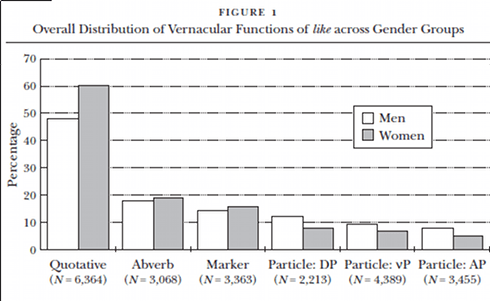
(Image from Alexandra D'Arcy's "Like and Language Ideology: Disentangling Fact from Fiction" (pdf) from 2007.)

Quote For The Day

"Like water, however, trash seeks its own level. Sarah’s appearance alongside her no-talent daughter at a Minnesota shopping mall is the clearest indicator yet that the 2008 Republican candidate for vice president of the United States is finally becoming not the national leader she never could have been, but part of our national landfill," – Joe McGinniss.

The Art Of The Interview

CBS MoneyWatch recently posted the "20 Craziest Job Interview Questions" from various employers. Giles Turnbull answered all of them. Among the Dish faves:

Kiewit Corp: What did you play with as a child?

We had no toys. Grandpa sometimes brought us interesting-looking stones that he’d found by the creek, so we gave them names and invested them with complex personalities and back-stories. They lived in a stony alter-universe where everybody was a stone. The stones had little stone parties sometimes. We offered them bugs to eat, but the stones weren’t hungry. I have my favorite stone in my pocket. He’s called Gufflin. Would you like to meet him?

(Hat tip: Kottke)

The Diabetes Boom

The Economist charts it:

The number of adults with diabetes more than doubled between 1980 and 2008, according to a new study led by Professor Majid Ezzati of Imperial College London and Goodarz Danaei at Harvard University and published in the Lancet. This jump is not quite as horrific as the numbers might initially suggest, because ageing helped push up rates. But a good 30% of the increase was caused by higher prevalence of diabetes across age groups.

City vs Goose

After dangerous run-ins with airplanes near La Guardia, Canadian geese must now face Lee Humberg, a wildlife biologist tasked with "culling" them in New York:

In general, the USDA is concerned with all the nonhuman species that no longer face any natural impediment toward population growth. Coyotes, deer, geese—these creatures have returned to the cities where hunting is extinct and where the lack of deadly competition makes for a new, human-filled Eden. “At the end of the day, we as humans have extirpated most of the predators of the species that we are now trying to manage as nuisances,” Humberg says. “Somebody has to do something.”

Chart Of The Day

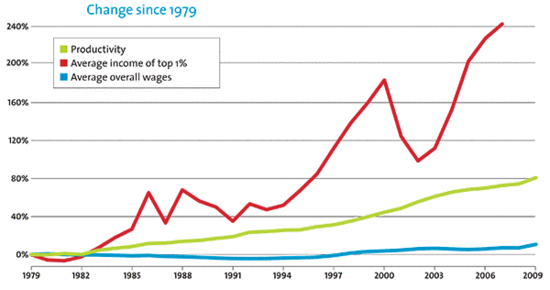
Change-since-1979-600

Dave Gilson editorializes on the average American wage:

In the past 20 years, the US economy has grown nearly 60 percent. This huge increase in productivity is partly due to automation, the internet, and other improvements in efficiency. But it's also the result of Americans working harder—often without a big boost to their bottom lines. Oh, and meanwhile, corporate profits are up 20 percent.

Gilson gives these statistics life by using more charts and the tales of overworked Americans.