“An Epidemic Of Not Watching” Ctd

Kiera Feldman scrutinizes Birthright Israel, which has spent almost $600 million to send more than 260,000 young Jews on free vacations to Israel over the last 11 years:

Alumni often assure me that Birthright is just a fun heritage trip. Funders and officials, too, reiterate Birthright’s “apolitical” nature. In January, J Street announced it would sponsor a Birthright trip. Shortly thereafter, Birthright said a miscommunication had occurred—as a “political” organization, J Street was ineligible. Yet a Birthright trip run by AIPAC, the far more conservative Israel lobby group, has been renewed for years.

Our guide was Shachar Peleg-Efroni, a second-generation secular kibbutznik. Several times a day he said things like, “Arabs are those who originated from Saudi Arabia.” Everything we saw out the tour bus window was “in the Bible,” reinforcing Zionist claims to the land. He used “Palestinian” interchangeably with “terrorist.” Driving through northern Israel, Shachar gave a lesson in “Judaization,” the government’s term for settlement policy. Passing through an Israeli-Arab town, he called our attention to a litter-strewn road (perhaps the result of inequities in municipal funding, which escaped mention) and then pointed to a neat ring of state-subsidized Jewish towns. “Judaization,” he explained, was necessary “to keep them from spreading.”

Marc Tracy both praises and criticizes the article.

Faces Of The Day

Twelve-hunger-strikers-caption

Hoda Saber, an Iranian journalist and political prisoner on hunger strike protesting the death of Haleh Sahabi, recently died under suspicious circumstances.  Twelve more imprisoned journalists began refusing food on Saturday, and the issue has become a flashpoint for debating the regime's flagrant disregard for human rights.  Golnaz Esfandari rounds up Iranian commentary.

The Moral Universe Of Jokes

Adam Serwer considers the politics of humor:

Comedy is deeply revelatory in the sense that the relationship between a comic and his audience defines the borders of a shared moral universe. When Louis C.K. jokes about how being white means he can time travel wherever he wants, the audience laughs because of a shared understanding about the long historical legacy of racial discrimination against minorities. It's a shrewd joke precisely because it forces the question of discrimination into an impossible hypothetical that circumvents the expected defensive reaction of someone who might normally deny that such things still matter. To think it's funny though, you have to be someone who doesn't pretend that race no longer makes a difference.

Geoffrey Pullum, meanwhile, dissects last week's video of a news anchor trying to tell the Dali Lama a one-liner.

Why Is Crime Down?

The Dish has debated the question before. Radley Balko runs through the various theories:

It could be that we have less crime now not because of any brilliant anti-crime initiatives dreamed up by academics and politicians but because civil society has quietly churned out benefits independent of those policies. Maybe the real lesson of the last two decades is that anti-crime policies at best have little effect on the crime rate.

Quote For The Day II

"Article 1, Section 8 of the Constitution is pretty simple. It says, ‘Raise an army.’ It says absolutely nothing about race, color, creed, sexual orientation. … Let’s just move on, treat everybody with firmness, fairness, dignity, compassion and respect. Let’s be Marines," – Sgt. Maj. Michael Barrett, the top non-commissioned officer of the Marine Corps, on the repeal of DADT.

The Spiritual Power Of Psilocybin, Ctd

Andrew Sabl adds his voice to these dissents:

Give mushrooms to a bunch of hippies and they’ll gain a new appreciation for yoga; give them to a heterodox Catholic and he’ll ponder the Incarnation. Give them to me and I might start to (wrongly) believe that I can understand complex mathematical proofs or conceive (wrongly) that I remember my once-adequate ancient Greek—which once gave me the very fulfilling experience of being able to read easy bits of Plato without a dictionary. But in none of these cases is there any reason to think that the drug-takers have come to know anything that’s actually true. And I would have thought that this would be relevant.

Drum introduces romance into the debate. I'm working on a follow-up post.

How The Public Sees HIV

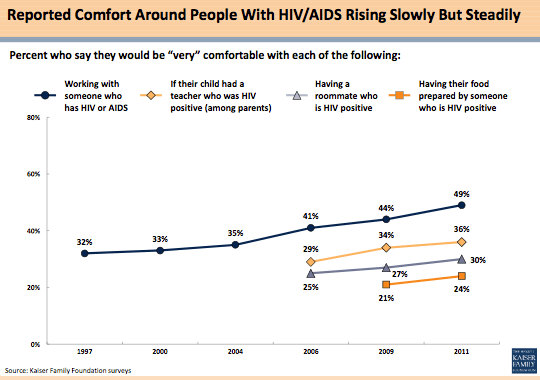
Kaiser has a new report on HIV/AIDS public opinion. Concern about the disease is fading, as is the stigma. But what I find notable is that irrational fears are still so prevalent:

Stigma

18 percent would feel uncomfortable working alongside someone like me. Here's some more evidence to support John McWhorter's concern about black homophobia:

Even though they are just as likely as other groups to report having a close friend or family member who is gay, blacks are much more likely than whites or Latinos to believe that homosexual behavior is morally wrong: 47 percent say so, compared to 32 percent of whites and 27 percent of Latinos. Even among the younger generation, with their generally more accepting views, blacks are more likely to say they view homosexuality as a moral wrong (37 percent of blacks under age 30 see it as such, compared to 24 percent of whites and 18 percent of Latinos).

When Did We Become Rome? Ctd

A reader winds down the discussion thread:

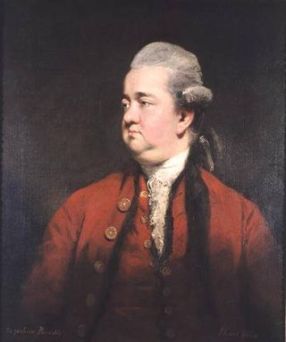
When did we become decadent? When did the fall of our great society begin? The Edward_Emily_Gibbonkicking that around for over 100 years. And while I'm sure we'd like to believe our 20-30 year window is the perfect encapsulation of a Romanesque collapse, can we at least acknowledge that the "fall" of Rome is generally considered to have occurred over a period of 300 years? We're not even that old. If this is the fall, then societies down the road will barely recognize we even got off the ground. Me? I'm optimistic.

When people compare the US to Rome, they toss around the erosion of morals and the lack of faith in leadership. But who do you think people would put their faith in today? That sleaze ball Bill Clinton? Or that devoted husband George W. Bush? While people love nothing more than a good sex scandal, they hate nothing more than a true fool. And if Bush is proof of anything, it's that too much faith in the moral character of our leaders can lead to total disaster.

Another writes:

I think the point when I realized our political system and our entire culture was not like late imperial Rome was when I read all the articles and posts by people declaring that our political system and our entire culture was like late imperial Rome. Most of the people who I read or hear say these things actually live pretty wonderful lives. It is like they want to be miserable or something.

What has been most disappointing to me since Obama has taken office is the negativity and pessimism that have pervaded our lives.

It is not his fault. He has been very optimistic and positive. He has worked admirably and diligently while enduring some of the worst political assaults in our history. He has looked for solutions even if they are not exactly what he would devise if he had been, oh, an emperor instead of one co-equal branch of our government. Yet, what has become an industry in this country – doom and gloom – threatens everything we are.

This country has endured very difficult and trying times and prevailed. Suddenly, we are in danger of extinction because of the deficit (just the part since Obama was elected) and Medicare and unions. Isn't anyone acquainted with Hitler, the Great Depression, or the Civil War? The most decadent thing in our culture is our hyperbole and our panic. What happened to fearing nothing but fear itself? If being wimpy is a symptom of decadence and the late Roman era, then I suppose we are in trouble.

As for me, I believe in this country, and sometimes surprising even to myself, I believe in the ultimate decency of the American people. We can be late imperial Rome, or we can choose not to be. It is that simple. The difficulty lies in what we do after we stop whining.

(Painting: Edward Gibbon, by Joshua Reynolds.)

The Fight Over “Conservatism”

Rick Hertzberg classifies me politically. He compares me to 1970s democratic socialists, who "devoted a lot of energy to trying to rescue what they regarded as the good name of socialism from what they regarded as its usurpers":

I see certain parallels between the Harrington-Howe socialists and Andrew Sullivan’s valiant defense of what he regards as true conservatism. Of course, there are big differences. One is that while the democratic socialists usually offered critical (often highly critical) support to the Democratic Party at election time, today’s Republican Party has veered beyond the limits where Andrew can offer even critical support (his quirky affection for Ron Paul notwithstanding).

By the same token, though, one of the two great political parties that alternate in power in the United States regards itself as conservative and will continue to do so, whereas the Democrats never remotely regarded themselves as socialist. One of these days or years, the Republican Party will be back in power. (With its House majority, it has veto power already.) For that reason, Andrew’s lonely fight for “The Conservative Soul” (the title of one of his books) is politically important and urgently worthwhile in a way that the Quixotic battle for “socialism” in America simply wasn’t.