America Is Getting Old

Young_America

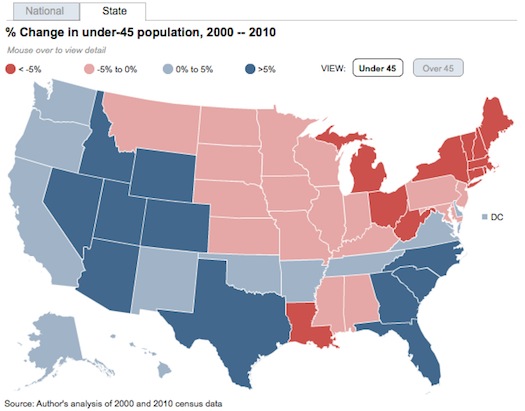
Yglesias summarizes a new report by Brookings on the uneven aging of America:

Interestingly, the highest median age state in America is not Florida — known for its senior citizens — but Maine, where 42.7 years is the median. Back in 1990, Florida was the oldest state. By 2000, it had been overtaken by West Virginia. But as of the 2010 census, New England leads the way with Maine followed by Vermont, then West Virginia, then New Hampshire, and then Florida

The End Of Librarians? Ctd

A reader writes:

Saying that modern librarians “teach students how to search the Internet” is about as offensive (at least to librarians) and dismissive as calling teachers glorified babysitters. Information retrieval is a major element in a reference librarian's job, yes, but it goes so far beyond Internet searches. Students already know very well how to search online – that’s part of the problem. Students love turning in research papers that cite Wikipedia as their primary source. Any college course that’s worth anything will want students to do scholarly research, and that’s where they fall short, because they don’t understand the difference between an online database of peer-reviewed journals and Google.

That’s what information retrieval librarians do: try to show students and other researchers how to tell good information from bad and how to pursue a line of research until you find the information you need. Teachers can’t show students how to do that because most teachers don’t know how. There’s a reason that it takes two or three years to get a Master’s Degree in Library Science.

And those are just the reference or information retrieval librarians – there are dozens more behind the scenes of any library, building and weeding the collection, cataloging items, acquiring new material. You'll probably never see these librarians, but without them, there wouldn’t be a library for you to use. For everybody who says that the book aspect of a library is obsolete because they can access any information they want to online and read any book they have a mind to on their Kindle, good for you – but the vast majority of people can’t. For readers who can’t afford to buy new books or people who don’t have Internet access at home, the library and its hard-copy collection is indispensible.

Another writes:

Teachers play a huge role in the lives of students and their place isn’t questioned. However, the responsibilities of librarians have never been fully realized. Without librarians educators are going to be at a huge loss. Teachers are already overworked and under paid. They have to build study plans, grade, keep their students (and often parents) informed of their progress and they have to do this often with growing class sizes. School librarians also carry a special burden of having several classrooms coming in and out of their library where they too need to come up with a course plan,
deal out grades and track student progress. All this goes along with maintaining the catalog, collection development and organization, helping students after school find information for their homework, and keeping a safe place (often times physically and emotionally) in the school.

The roles of educators and librarians are complementary and often wade into the other’s world, but one cannot replace the other, and one cannot shoulder the weight of both and do well at either.

Another:

Your selected quotations actually frame the wrong argument, as reading the other two debate articles (and a large number of the comments) would demonstrate. Wurman is just flat wrong in his understanding of the issue.  Certified school librarians ARE teachers, credentialed and everything.  In fact, many of us were classroom teachers before we went back to school for additional training to transition into the library.  I switched from teaching English (including AP and IB) to the library precisely because I realized a) technology could profoundly change pedagogy, but nobody was training teachers and I wanted to be a part of that, and b) I wanted a broader sphere of influence among the students than the (mere) 150 or so I saw in my classes every day.

As a librarian, I teach every student in the school at one point or another.  Thus, the argument is not whether teachers are more valuable than librarians.  The argument is whether society values what librarians offer.  Again, contrary to Wurzel, we are not just about handing out books to ensure students are reading.  That's only a small part of what I do, actually.  In my school, I am the main go-to person for faculty and students in technology integration, whether it's film editing, the latest Web 2.0 app, or using Google Docs for collaboration.  I teach regular classes on research and information literacy.

Unfortunately, information literacy skills are not part of many schools core (read: tested) curriculum, making us easy to shove out the door in a budget crunch.

The Daily Wrap

View

Today on the Dish, Andrew praised Obama for getting so much done in what may be the most seismic period for gay equality in history. Andrew challenged Chris Christie's non-argument against gay marriage, compared his own radical fight to Larry Kramer's conservative one, and regaled us with tales of his first gay bar experience. Changing your mind is a legitimate conservative move, we kept an eye on Minnesota's marriage vote, Texas welcomed gay families, and K-Lo and Robbie George had a bitter pity party.

Kucinich showed up in Syria, tear gas rained down on Tahrir, a rift opened up between Iran and Bahrain, and al Qaeda got rebranded. Obama avoided copping to war in Libya, the Goldstone retraction didn't undo certain Israeli crimes, and Niebuhr's God wouldn't approve of the American Empire. Bin Laden got us to spend $4.4 trillion with boxcutters, we treat our veterans like shit, and leaving Afghanistan is popular.

Bachmann had to maintain her crazy edge, but her gaffes were less troubling than her actual policies, and Palin was set to lose Alaska to Obama. The debt negotiations failed, and we hailed Coburn/Lieberman for saving money while it saves Medicare. Sex-selective abortion troubled Douthat, smartphones were made with slave labor, and all immigration appeared morally problematic. We parsed the Supreme Court decision on video games, and wrongful convictions cost us a ton of money. Ze’ev Wurman picked a fight with librarians, innovation is complicated, and caffeine is still the best drug around. Curly haired women became heroines, Chipotle broke our hearts, and Bill Hicks found God in psilocybin.

Chart of the day here, quotes for the day here, here, here, here and here, cool ad watch here, VFYW here, FOTD here, and MHB here.

–Z.P.

The Price Tag On Wrongful Convictions

Wrongful_Convictions

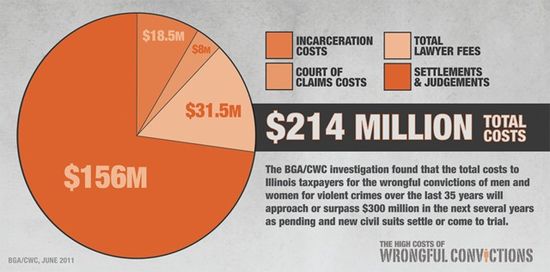
Better Government Association and the Center on Wrongful Convictions tracked wrongful convictions in Illinois from 1989 through 2010:

The joint investigation, which tracked exonerations from 1989 through 2010, also determined that while 85 people were wrongfully incarcerated, the actual perpetrators were on a collective crime spree that included 14 murders, 11 sexual assaults, 10 kidnappings and at least 62 other felonies.

(Hat tip: Kain)

The Negotiations Failed?

Ezra Klein reads tea leaves:

The best advice I’ve gotten for assessing the debt-ceiling negotiations was to “watch for the day when the White House goes public.” As long as the Obama administration was refusing to attack Republicans publicly, my source said, they believed they could cut a deal. And that held true. They were quiet when the negotiations were going on. They were restrained after Eric Cantor and Jon Kyl walked out last week. Press Secretary Jay Carney simply said, “We are confident that we can continue to seek common ground and that we will achieve a balanced approach to deficit reduction.” But today they went public. The negotiations have failed.

David Frum calls Obama naive.

SCOTUS v. The Nanny State

Thomas Denby chats with Tom Bissell, author of Extra Lives: Why Video Games Matter, about the recent Supreme Court decision striking down California's ban against selling violent video games to children. Bissell:

When “Transformers 3” came out we didn’t call it the death of film. The fact that you can throw poop around in Duke Nukem is a corollary of more dark and twisted games being protected. It’s a concession you have to make in a free society—if you want a legitimately fascinating, dark, violent game to be available, you have to let Duke Nukem throw his feces around.

From Lyle Denniston's analysis:

The Scalia opinion drew an exceedingly bright constitutional line between obscenity and violence, with obscenity outside the First Amendment and violent expression within it. The majority commented that the Court has never taken violent expression out from under the First Amendment’s protection.  The new ruling, in fact, was said to be a direct outgrowth of the Court’s decision the prior Term, striking down a federal law that banned video or other depictions of animal cruelty, on the premise that violent displays were a form of protected free speech. That was the ruling in U.S. v. Stevens.

The War Casualities We Don’t Count

Lena Groeger reports on veterans unable to get treatment in a timely fashion:

As of 2010, the VA had a backlog of over 1 million benefits claims. Veterans can wait a year or more for disability checks, and weeks for mental health referrals. The problem is only getting worse, with the influx of troops from Afghanistan and Iraq. Meanwhile, the rate of suicide for veterans is three times higher than the general public, according to a 2006 study.

Cool Ad Watch

Andrew Price unpacks a recent Nissan Leaf ad:

We think of gas as an Industrial Age power source, whereas iPods and computers are Information Age products. By highlighting that contrast, the ad is selling electric cars as modern and efficient, rather than as the saviors of rainforests. That's gives them an aspirational appeal that resonates with a much broader swath of America than just the treehuggers.

A Chipotle Tortilla Has 290 Calories?

Score one for a wheat allergy:

The truth was shocking. The tortilla alone was 290 calories, plus beans and rice added another 250 calories. That was 540 calories before I even made a real choice. For my favorite burrito — chicken with corn salsa and guacamole — the grand total was about 960 calories. Here I was making "healthy choices" at Chipotle, and I'd blown nearly half a day's suggested calories.

It's been fascinating to watch how my new diet has affected me. Adjusting to fewer carbs has meant a long phase of relative tiredness now beginning to lift. But my muscle-fat ratio has shifted in the right direction a little. The rash is now gone.

iPhones Made By Slaves?

Michelle Goldberg highlights the issue:

“Most of what’s in our medicine chests has palm oil, which comes from eastern Cambodia or Sumatra or other places where we know there’s a lot of folks enslaved on those plantations,” says CdeBaca. “There’s an awful lot of slavery on the fishing fleets of Southeast Asia, and a lot of the shrimp that we eat in the United States comes from there.” He points to my iPhone, which is sitting on the table recording our conversation. It, like all smartphones, relies on a mineral called coltan, much of which is mined by forced laborers in the Democratic Republic of Congo. “The likelihood that one of these was not touched by a slave is pretty low,” he says.