When the heat index in DC approaches 100, all you want to do is escape to Venice Beach:
(Hat tip: Matt Stopera)
When the heat index in DC approaches 100, all you want to do is escape to Venice Beach:
(Hat tip: Matt Stopera)
Coming soon:
Douthat goes another round:
Where the legalization of assisted suicide is concerned, then, the question isn’t "suicide, yes or no" — it’s more like, "what effect is this law likely to have on the way that suicidal people are treated in our society, the way they (and their doctors) think about their own suicidal impulses, and the ease with which they can end their lives?" And my argument in the column was that both the moral logic of assisted suicide and the real-world experience of its implementation suggest that such a "right" will tend to legitimate suicide not just as an escape from unbearable agony in the last hours of death, but as an escape from other forms of suffering in other stages of life as well.
A reader is in the same territory:
I think that your reader who criticized Douthat’s argument about the depressed wheelchair user greatly simplifies the issue of depression among persons with disabilities.
From a disability rights perspective, the person in the wheelchair is depressed, not because of an inherent organic condition, but rather because of the discrimination he faces as a result of his disability. In a society in which persons with disabilities and incurable illnesses are portrayed as living lives unworthy of living – and are in fact excluded from prominent aspects of our social life – it is not surprising that some of them will become depressed.
This depression will have an organic – neurological – component, sure. But it is a profoundly social matter, and alleviating it involves not only medical interventions, but also social change. It is also, for that matter, a social responsibility. Saying that there is "nothing" to be done for this person, other than helping them to end their lives, is to turn away from examining the problem at all. Worse, it is to reinforce the very discrimination that contributes to suicidal ideation among persons with incurable illnesses and disabilities to begin with. In that sense, its pretense to "mercy" can be very hypocritical.For the record, I am not dogmatically opposed to physician-assisted suicide – life-ending interventions are an inevitable aspect of end-of-life care – but there are problems with the basic provision and practice of end-of-life care, as well as our society’s treatment of the incurably ill, that we need to address first. Right now, the "right to die" is at best distracting us from these issues – and may be in fact making them worse.
In this sense, I view the situation as analogous to your assessment of the San Francisco bill to ban circumcision: I could support a right to die, but not in this form.
Noah Millman sees both sides of the debate.
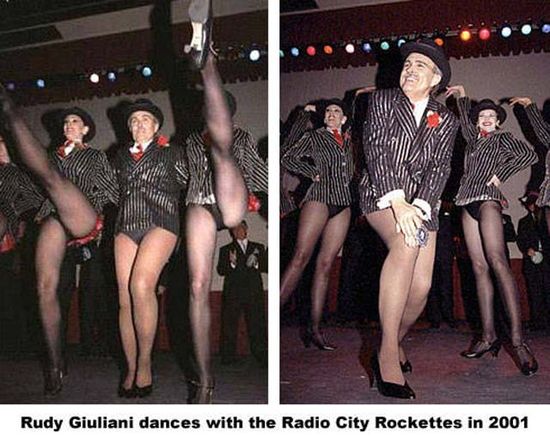
A couple days ago, Bill Kristol announced that Rudy Guliani is going to run for president again. Bernstein says we can safely ignore this news:
[Rudy] happens to be a social liberal — and a socially liberal Republican nominee in 2012 is simply not possible. Not going to happen. Giuliani may think that abortion is an important issue mainly for one limited faction of Republicans. But that’s just not true. It’s an issue, and probably a voting issue, for large majorities of Republicans nationwide.
(Image via Dump A Day)

Buenos Aires, Argentina, 11.08 am
Dan Savage slams pundits such as McArdle for "speaking on behalf of his poor, defenseless wife—and these same dopes would turn on Weiner's wife instantly if she came out and said that she knew, didn't care, and wanted everyone to back the fuck off":
I think it's unlikely that Mrs. Weiner doesn't give a shit, for the record, but there are wives out there who don't give a shit about their husband's online activities—as well as wives who engage in online sexting, texting, flirting, and Tweeting themselves. And one day a sex scandal is going to break and instead of playing the stoic victim, a la Mrs. Vitter and Mrs. Spitzer and Mrs. Clinton, the wife is going to join her "disgraced" husband at the press conference and they're going to announce that they have an open relationship. And Megan's head will explode.
P.J. Crowley argues that we should stay in Afghanistan until 2014. He ponders national security policy after we've pulled out:
With U.S. forces leaving Iraq this year, and Afghanistan no later than 2014, the real debate is what will drive U.S. national security policy globally for the coming decade and beyond. Since 2001, the driver has been combating terrorists—primarily through military intervention—and installing democratic governments in the process. This strategy has run its course and is no longer affordable, either fiscally or politically.
A more realistic (and prudent) national security policy is to aggressively support transitions from weak or autocratic states to pluralistic and democratic societies, whether in South Asia, North Africa, or the Middle East. U.S. leadership and engagement will still be vital, but with less reliance on military means and greater use of civilian tools.

Joe Klein calls Weiner "yet another male victim of testosterone poisoning":
As I get older, and farther removed from my own hormone-addled salad days, I find maleness–the blind, bullish insensitivity of it–to be as much a disease as a gender. And as I watch (male) politicians routinely get their weiners caught in a wringer under the most outrageously stupid (Weiner) and/or brutal (DSK) of circumstances, I become increasingly (a) perplexed and (b) convinced that we are the lesser sex. Perplexed, because even in my most obsessive hunter-gatherer period (which mostly occurred before the advent of the women’s movement), I would immediately stand down, as it were, when a woman indicated that things had gone far enough–it just wasn’t even remotely sexy to blast through the stop sign.
As a gay man, I have lived in a world created, propelled and dominated by testosterone. I have loved it, been entranced by it, obsessed by it, crushed by it, exposed by it, humiliated by it and also exhausted by it. The gay male world is in some respects women's revenge on men – because everything women deal with on the testosterone front is doubled and then inflicted on other men.
In the long run, it makes sense to settle down and see this raging, deranging horniness/temper decline in one's life, whether you're gay or straight. Marriage has had this effect on me in ways I never fully expected. Yes, men can domesticate men, even if not as effectively as women can. But in the short run, especially when young, surging testosterone offers unparalleled sexual excitement, constant no-strings-attached adventure, risk, ecstasy, thrills, passion and a form of psychological escape from the ordeal of consciousness that is, to my mind, unmatched. I suspect that's especially true for men, gay and straight, under stress or in the public eye constantly. To be something else for a while, to be purely an id, must be a particularly powerful relief for those required to be civilization's super-egos.
But back to the gay angle. Because there is so much more physical and psychological equality in a male-only sexual culture, the traps and tragedies of straight men's testosteroned lives in interaction with calmer, saner women, may not be so common. Yes, hearts are broken, diseases caught (by far the biggest drawback), cruelties unleashed. But there is also more civility than you might expect. Very few fights break out in gay bars over emotional rivalries. Aggressive, unwanted pursuits of beloveds are less likely, because guys can tell guys to fuck off and mean it much more successfully than less physically imposing and more decorous women. When you're rejected, you are more likely, as a man, to know it's only superficial, because you too are superficial, and perhaps recover more quickly from the blow to the ego.
I generalize wildly of course but when I tell straight friends that among the most civil places I have ever been have been gay sex clubs, they are often amazed. But they are. The best check on testosterone can be testosterone. And gay men are simply less affronted by an unsolicited picture of someone's dick than many women. Just don't send them the female equivalent. Now that will offend them.
But to echo Joe, testosterone is a blessing and a curse. (I wrote a whole essay on it a while back.) But in gay male culture, these things tend to cancel themselves out with fewer costs and less drama. We are lucky in this way, which is why so many gay men remain a little mystified by the outrage over a few emailed dick pics. But, as marriage spreads and gay male culture evolves, perhaps this will begin to decline, or gay marriages will seek their own ways to deal with them, without wrecking the marriage entirely. Perhaps that will help inform straights better; or warn them of the dangers.
We are, of course, also cursed by it – and I don't want to minimize that. What matters in a testosterone-only society are muscles, good looks, youth, masculinity. There is a ruthless simplicity to this that keeps gay guys in better shape than many straights, but leaves many men with more to offer than a hot pair of biceps a little stranded at times. Ageing can be particularly cruel. Marriage, in this way, has helped give more dignity and status to older, less sexually marketable men. Which is one reason it helps humanize what can be a brutal facet of a subculture. Otherwise, you're on your own. And, yes, it can be harsh as well as manly.
(Photo: A competitor runs through fire during the Tough Guy Challenge 2009 at South Perton Farm on February 1, 2009 in Wolverhampton, England. The biannual event to raise cash for charity challenges thousands of international competitors to run through a grueling set of 21 obstacles including water, fire and tunnels after a lengthy run at the start. By Christopher Furlong/Getty Images.)
Awfully cute – but mostly awful:
 The Dish