A category that finally gets its own tumblr.
Month: June 2011
Beyond Statism
Reihan acknowledges that we have a hybrid healthcare system, one with both public and private elements, and that "we will continue to have a hybrid system under any imaginable set of health system reforms":
Singapore is another hybrid system, in which the state aggressively regulates prices, mandates transparency, and has created a mandatory systems of savings accounts that residents draw on for routine health expenditures and universal catastrophic coverage. One can argue that Singapore’s system is more statist than the U.S. health system, yet the U.S., as a sprawling federal republic, has a large number of overlapping jurisdictions that impose their own regulations that add to the thicket.
Another “What The Fuck” Moment
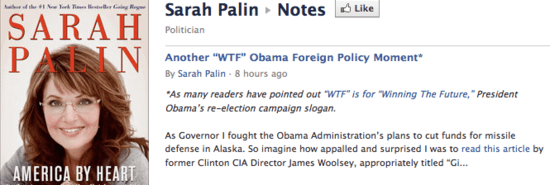
Dave Stopera keeps tabs on Palin's construction of her own reality:
Sarah Palin's fans freaked out over her use of WTF on one of her facebook posts, because Sarah never swears! So, she just made a new meaning.
A Right To Die? Ctd
Responding to Douthat's thought experiment about assisted suicide, Kevin Drum puts all his cards on the table:
[A]side from our religious differences, I suspect that the big difference between Douthat and me is that I've suffered from chronic depression nearly my entire life and he hasn't. Luckily, my case is moderate, and I've never felt like drowning myself in a bathtub. Still, I understand keenly what it feels like, which makes it easy for me to have a pretty good sense of what it would feel like if it were more serious. And that deep-seated understanding of what serious, long-lasting, incurable depression probably feels like is part of what drives my policy preferences here. I can actually imagine myself being in a situation where I'd want that prescription available to me, so reasons of self-interest dictate that I'd prefer it to be legally available. If you can't even conceive of such a situation in your own life, you'll probably feel differently.
All Spending Is Not Created Equal
Will Wilkinson's post on the dysfunctional spending debate is worth reading in full. Money quote:
Some government spending gives folks stuff they want. Some government spending is worse than stealing money, throwing it in a hole and burning it. This is obvious when you think about it for a second, but it sometimes seems that partisan political discourse is based on the refusal to think about it at all.
Conservatives with a libertarian edge often proceed as if government spending as such is an evil to resist, except when they're defending a free-lunch tax cut (we'll have more money to wrongly spend!) or the ongoing development of experimental underwater battle helicopters. And liberals with a social-democratic streak often operate within a framework of crypto-Keynesian mysticism according to which handing a dollar to government is like handing a fish to Jesus Christ, the ultimate multiplier of free lunches.
Hathos Alert, Ctd

A reader writes:
I could only get through half of the propaganda piece of the Palin magical history tour, but what's really disturbing is she has the balls to use clips from the "lamestream" media. She treats the media like crap and then uses their work. What a hypocrite.
Another notes:
During the opening and closing sequences of the video, regarding the superimposition of the US map, one state is conspicuously absent. An oversight, I'm sure.
The Daily Wrap
Today on the Dish, Andrew dismantled AIPAC's disproportionate popularity in Congress. He also pinpointed the moment our political system became decadent, and poked Limbaugh for thinking anyone in the world thinks Palin is sane and stable. Herman Cain kept chugging along on the crazy train, Bruce Bartlett rejected Pawlenty's economic nonsense, and Gingrich's staffers jumped the sinking ship.
McArdle debated marriage and monogamy, Democrats defriended Weiner, New Yorkers didn't appreciate being represented by him, and readers analyzed our online avatars. Financial scandals mattered more than moral ones, Cynthia Haven was sick of fake apologies, and willpower comes in a finite amount. Obesity spiked our healthcare costs, and Americans failed at efficiency in private healthcare markets.
We hashed out Mubarak's trial, the Syrian regime tortured another boy, and John Yoo gave Bush the same authority. We continued the assisted suicide thread here and here with thoughts on palliative care here. Circumcision removed human choice, TNC pondered race in pop culture movies, prison hurt an employee's prospects, and Gabby Giffords was recovering slowly. The Smurfs didn't stump pop culture, and an Egyptian challenged a lion.
Chart of the day here, hathos alert here, creepy ad watch here, Malkin award here, adorable lecture fail here, metal vegan chef here, VFYW here, MHB here, and FOTD here.
–Z.P.
Gabby Giffords, Five Months Later
A Giffords staffer updates us on the congresswoman's condition:
She is borrowing upon other ways of communicating. Her words are back more and more now, but she’s still using facial expressions as a way to express. Pointing. Gesturing. Add it all together, and she’s able to express the basics of what she wants or needs. But, when it comes to a bigger and more complex thought that requires words, that’s where she’s had the trouble.
Amy Davidson empathizes.
Foolish, Not Boring
Larison considers Pawlenty's political strategy:
Had Pawlenty delivered a remotely plausible economic policy speech, very few people would have paid attention to it, and it would have reinforced the view that Pawlenty is so very boring. No one’s saying that now. Some people are saying that Pawlenty is the new incarnation of George W. Bush, and some are saying that he is a con-man, but at least they aren’t still talking about how “nice” and boring he is. The most significant thing that Pawlenty may have done by giving this speech was to differentiate himself as a presidential candidate from the rather dull Minnesota governor that he has been until now.
Weigel compares Pawlenty to Huntsman.
Deconstructing The Smurfs, Ctd
A reader writes:
I couldn't read this entry on deconstructing the Smurfs without thinking of one of the greatest scenes from Richard Linklater's "Slacker".
Above. Yet another theory:
Your post about the Smurfs' communist leanings reminded me of an analysis I've been working on for some years to explain why I found the Showtime series Queer as Folk so particularly loathesome.
The little insular gay community of Queer as Folk has plenty in common with the Smurfs' collective universe. Both exist in a world with extremely few women. Both employ dialogue that uses and re-uses the same name to define said communities as a poor excuse for wit. ("Smurf's Away!" "What are you, the gay Lucy and Ethel!" "Because I'm gay.") Both deal with the same two or three villains hellbent on the community's destruction. If Gargomel fulfills some anti-semitic fantasy, the one angry bullying jock and the one opportunistic congressman of Queer as Folk offer their own, less disturbing, but still overly-simplified external manifestation of a threat to the community.
My guess is that the ideology of Queer as Folk serves as a conscious, ill-thought-out attempt to create the myth of a gay community, with a vision of gay identity that can be comfortably defined and understood. In that it represents the totalitarian mindset that fears individualistic expression.
Another:
And on a more frivolous note, here's Donnie Darko on the Smurfs. "It just couldn't happen"…
 The Dish